 |
PDBsum entry 3hpn

|
|
|
|
|
 |
Contents |
 |
|
|
|
|
|
|
|
|
|
|
* Residue conservation analysis
|
|
|
|
|
|
PDB id:
|
|
|
|
| Name: |
|
Transferase
|
|
|
Title:
|
|
Ligand recognition by a-class eph receptors: crystal structures of the epha2 ligand-binding domain and the epha2/ephrin-a1 complex
|
|
Structure:
|
|
Ephrin type-a receptor 2. Chain: a, b, c, d, e, f. Fragment: unp residues 28-201. Synonym: tyrosine-protein kinase receptor eck, epithelial cell kinase. Engineered: yes
|
|
Source:
|
|
Homo sapiens. Human. Organism_taxid: 9606. Gene: epha2, eck. Expressed in: homo sapiens. Expression_system_taxid: 9606. Expression_system_cell_line: hek293. Expression_system_organ: kidney.
|
|
Resolution:
|
|
|
2.52Å
|
R-factor:
|
0.236
|
R-free:
|
0.307
|
|
|
Authors:
|
|
J.P.Himanen,Y.Goldgur,H.Miao,E.Myshkin,H.Guo,M.Buck,M.Nguyen, K.R.Rajashankar,B.Wang,D.B.Nikolov
|
|
Key ref:
|
|
J.P.Himanen
et al.
(2009).
Ligand recognition by A-class Eph receptors: crystal structures of the EphA2 ligand-binding domain and the EphA2/ephrin-A1 complex.
Embo Rep,
10,
722-728.
PubMed id:
|
|
|
Date:
|
|
|
04-Jun-09
|
Release date:
|
30-Jun-09
|
|
|
|
|
|
|
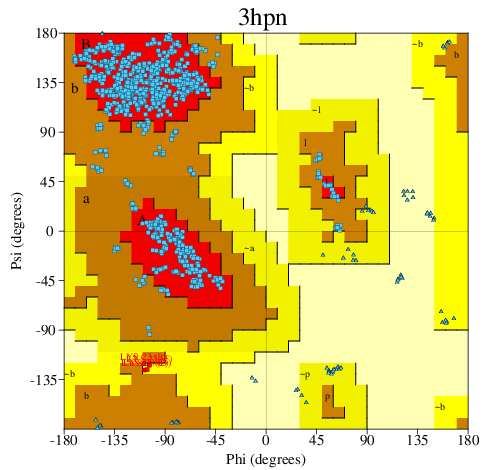
PROCHECK
|
|
|
|
|
|
Headers
|
|
|
|
References
|
|
|
|
|
|

|
|
P29317
(EPHA2_HUMAN) -
Ephrin type-A receptor 2 from Homo sapiens
|
|
|
|
Seq:
Struc:
|
|
|
|
976 a.a.
174 a.a.
|
|

|

|

|
|
|
|
|
|
|
|
|
|
|
Key: |
 |
PfamA domain |
|
|
 |
Secondary structure |
|
 |
CATH domain |
|
|
|
|
|
|
|
|
|
|
|
|
|
Enzyme class:
|
|
E.C.2.7.10.1
- receptor protein-tyrosine kinase.
|
|
|
|
|
|
|
Reaction:
|
|
L-tyrosyl-[protein] + ATP = O-phospho-L-tyrosyl-[protein] + ADP + H+
|
|
|
|
|
|
L-tyrosyl-[protein]
|
+
|
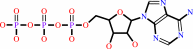 ATP
ATP
|
=
|
O-phospho-L-tyrosyl-[protein]
|
+
|
 ADP
ADP
|
+
|
H(+)
|
|
|
|
|
|
|
|
|
|
|
|
|
Molecule diagrams generated from .mol files obtained from the
KEGG ftp site
|
|
|
|
|
|
|
|
|
|
|
|
|
|
 |
|
|
|
|
|
|
| |
|
|
| |
|
|
Embo Rep
10:722-728
(2009)
|
|
PubMed id:
|
|
|
|
|
|
| |
|
Ligand recognition by A-class Eph receptors: crystal structures of the EphA2 ligand-binding domain and the EphA2/ephrin-A1 complex.
|
|
J.P.Himanen,
Y.Goldgur,
H.Miao,
E.Myshkin,
H.Guo,
M.Buck,
M.Nguyen,
K.R.Rajashankar,
B.Wang,
D.B.Nikolov.
|
|
|
|
|
| |
ABSTRACT
|
|
|
|
| |
|
|
Ephrin (Eph) receptor tyrosine kinases fall into two subclasses (A and B)
according to preferences for their ephrin ligands. All published structural
studies of Eph receptor/ephrin complexes involve B-class receptors. Here, we
present the crystal structures of an A-class complex between EphA2 and ephrin-A1
and of unbound EphA2. Although these structures are similar overall to their
B-class counterparts, they reveal important differences that define subclass
specificity. The structures suggest that the A-class Eph receptor/ephrin
interactions involve smaller rearrangements in the interacting partners, better
described by a 'lock-and-key'-type binding mechanism, in contrast to the
'induced fit' mechanism defining the B-class molecules. This model is supported
by structure-based mutagenesis and by differential requirements for ligand
oligomerization by the two subclasses in cell-based Eph receptor activation
assays. Finally, the structure of the unligated receptor reveals a homodimer
assembly that might represent EphA2-specific homotypic cell adhesion
interactions.
|
|
|
|
|
|
|
|
|
|
|
|
|
|
|
|
|
|
 |
 |
 |
|
Literature references that cite this PDB file's key reference
|
|
|
| |
PubMed id
|
|
Reference
|
|
|
|
|
|
C.Giorgio,
I.Hassan Mohamed,
L.Flammini,
E.Barocelli,
M.Incerti,
A.Lodola,
and
M.Tognolini
(2011).
Lithocholic acid is an Eph-ephrin ligand interfering with Eph-kinase activation.
|
| |
PLoS One,
6,
e18128.
|
|
|
|
|
|
|
E.Seiradake,
K.Harlos,
G.Sutton,
A.R.Aricescu,
and
E.Y.Jones
(2010).
An extracellular steric seeding mechanism for Eph-ephrin signaling platform assembly.
|
| |
Nat Struct Mol Biol,
17,
398-402.
|
|
|
PDB code:
|
|
|
|
|
|
|
|
H.Qin,
R.Noberini,
X.Huan,
J.Shi,
E.B.Pasquale,
and
J.Song
(2010).
Structural characterization of the EphA4-Ephrin-B2 complex reveals new features enabling Eph-ephrin binding promiscuity.
|
| |
J Biol Chem,
285,
644-654.
|
|
|
PDB code:
|
|
|
|
|
|
|
|
J.K.McCarron,
B.W.Stringer,
B.W.Day,
and
A.W.Boyd
(2010).
Ephrin expression and function in cancer.
|
| |
Future Oncol,
6,
165-176.
|
|
|
|
|
|
|
J.P.Himanen,
L.Yermekbayeva,
P.W.Janes,
J.R.Walker,
K.Xu,
L.Atapattu,
K.R.Rajashankar,
A.Mensinga,
M.Lackmann,
D.B.Nikolov,
and
S.Dhe-Paganon
(2010).
Architecture of Eph receptor clusters.
|
| |
Proc Natl Acad Sci U S A,
107,
10860-10865.
|
|
|
PDB codes:
|
|
|
|
|
|
|
|
T.A.Bowden,
A.R.Aricescu,
J.E.Nettleship,
C.Siebold,
N.Rahman-Huq,
R.J.Owens,
D.I.Stuart,
and
E.Y.Jones
(2009).
Structural plasticity of eph receptor A4 facilitates cross-class ephrin signaling.
|
| |
Structure,
17,
1386-1397.
|
|
|
PDB codes:
|
|
|
|
|
|
|
The most recent references are shown first.
Citation data come partly from CiteXplore and partly
from an automated harvesting procedure. Note that this is likely to be
only a partial list as not all journals are covered by
either method. However, we are continually building up the citation data
so more and more references will be included with time.
Where a reference describes a PDB structure, the PDB
code is
shown on the right.
|
|


 Links
Links



