 |
PDBsum entry 3f6d

|
|
|
|
|
 |
Contents |
 |
|
|
|
|
|
|
|
|
|
|
|
|
* Residue conservation analysis
|
|
|
|
|
|
|
|
|
|
Enzyme class:
|
|
Chains A, B:
E.C.2.5.1.18
- glutathione transferase.
|
|
|
|
|
|
|
Reaction:
|
|
RX + glutathione = an S-substituted glutathione + a halide anion + H+
|
|
|
|
|
|
RX
Bound ligand (Het Group name = )
matches with 76.92% similarity
|
+
|
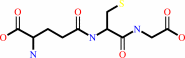 glutathione
|
=
|
S-substituted glutathione
|
+
|
halide anion
|
+
|
H(+)
|
|
|
|
|
|
|
|
|
|
|
|
|
Molecule diagrams generated from .mol files obtained from the
KEGG ftp site
|
|
|
|
|
|
|
|
|
|
|
|
|
|
 |
|
|
|
|
|
|
| |
|
|
| |
|
|
Biochem J
428:25-32
(2010)
|
|
PubMed id:
|
|
|
|
|
|
| |
|
Structural contributions of delta class glutathione transferase active-site residues to catalysis.
|
|
J.Wongsantichon,
R.C.Robinson,
A.J.Ketterman.
|
|
|
|
|
| |
ABSTRACT
|
|
|
|
| |
|
|
GST (glutathione transferase) is a dimeric enzyme recognized for
biotransformation of xenobiotics and endogenous toxic compounds. In the present
study, residues forming the hydrophobic substrate-binding site (H-site) of a
Delta class enzyme were investigated in detail for the first time by
site-directed mutagenesis and crystallographic studies. Enzyme kinetics reveal
that Tyr111 indirectly stabilizes GSH binding, Tyr119 modulates hydrophobic
substrate binding and Phe123 indirectly modulates catalysis. Mutations at Tyr111
and Phe123 also showed evidence for positive co-operativity for GSH and
1-chloro-2,4-dinitrobenzene respectively, strongly suggesting a role for these
residues in manipulating subunit-subunit communication. In the present paper we
report crystal structures of the wild-type enzyme, and two mutants, in complex
with S-hexylglutathione. This study has identified an aromatic 'zipper' in the
H-site contributing a network of aromatic pi-pi interactions. Several residues
of the cluster directly interact with the hydrophobic substrate, whereas others
indirectly maintain conformational stability of the dimeric structure through
the C-terminal domain (domain II). The Y119E mutant structure shows major
main-chain rearrangement of domain II. This reorganization is moderated through
the 'zipper' that contributes to the H-site remodelling, thus illustrating a
role in co-substrate binding modulation. The F123A structure shows molecular
rearrangement of the H-site in one subunit, but not the other, explaining
weakened hydrophobic substrate binding and kinetic co-operativity effects of
Phe123 mutations. The three crystal structures provide comprehensive evidence of
the aromatic 'zipper' residues having an impact upon protein stability,
catalysis and specificity. Consequently, 'zipper' residues appear to modulate
and co-ordinate substrate processing through permissive flexing.
|
|
|
|
|
|
|
|
|
|
|
|
|
|
|
|
|
|
 |
 |
 |
|
Literature references that cite this PDB file's key reference
|
|
|
| |
PubMed id
|
|
Reference
|
|
|
|
|
|
A.J.Ketterman,
C.Saisawang,
and
J.Wongsantichon
(2011).
Insect glutathione transferases.
|
| |
Drug Metab Rev,
43,
253-265.
|
|
|
|
|
|
The most recent references are shown first.
Citation data come partly from CiteXplore and partly
from an automated harvesting procedure. Note that this is likely to be
only a partial list as not all journals are covered by
either method. However, we are continually building up the citation data
so more and more references will be included with time.
|
|
|


 Links
Links


