 |
PDBsum entry 3vuy

|
|
|
|
|
|

|

|

|

|
|

|
|

|
|

|
|

|
|

|
|
|
 |

|

|
|
|
|
|
|
|
|
|
|
|
|
|
|
|
|
|
|
|
|
|
|
|
|
|
|
|
|
|
|
|
|
|
|
Protein binding/metal binding protein
|
PDB id
|
|
|
|
3vuy
|
|
|
|
|
|
|
|
|
|
|
|
|
|
|

|

|

|
|
|
|
|
|
|
|
 |
Contents |
 |
|
|
|
|
|
|
|
|
|
|
|


 76 a.a.
|
|
|
|
|
|
|
|
|
|
|
 33 a.a.
|
|
|
|
|
|
|
|
|
|
|
 31 a.a.
|
|
|
|
|
|
|
|
|
|
|
 32 a.a.
|
|
|
|
|
|
|
|
|
|
|
|
|
|
|
PDB id:
|
|
|
|
| Name: |
|
Protein binding/metal binding protein
|
|
|
Title:
|
|
Crystal structure of a20 zf7 in complex with linear tetraubiquitin
|
|
Structure:
|
|
Polyubiquitin-c. Chain: a, c, b. Fragment: ubiquitin. Engineered: yes. Tumor necrosis factor alpha-induced protein 3. Chain: d, f, e. Fragment: a20-type 7 zinc finger domain, residues 757-790. Synonym: tnf alpha-induced protein 3, otu domain-containing protein 7c, putative DNA-binding protein a20, zinc finger protein a20.
|
|
Source:
|
|
Homo sapiens. Human. Organism_taxid: 9606. Gene: ubc. Expressed in: escherichia coli. Expression_system_taxid: 562. Gene: tnfaip3.
|
|
Resolution:
|
|
|
1.98Å
|
R-factor:
|
0.218
|
R-free:
|
0.255
|
|
|
Authors:
|
|
H.Nishimasu,R.Ishitani,O.Nureki
|
|
Key ref:
|
|
F.Tokunaga
et al.
(2012).
Specific recognition of linear polyubiquitin by A20 zinc finger 7 is involved in NF-κB regulation.
Embo J,
31,
3856-3870.
PubMed id:
|
|
|
Date:
|
|
|
09-Jul-12
|
Release date:
|
13-Feb-13
|
|
|
|
|
|
|
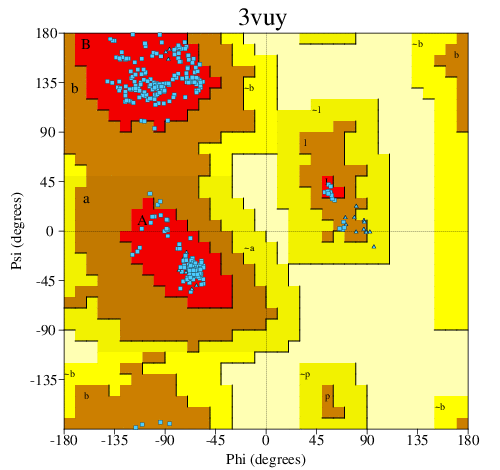
PROCHECK
|
|
|
|
|
|
Headers
|
|
|
|
References
|
|
|
|
|
|

|
|
P0CG48
(UBC_HUMAN) -
Polyubiquitin-C from Homo sapiens
|
|
|
|
Seq:
Struc:
|
|
|
|
685 a.a.
76 a.a.
|
|

|

|
|
|
|
|
|
|
|
|
|
|
|
|

|
|
P21580
(TNAP3_HUMAN) -
Tumor necrosis factor alpha-induced protein 3 from Homo sapiens
|
|
|
|
Seq:
Struc:
|
|
|
|
790 a.a.
33 a.a.
|
|
|

|

|
|
|
|
|
|
|
|
|
|
|
|
|
|
|
|
|
Enzyme class 1:
|
|
Chains D, F, E:
E.C.2.3.2.-
- ?????
|
|
|
|
|
|
|
Enzyme class 2:
|
|
Chains D, F, E:
E.C.3.4.19.12
- ubiquitinyl hydrolase 1.
|
|
|
|
|
|
|
Reaction:
|
|
Thiol-dependent hydrolysis of ester, thiolester, amide, peptide and isopeptide bonds formed by the C-terminal Gly of ubiquitin (a 76-residue protein attached to proteins as an intracellular targeting signal).
|
|
|
|
|
|
|
|
|
Note, where more than one E.C. class is given (as above), each may
correspond to a different protein domain or, in the case of polyprotein
precursors, to a different mature protein.
|
|
|
|
|
|
|
|
|
|
|
|
|
|
 |
|
|
|
|
|
|
| |
|
|
Embo J
31:3856-3870
(2012)
|
|
PubMed id:
|
|
|
|
|
|
| |
|
Specific recognition of linear polyubiquitin by A20 zinc finger 7 is involved in NF-κB regulation.
|
|
F.Tokunaga,
H.Nishimasu,
R.Ishitani,
E.Goto,
T.Noguchi,
K.Mio,
K.Kamei,
A.Ma,
K.Iwai,
O.Nureki.
|
|
|
|
|
| |
ABSTRACT
|
|
|
|
| |
|
|
LUBAC (linear ubiquitin chain assembly complex) activates the canonical NF-κB
pathway through linear polyubiquitination of NEMO (NF-κB essential modulator,
also known as IKKγ) and RIP1. However, the regulatory mechanism of
LUBAC-mediated NF-κB activation remains elusive. Here, we show that A20
suppresses LUBAC-mediated NF-κB activation by binding linear polyubiquitin via
the C-terminal seventh zinc finger (ZF7), whereas CYLD suppresses it through
deubiquitinase (DUB) activity. We determined the crystal structures of A20 ZF7
in complex with linear diubiquitin at 1.70-1.98 Å resolutions. The crystal
structures revealed that A20 ZF7 simultaneously recognizes the Met1-linked
proximal and distal ubiquitins, and that genetic mutations associated with B
cell lymphomas map to the ubiquitin-binding sites. Our functional analysis
indicated that the binding of A20 ZF7 to linear polyubiquitin contributes to the
recruitment of A20 into a TNF receptor (TNFR) signalling complex containing
LUBAC and IκB kinase (IKK), which results in NF-κB suppression. These findings
provide new insight into the regulation of immune and inflammatory responses.
|
|
|
|
|
|
|
|
|
|
|
|
|
|
|
|
|
|
 |
 |
 |
| | |


 Links
Links


