 |
PDBsum entry 3pvb

|
|
|
|
|
 |
Contents |
 |
|
|
|
|
|
|
|
|
|
|
|
|
|
|
* Residue conservation analysis
|
|
|
|
|
|
PDB id:
|
|
|
|
| Name: |
|
Transferase
|
|
|
Title:
|
|
Crystal structure of (73-244)ria:c holoenzyme of camp-dependent protein kinase
|
|
Structure:
|
|
Camp-dependent protein kinase catalytic subunit alpha. Chain: a. Fragment: unp residues 7-351. Synonym: pka c-alpha. Engineered: yes. Camp-dependent protein kinase type i-alpha regulatory subunit. Chain: b. Fragment: unp residues 85-244.
|
|
Source:
|
|
Mus musculus. Mouse. Organism_taxid: 10090. Gene: prkaca, pkaca. Expressed in: escherichia coli. Expression_system_taxid: 562. Bos taurus. Bovine,cow,domestic cattle,domestic cow. Organism_taxid: 9913.
|
|
Resolution:
|
|
|
3.30Å
|
R-factor:
|
0.242
|
R-free:
|
0.290
|
|
|
Authors:
|
|
A.J.Boettcher,J.Wu,C.Kim,J.Yang,J.Bruystens,N.Cheung,J.K.Pennypacker, D.A.Blumenthal,A.P.Kornev,S.S.Taylor
|
|
Key ref:
|
|
A.J.Boettcher
et al.
(2011).
Realizing the allosteric potential of the tetrameric protein kinase A RIα holoenzyme.
Structure,
19,
265-276.
PubMed id:
|
|
|
Date:
|
|
|
06-Dec-10
|
Release date:
|
02-Feb-11
|
|
|
|
|
|
|
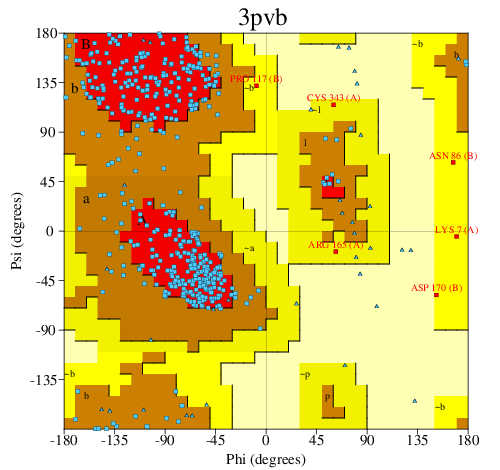
PROCHECK
|
|
|
|
|
|
Headers
|
|
|
|
References
|
|
|
|
|
|
|
|
|
|
|
|
Enzyme class:
|
|
Chain A:
E.C.2.7.11.11
- cAMP-dependent protein kinase.
|
|
|
|
|
|
|
Reaction:
|
|
|
1.
|
L-seryl-[protein] + ATP = O-phospho-L-seryl-[protein] + ADP + H+
|
|
2.
|
L-threonyl-[protein] + ATP = O-phospho-L-threonyl-[protein] + ADP + H+
|
|
|
|
|
|
|
L-seryl-[protein]
|
+
|
 ATP
ATP
|
=
|
O-phospho-L-seryl-[protein]
Bound ligand (Het Group name = )
matches with 81.25% similarity
|
+
|
 ADP
ADP
|
+
|
H(+)
|
|
|
|
|
|
|
L-threonyl-[protein]
|
+
|
ATP
|
=
|
O-phospho-L-threonyl-[protein]
Bound ligand (Het Group name = )
matches with 81.25% similarity
|
+
|
ADP
|
+
|
H(+)
|
|
|
|
|
|
|
|
|
|
|
|
|
Molecule diagrams generated from .mol files obtained from the
KEGG ftp site
|
|
|
|
|
|
|
|
|
|
|
|
|
|
 |
|
|
|
|
|
|
| |
|
|
| |
|
|
Structure
19:265-276
(2011)
|
|
PubMed id:
|
|
|
|
|
|
| |
|
Realizing the allosteric potential of the tetrameric protein kinase A RIα holoenzyme.
|
|
A.J.Boettcher,
J.Wu,
C.Kim,
J.Yang,
J.Bruystens,
N.Cheung,
J.K.Pennypacker,
D.A.Blumenthal,
A.P.Kornev,
S.S.Taylor.
|
|
|
|
|
| |
ABSTRACT
|
|
|
|
| |
|
|
PKA holoenzymes containing two catalytic (C) subunits and a regulatory (R)
subunit dimer are activated cooperatively by cAMP. While cooperativity involves
the two tandem cAMP binding domains in each R-subunit, additional cooperativity
is associated with the tetramer. Of critical importance is the flexible linker
in R that contains an inhibitor site (IS). While the IS becomes ordered in the
R:C heterodimer, the overall conformation of the tetramer is mediated largely by
the N-Linker that connects the D/D domain to the IS. To understand how the
N-Linker contributes to assembly of tetrameric holoenzymes, we engineered a
monomeric RIα that contains most of the N-Linker, RIα(73-244), and
crystallized a holoenzyme complex. Part of the N-linker is now ordered by
interactions with a symmetry-related dimer. This complex of two symmetry-related
dimers forms a tetramer that reveals novel mechanisms for allosteric regulation
and has many features associated with full-length holoenzyme. A model of the
tetrameric holoenzyme, based on this structure, is consistent with previous
small angle X-ray and neutron scattering data, and is validated with new SAXS
data and with an RIα mutation localized to a novel interface unique to the
tetramer.
|
|
|
|
|
|
|
|
|
|
|
|
|
|
|
|
|
|
 |
 |
 |
|
Literature references that cite this PDB file's key reference
|
|
|
| |
PubMed id
|
|
Reference
|
|
|
|
|
|
S.S.Taylor,
R.Ilouz,
P.Zhang,
and
A.P.Kornev
(2012).
Assembly of allosteric macromolecular switches: lessons from PKA.
|
| |
Nat Rev Mol Cell Biol,
13,
646-658.
|
|
|
|
|
|
The most recent references are shown first.
Citation data come partly from CiteXplore and partly
from an automated harvesting procedure. Note that this is likely to be
only a partial list as not all journals are covered by
either method. However, we are continually building up the citation data
so more and more references will be included with time.
|
|
|


 Links
Links


