 |
PDBsum entry 3kb7

|
|
|
|
|
 |
Contents |
 |
|
|
|
|
|
|
|
|
|
|
|
|
|
|
* Residue conservation analysis
|
|
|
|
|
|
|
|
|
|
|
Enzyme class:
|
|
E.C.2.7.11.21
- polo kinase.
|
|
|
|
|
|
|
Reaction:
|
|
|
1.
|
L-seryl-[protein] + ATP = O-phospho-L-seryl-[protein] + ADP + H+
|
|
2.
|
L-threonyl-[protein] + ATP = O-phospho-L-threonyl-[protein] + ADP + H+
|
|
|
|
|
|
|
L-seryl-[protein]
|
+
|
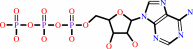 ATP
ATP
|
=
|
O-phospho-L-seryl-[protein]
|
+
|
 ADP
ADP
|
+
|
H(+)
|
|
|
|
|
|
|
L-threonyl-[protein]
|
+
|
ATP
|
=
|
O-phospho-L-threonyl-[protein]
|
+
|
ADP
|
+
|
H(+)
|
|
|
|
|
|
|
|
|
|
|
|
|
Molecule diagrams generated from .mol files obtained from the
KEGG ftp site
|
|
|
|
|
|
|
|
|
|
|
|
|
|
 |
|
|
|
|
|
|
| |
|
|
| |
|
|
J Med Chem
53:3532-3551
(2010)
|
|
PubMed id:
|
|
|
|
|
|
| |
|
Identification of 4,5-dihydro-1H-pyrazolo[4,3-h]quinazoline derivatives as a new class of orally and selective Polo-like kinase 1 inhibitors.
|
|
I.Beria,
D.Ballinari,
J.A.Bertrand,
D.Borghi,
R.T.Bossi,
M.G.Brasca,
P.Cappella,
M.Caruso,
W.Ceccarelli,
A.Ciavolella,
C.Cristiani,
V.Croci,
A.De Ponti,
G.Fachin,
R.D.Ferguson,
J.Lansen,
J.K.Moll,
E.Pesenti,
H.Posteri,
R.Perego,
M.Rocchetti,
P.Storici,
D.Volpi,
B.Valsasina.
|
|
|
|
|
| |
ABSTRACT
|
|
|
|
| |
|
|
Polo-like kinase 1 (Plk1) is a fundamental regulator of mitotic progression
whose overexpression is often associated with oncogenesis and therefore is
recognized as an attractive therapeutic target in the treatment of proliferative
diseases. Here we discuss the structure-activity relationship of the
4,5-dihydro-1H-pyrazolo[4,3-h]quinazoline class of compounds that emerged from a
high throughput screening (HTS) campaign as potent inhibitors of Plk1 kinase.
Furthermore, we describe the discovery of 49,
8-{[2-methoxy-5-(4-methylpiperazin-1-yl)phenyl]amino}-1-methyl-4,5-dihydro-1H-pyrazolo[4,3-h]quinazoline-3-carboxamide,
as a highly potent and specific ATP mimetic inhibitor of Plk1 (IC(50) = 0.007
microM) as well as its crystal structure in complex with the methylated
Plk1(36-345) construct. Compound 49 was active in cell proliferation against
different tumor cell lines with IC(50) values in the submicromolar range and
active in vivo in the HCT116 xenograft model where it showed 82% tumor growth
inhibition after repeated oral administration.
|
|
|
|
|
|
|
|
|
|
|
|
|
|
|
|
|
|
 |
 |
 |
|
Literature references that cite this PDB file's key reference
|
|
|
| |
PubMed id
|
|
Reference
|
|
|
|
|
|
I.Beria,
R.T.Bossi,
M.G.Brasca,
M.Caruso,
W.Ceccarelli,
G.Fachin,
M.Fasolini,
B.Forte,
F.Fiorentini,
E.Pesenti,
D.Pezzetta,
H.Posteri,
A.Scolaro,
S.Re Depaolini,
and
B.Valsasina
(2011).
NMS-P937, a 4,5-dihydro-1H-pyrazolo[4,3-h]quinazoline derivative as potent and selective Polo-like kinase 1 inhibitor.
|
| |
Bioorg Med Chem Lett,
21,
2969-2974.
|
|
|
PDB code:
|
|
|
|
|
|
|
|
K.Strebhardt
(2010).
Multifaceted polo-like kinases: drug targets and antitargets for cancer therapy.
|
| |
Nat Rev Drug Discov,
9,
643-660.
|
|
|
|
|
|
|
Y.Ai,
S.T.Wang,
P.H.Sun,
and
F.J.Song
(2010).
Molecular Modeling Studies of 4,5-Dihydro-1H-pyrazolo[4,3-h] quinazoline Derivatives as Potent CDK2/Cyclin A Inhibitors Using 3D-QSAR and Docking.
|
| |
Int J Mol Sci,
11,
3705-3724.
|
|
|
|
|
|
The most recent references are shown first.
Citation data come partly from CiteXplore and partly
from an automated harvesting procedure. Note that this is likely to be
only a partial list as not all journals are covered by
either method. However, we are continually building up the citation data
so more and more references will be included with time.
Where a reference describes a PDB structure, the PDB
code is
shown on the right.
|
|


 Links
Links


