 |
PDBsum entry 3cjg

|
|
|
|
|
 |
Contents |
 |
|
|
|
|
|
|
|
|
|
|
|
|
* Residue conservation analysis
|
|
|
|
|
|
PDB id:
|
|
|
|
| Name: |
|
Transferase
|
|
|
Title:
|
|
Crystal structure of vegfr2 in complex with a 3,4,5-trimethoxy aniline containing pyrimidine
|
|
Structure:
|
|
Vascular endothelial growth factor receptor 2. Chain: a. Fragment: kinase domain. Residues 806-939 and 994-1168. Synonym: vegfr-2, kinase insert domain receptor, protein-tyrosine kinase receptor flk-1, cd309 antigen. Engineered: yes
|
|
Source:
|
|
Homo sapiens. Human. Gene: kdr, flk1. Expressed in: spodoptera frugiperda. Other_details: kid insert removed
|
|
Resolution:
|
|
|
2.25Å
|
R-factor:
|
0.209
|
R-free:
|
0.253
|
|
|
Authors:
|
|
R.T.Nolte
|
|
Key ref:
|
|
P.A.Harris
et al.
(2008).
Discovery of 5-[[4-[(2,3-dimethyl-2H-indazol-6-yl)methylamino]-2-pyrimidinyl]amino]-2-methyl-benzenesulfonamide (Pazopanib), a novel and potent vascular endothelial growth factor receptor inhibitor.
J Med Chem,
51,
4632-4640.
PubMed id:
|
|
|
Date:
|
|
|
12-Mar-08
|
Release date:
|
07-Oct-08
|
|
|
|
|
|
|
PROCHECK
|

|
|
|
|
|
Headers
|
|
|
|
References
|
|
|
|
|
|

|
|
P35968
(VGFR2_HUMAN) -
Vascular endothelial growth factor receptor 2 from Homo sapiens
|
|
|
|
Seq:
Struc:
|
|
|
|
1356 a.a.
282 a.a.*
|
|

|

|

|
|
|
|
|
|
|
|
|
|
|
Key: |
 |
PfamA domain |
|
|
 |
Secondary structure |
|
 |
CATH domain |
|
|
*
PDB and UniProt seqs differ
at 3 residue positions (black
crosses)
|
|
|
|
|
|
|
|
|
|
|
|
|
Enzyme class:
|
|
E.C.2.7.10.1
- receptor protein-tyrosine kinase.
|
|
|
|
|
|
|
Reaction:
|
|
L-tyrosyl-[protein] + ATP = O-phospho-L-tyrosyl-[protein] + ADP + H+
|
|
|
|
|
|
L-tyrosyl-[protein]
|
+
|
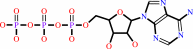 ATP
ATP
|
=
|
O-phospho-L-tyrosyl-[protein]
|
+
|
 ADP
ADP
|
+
|
H(+)
|
|
|
|
|
|
|
|
|
|
|
|
|
Molecule diagrams generated from .mol files obtained from the
KEGG ftp site
|
|
|
|
|
|
|
|
|
|
|
|
|
|
 |
|
|
|
|
|
|
| |
|
|
| |
|
|
J Med Chem
51:4632-4640
(2008)
|
|
PubMed id:
|
|
|
|
|
|
| |
|
Discovery of 5-[[4-[(2,3-dimethyl-2H-indazol-6-yl)methylamino]-2-pyrimidinyl]amino]-2-methyl-benzenesulfonamide (Pazopanib), a novel and potent vascular endothelial growth factor receptor inhibitor.
|
|
P.A.Harris,
A.Boloor,
M.Cheung,
R.Kumar,
R.M.Crosby,
R.G.Davis-Ward,
A.H.Epperly,
K.W.Hinkle,
R.N.Hunter,
J.H.Johnson,
V.B.Knick,
C.P.Laudeman,
D.K.Luttrell,
R.A.Mook,
R.T.Nolte,
S.K.Rudolph,
J.R.Szewczyk,
A.T.Truesdale,
J.M.Veal,
L.Wang,
J.A.Stafford.
|
|
|
|
|
| |
ABSTRACT
|
|
|
|
| |
|
|
Inhibition of the vascular endothelial growth factor (VEGF) signaling pathway
has emerged as one of the most promising new approaches for cancer therapy. We
describe herein the key steps starting from an initial screening hit leading to
the discovery of pazopanib,
N(4)-(2,3-dimethyl-2H-indazol-6-yl)-N(4)-methyl-N(2)-(4-methyl-3-sulfonamidophenyl)-2,4-pyrimidinediamine,
a potent pan-VEGF receptor (VEGFR) inhibitor under clinical development for
renal-cell cancer and other solid tumors.
|
|
|
|
|
|
|
|
|
|
|
|
|
|
|
|
|
|
 |
 |
 |
|
Literature references that cite this PDB file's key reference
|
|
|
| |
PubMed id
|
|
Reference
|
|
|
|
|
|
A.Truong,
T.Y.Wong,
and
L.M.Khachigian
(2011).
Emerging therapeutic approaches in the management of retinal angiogenesis and edema.
|
| |
J Mol Med,
89,
343-361.
|
|
|
|
|
|
|
F.A.Schutz,
T.K.Choueiri,
and
C.N.Sternberg
(2011).
Pazopanib: Clinical development of a potent anti-angiogenic drug.
|
| |
Crit Rev Oncol Hematol,
77,
163-171.
|
|
|
|
|
|
|
B.C.Goh,
N.J.Reddy,
U.B.Dandamudi,
K.H.Laubscher,
T.Peckham,
J.P.Hodge,
A.B.Suttle,
T.Arumugham,
Y.Xu,
C.F.Xu,
J.Lager,
M.M.Dar,
and
L.D.Lewis
(2010).
An evaluation of the drug interaction potential of pazopanib, an oral vascular endothelial growth factor receptor tyrosine kinase inhibitor, using a modified Cooperstown 5+1 cocktail in patients with advanced solid tumors.
|
| |
Clin Pharmacol Ther,
88,
652-659.
|
|
|
|
|
|
|
C.L.Cowey,
G.Sonpavde,
and
T.E.Hutson
(2010).
New advancements and developments in treatment of renal cell carcinoma: focus on pazopanib.
|
| |
Onco Targets Ther,
3,
147-155.
|
|
|
|
|
|
|
J.Kocí,
A.G.Oliver,
and
V.Krchnák
(2010).
Unprecedented rearrangement of 2-(2-aminoethyl)-1-aryl-3,4-dihydropyrazino[1,2-b]indazole-2-ium 6-oxides to 2,3-dihydro-1H-imidazo[1,2-b]indazoles.
|
| |
J Org Chem,
75,
502-505.
|
|
|
|
|
|
|
K.A.Furge,
J.P.MacKeigan,
and
B.T.Teh
(2010).
Kinase targets in renal-cell carcinomas: reassessing the old and discovering the new.
|
| |
Lancet Oncol,
11,
571-578.
|
|
|
|
|
|
|
L.Arko,
I.Katsyv,
G.E.Park,
W.P.Luan,
and
J.K.Park
(2010).
Experimental approaches for the treatment of malignant gliomas.
|
| |
Pharmacol Ther,
128,
1.
|
|
|
|
|
|
|
P.E.Clark
(2010).
Rationale for targeted therapies and potential role of pazopanib in advanced renal cell carcinoma.
|
| |
Biologics,
4,
187-197.
|
|
|
|
|
|
|
R.M.Bukowski,
U.Yasothan,
and
P.Kirkpatrick
(2010).
Pazopanib.
|
| |
Nat Rev Drug Discov,
9,
17-18.
|
|
|
|
|
|
|
R.M.Bukowski
(2010).
Pazopanib: a multikinase inhibitor with activity in advanced renal cell carcinoma.
|
| |
Expert Rev Anticancer Ther,
10,
635-645.
|
|
|
|
|
|
|
W.M.Linehan,
R.Srinivasan,
and
L.S.Schmidt
(2010).
The genetic basis of kidney cancer: a metabolic disease.
|
| |
Nat Rev Urol,
7,
277-285.
|
|
|
|
|
|
|
C.A.Castaneda,
and
H.L.Gomez
(2009).
Pazopanib: an antiangiogenic drug in perspective.
|
| |
Future Oncol,
5,
1335-1348.
|
|
|
|
|
|
|
K.A.Olaussen,
F.Commo,
M.Tailler,
L.Lacroix,
I.Vitale,
S.Q.Raza,
C.Richon,
P.Dessen,
V.Lazar,
J.C.Soria,
and
G.Kroemer
(2009).
Synergistic proapoptotic effects of the two tyrosine kinase inhibitors pazopanib and lapatinib on multiple carcinoma cell lines.
|
| |
Oncogene,
28,
4249-4260.
|
|
|
|
|
|
|
M.Radi,
S.Schenone,
and
M.Botta
(2009).
Recent highlights in the synthesis of highly functionalized pyrimidines.
|
| |
Org Biomol Chem,
7,
2841-2847.
|
|
|
|
|
|
The most recent references are shown first.
Citation data come partly from CiteXplore and partly
from an automated harvesting procedure. Note that this is likely to be
only a partial list as not all journals are covered by
either method. However, we are continually building up the citation data
so more and more references will be included with time.
|
|


 Links
Links


