 |
PDBsum entry 2vq3

|
|
|
|
|
|

|

|

|

|
|

|
|

|
|

|
|

|
|

|
|
|
 |

|

|
|
|
|
|
|
|
|
|
|
|
|
|
|
|
|
|
|
|
|
|
|
|
|
|
|
|
|
|
|
|
|
|
|
Oxidoreductase
|
PDB id
|
|
|
|
2vq3
|
|
|
|
|
|
|
|
|
|
|
|
|
|
|

|

|

|
|
|
|
|
|
|
|
 |
Contents |
 |
|
|
|
|
|
|
|
|
|
|
|
|
* Residue conservation analysis
|
|
|
|
|
|
PDB id:
|
|
|
|
| Name: |
|
Oxidoreductase
|
|
|
Title:
|
|
Crystal structure of the membrane proximal oxidoreductase domain of human steap3, the dominant ferric reductase of the erythroid transferrin cycle
|
|
Structure:
|
|
Metalloreductase steap3. Chain: a, b. Fragment: NADPH/flavin dependent oxidoreductase, residues 1-215. Synonym: steap3 dimer with NADPH, six-transmembrane epithelial antigen of prostate 3, tumor suppressor-activated pathway protein 6, htsap6, phyde, hphyde, dudulin-2. Engineered: yes. Other_details: residues 1-215 cloned, NADPH bound
|
|
Source:
|
|
Homo sapiens. Human. Organism_taxid: 9606. Organ: kidney. Tissue: renal cell adenocarcinoma. Expressed in: escherichia coli. Expression_system_taxid: 469008. Expression_system_variant: ril.
|
|
Resolution:
|
|
|
2.00Å
|
R-factor:
|
0.199
|
R-free:
|
0.236
|
|
|
Authors:
|
|
A.K.Sendamarai,R.S.Ohgami,M.D.Fleming,C.M.Lawrence
|
Key ref:

|
|
A.K.Sendamarai
et al.
(2008).
Structure of the membrane proximal oxidoreductase domain of human Steap3, the dominant ferrireductase of the erythroid transferrin cycle.
Proc Natl Acad Sci U S A,
105,
7410-7415.
PubMed id:
DOI:

|
|
|
Date:
|
|
|
10-Mar-08
|
Release date:
|
06-May-08
|
|
|
|
|
|
|
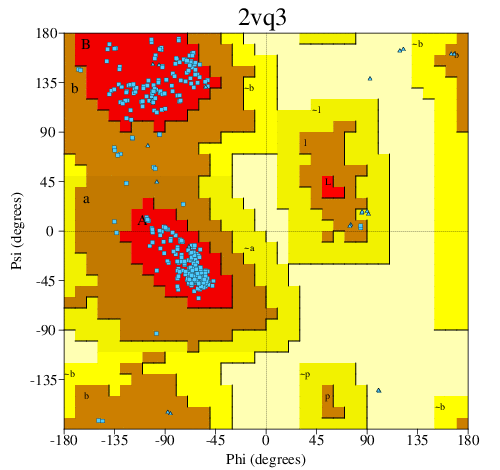
PROCHECK
|
|
|
|
|
|
Headers
|
|
|
|
References
|
|
|
|
|
|

|
|
Q658P3
(STEA3_HUMAN) -
Metalloreductase STEAP3 from Homo sapiens
|
|
|
|
Seq:
Struc:
|
|
|
|
488 a.a.
181 a.a.
|
|

|

|

|
|
|
|
|
|
|
|
|
|
|
Key: |
 |
PfamA domain |
|
|
 |
Secondary structure |
|
 |
CATH domain |
|
|
|
|
|
|
|
|
|
|
|
|
|
|
|
|
|
 |
|
|
|
|
|
|
| |
|
DOI no:
|
Proc Natl Acad Sci U S A
105:7410-7415
(2008)
|
|
PubMed id:
|
|
|
|
|
|
| |
|
Structure of the membrane proximal oxidoreductase domain of human Steap3, the dominant ferrireductase of the erythroid transferrin cycle.
|
|
A.K.Sendamarai,
R.S.Ohgami,
M.D.Fleming,
C.M.Lawrence.
|
|
|
|
|
| |
ABSTRACT
|
|
|
|
| |
|
|
The daily production of 200 billion erythrocytes requires 20 mg of iron,
accounting for nearly 80% of the iron demand in humans. Thus, erythroid
precursor cells possess an efficient mechanism for iron uptake in which iron
loaded transferrin (Tf) binds to the transferrin receptor (TfR) at the cell
surface. The Tf:TfR complex then enters the endosome via receptor-mediated
endocytosis. Upon endosomal acidification, iron is released from Tf, reduced to
Fe(2+) by Steap3, and transported across the endosomal membrane by divalent
metal iron transporter 1. Steap3, the major ferrireductase in erythrocyte
endosomes, is a member of a unique family of reductases. Steap3 is comprised of
an N-terminal cytosolic oxidoreductase domain and a C-terminal heme-containing
transmembrane domain. Cytosolic NADPH and a flavin are predicted cofactors, but
the NADPH/flavin binding domain differs significantly from those in other
eukaryotic reductases. Instead, Steap3 shows remarkable, although limited
homology to FNO, an archaeal oxidoreductase. We have determined the crystal
structure of the human Steap3 oxidoreductase domain in the absence and presence
of NADPH. The structure reveals an FNO-like domain with an unexpected dimer
interface and substrate binding sites that are well positioned to direct
electron transfer from the cytosol to a heme moiety predicted to be fixed within
the transmembrane domain. Here, we discuss possible gating mechanisms for
electron transfer across the endosomal membrane.
|
|
|
|
|
|
| |
Selected figure(s)
|
|
|
|
| |
|
|

|
|

|
|
Figure 1.
Steap3 Structure. (A) The structure of the oxidoreductase
dimer is depicted with α-helices in red, β-strands in blue,
and connecting loops in green. The twofold axis runs vertically
within the plane of the paper (double headed arrow). The
truncated C termini, which must connect to the C terminal
transmembrane domain, are in green at the top of the structure.
NADPH (C, yellow; N, blue; O, red; and P, orange) runs up the
front side of the right subunit (back side of the left subunit)
with the adenine-ribose-2′phosphate moieties near the bottom
and the nicotinamide ring near the top. (B) Stereo figure of the
Steap3 subunit with labeled secondary structural elements. A
color gradient runs from the N terminus (blue) to the C terminus
(red). Note the proximity of the NADPH binding site to the dimer
interface. (C) Stereo figure depicting the superposition of FNO
on the Steap3 protomer. The Steap3 C[α] trace is in blue, and
FNO in red. The approximate location and extent of the FNO dimer
interface is indicated by black arrows along the top of FNO. In
contrast, the Steap3 interface is formed by α7, α1, and the
C-terminal end of α2, which is significantly shorter in Steap3.
Relocation of the dimer interface, combined with the shorter β5
and α9 elements, allow the Steap3 NADPH binding site to
approach the membrane.
|
|
Figure 3.
The electrostatic potential mapped to the surface of the
Steap3 dimer. Positive potentials are in blue, negative
potentials in red (±25 kT/e). Steap3-NADPH and the docked
FMN from BVR-B are also shown. The orientation of the dimer and
colors for NADPH are as in Fig. 1. FMN is similarly colored, but
carbons are in cyan. Note the cleft running up the front side
and across the top of the dimer interface. Because of the
symmetry of the dimer, the cleft continues along the interface
down the back side of the dimer.
|
|
|
|
| |
Figures were
selected
by an automated process.
|
|
|
|
|
|
|
|
|
|
|
|
|
|
|
|
 |
 |
 |
|
Literature references that cite this PDB file's key reference
|
|
|
| |
PubMed id
|
|
Reference
|
|
|
|
|
|
T.Takami,
and
I.Sakaida
(2011).
Iron regulation by hepatocytes and free radicals.
|
| |
J Clin Biochem Nutr,
48,
103-106.
|
|
|
|
|
|
|
D.R.Richardson,
D.J.Lane,
E.M.Becker,
M.L.Huang,
M.Whitnall,
Y.S.Rahmanto,
A.D.Sheftel,
and
P.Ponka
(2010).
Mitochondrial iron trafficking and the integration of iron metabolism between the mitochondrion and cytosol.
|
| |
Proc Natl Acad Sci U S A,
107,
10775-10782.
|
|
|
|
|
|
|
L.Li,
C.J.Fang,
J.C.Ryan,
E.C.Niemi,
J.A.Lebrón,
P.J.Björkman,
H.Arase,
F.M.Torti,
S.V.Torti,
M.C.Nakamura,
and
W.E.Seaman
(2010).
Binding and uptake of H-ferritin are mediated by human transferrin receptor-1.
|
| |
Proc Natl Acad Sci U S A,
107,
3505-3510.
|
|
|
|
|
|
|
M.Wessling-Resnick
(2010).
Iron homeostasis and the inflammatory response.
|
| |
Annu Rev Nutr,
30,
105-122.
|
|
|
|
|
|
|
S.L.Byrne,
N.D.Chasteen,
A.N.Steere,
and
A.B.Mason
(2010).
The unique kinetics of iron release from transferrin: the role of receptor, lobe-lobe interactions, and salt at endosomal pH.
|
| |
J Mol Biol,
396,
130-140.
|
|
|
|
|
|
|
T.Oda,
H.Hashimoto,
N.Kuwabara,
S.Akashi,
K.Hayashi,
C.Kojima,
H.L.Wong,
T.Kawasaki,
K.Shimamoto,
M.Sato,
and
T.Shimizu
(2010).
Structure of the N-terminal regulatory domain of a plant NADPH oxidase and its functional implications.
|
| |
J Biol Chem,
285,
1435-1445.
|
|
|
PDB code:
|
|
|
|
|
|
|
|
G.J.Anderson,
and
C.D.Vulpe
(2009).
Mammalian iron transport.
|
| |
Cell Mol Life Sci,
66,
3241-3261.
|
|
|
|
|
|
|
X.Yu,
T.Riley,
and
A.J.Levine
(2009).
The regulation of the endosomal compartment by p53 the tumor suppressor gene.
|
| |
FEBS J,
276,
2201-2212.
|
|
|
|
|
|
The most recent references are shown first.
Citation data come partly from CiteXplore and partly
from an automated harvesting procedure. Note that this is likely to be
only a partial list as not all journals are covered by
either method. However, we are continually building up the citation data
so more and more references will be included with time.
Where a reference describes a PDB structure, the PDB
code is
shown on the right.
|
|


 Links
Links


