|
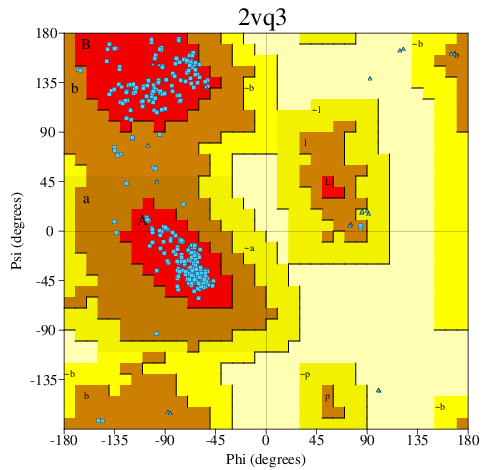
PDBsum entry 2vq3

|
|
|
|
|
|

|
|

|
|

|
|

|
|

|
|

|
|

|
|
|
 |

|

|
|
|
|
|
|
|
|
|
|
|
|
|
|
|
|
|
|
|
|
|
|
|
|
|
|
|
|
|
|
|
|
Oxidoreductase
|
PDB id
|
|
|
|
2vq3
|
|
|
|
|
|
|
|
|
|
|
|
|
|
|

|

|

|
|
|
|
|
|
References listed in PDB file
|
|
|
Key reference
|
|
|
Title
|
|
Structure of the membrane proximal oxidoreductase domain of human steap3, The dominant ferrireductase of the erythroid transferrin cycle.
|
|
|
Authors
|
|
A.K.Sendamarai,
R.S.Ohgami,
M.D.Fleming,
C.M.Lawrence.
|
|
|
Ref.
|
|
Proc Natl Acad Sci U S A, 2008,
105,
7410-7415.
[DOI no: ]
|
|
|
PubMed id
|
|
|
|
|
|
|
|
|
Abstract
|
|
|
The daily production of 200 billion erythrocytes requires 20 mg of iron,
accounting for nearly 80% of the iron demand in humans. Thus, erythroid
precursor cells possess an efficient mechanism for iron uptake in which iron
loaded transferrin (Tf) binds to the transferrin receptor (TfR) at the cell
surface. The Tf:TfR complex then enters the endosome via receptor-mediated
endocytosis. Upon endosomal acidification, iron is released from Tf, reduced to
Fe(2+) by Steap3, and transported across the endosomal membrane by divalent
metal iron transporter 1. Steap3, the major ferrireductase in erythrocyte
endosomes, is a member of a unique family of reductases. Steap3 is comprised of
an N-terminal cytosolic oxidoreductase domain and a C-terminal heme-containing
transmembrane domain. Cytosolic NADPH and a flavin are predicted cofactors, but
the NADPH/flavin binding domain differs significantly from those in other
eukaryotic reductases. Instead, Steap3 shows remarkable, although limited
homology to FNO, an archaeal oxidoreductase. We have determined the crystal
structure of the human Steap3 oxidoreductase domain in the absence and presence
of NADPH. The structure reveals an FNO-like domain with an unexpected dimer
interface and substrate binding sites that are well positioned to direct
electron transfer from the cytosol to a heme moiety predicted to be fixed within
the transmembrane domain. Here, we discuss possible gating mechanisms for
electron transfer across the endosomal membrane.
|
|
|
|

|
|

|
|
Figure 1.
Steap3 Structure. (A) The structure of the oxidoreductase
dimer is depicted with α-helices in red, β-strands in blue,
and connecting loops in green. The twofold axis runs vertically
within the plane of the paper (double headed arrow). The
truncated C termini, which must connect to the C terminal
transmembrane domain, are in green at the top of the structure.
NADPH (C, yellow; N, blue; O, red; and P, orange) runs up the
front side of the right subunit (back side of the left subunit)
with the adenine-ribose-2′phosphate moieties near the bottom
and the nicotinamide ring near the top. (B) Stereo figure of the
Steap3 subunit with labeled secondary structural elements. A
color gradient runs from the N terminus (blue) to the C terminus
(red). Note the proximity of the NADPH binding site to the dimer
interface. (C) Stereo figure depicting the superposition of FNO
on the Steap3 protomer. The Steap3 C[α] trace is in blue, and
FNO in red. The approximate location and extent of the FNO dimer
interface is indicated by black arrows along the top of FNO. In
contrast, the Steap3 interface is formed by α7, α1, and the
C-terminal end of α2, which is significantly shorter in Steap3.
Relocation of the dimer interface, combined with the shorter β5
and α9 elements, allow the Steap3 NADPH binding site to
approach the membrane.
|
|
Figure 3.
The electrostatic potential mapped to the surface of the
Steap3 dimer. Positive potentials are in blue, negative
potentials in red (±25 kT/e). Steap3-NADPH and the docked
FMN from BVR-B are also shown. The orientation of the dimer and
colors for NADPH are as in Fig. 1. FMN is similarly colored, but
carbons are in cyan. Note the cleft running up the front side
and across the top of the dimer interface. Because of the
symmetry of the dimer, the cleft continues along the interface
down the back side of the dimer.
|
|
|
|
|
|
Secondary reference #1
|
|
|
Title
|
|
Identification of a ferrireductase required for efficient transferrin-Dependent iron uptake in erythroid cells.
|
|
|
Authors
|
|
R.S.Ohgami,
D.R.Campagna,
E.L.Greer,
B.Antiochos,
A.Mcdonald,
J.Chen,
J.J.Sharp,
Y.Fujiwara,
J.E.Barker,
M.D.Fleming.
|
|
|
Ref.
|
|
Nat Genet, 2005,
37,
1264-1269.
[DOI no: ]
|
|
|
PubMed id
|
|
|
|
|
|
|
|
|
|

|
|

|
|
Figure 2.
Figure 2. Steap3 mRNA expression. (a) In situ hybridization
of homozygous mutant (nm/nm) and wild-type mouse embryos at
embryonic day 15.5 showing high-level fetal liver (open arrow)
and labyrinthine placental (closed arrow) expression. (b)
Quantitative real-time PCR of STEAP3 in human tissues. Relative
RNA abundance is normalized to spleen, which was defined as a
ratio of 1.0. Error bars represent one standard deviation.
|
|
Figure 3.
Figure 3. Steap3 subcellular localization. (a–i)
Colocalization of epitope-tagged Steap3 with endogenous Tf and
Tfr1 and epitope-tagged DMT1. (a) Steap3. (b) Tf. (c) Tf and
Steap3 merged. (d) Steap3. (e) Tfr1. (f) Tfr1 and Steap3 merged.
(g) Steap3. (h) Dmt1. (i) Dmt1 and Steap3 merged.
|
|
|
|
|
|
The above figures are
reproduced from the cited reference
which is an Open Access publication published by Macmillan Publishers Ltd
|
|
|
Secondary reference #2
|
|
|
Title
|
|
Nm1054: a spontaneous, Recessive, Hypochromic, Microcytic anemia mutation in the mouse.
|
|
|
Authors
|
|
R.S.Ohgami,
D.R.Campagna,
B.Antiochos,
E.B.Wood,
J.J.Sharp,
J.E.Barker,
M.D.Fleming.
|
|
|
Ref.
|
|
Blood, 2005,
106,
3625-3631.
|
|
|
PubMed id
|
|
|
|
|
|
|
|
|
|
|
|
|