 |
PDBsum entry 2v0s

|
|
|
|
|
|

|

|

|

|
|

|
|

|
|

|
|

|
|

|
|
|
 |

|

|
|
|
|
|
|
|
|
|
|
|
|
|
|
|
|
|
|
|
|
|
|
|
|
|
|
|
|
|
|
|
|
|
|
Transcription
|
PDB id
|
|
|
|
2v0s
|
|
|
|
|
|
|
|
|
|
|
|
|
|
|

|

|

|
|
|
|
|
|
|
|
 |
Contents |
 |
|
|
|
|
|
|
|
|
|
|
|
|
|
|
* Residue conservation analysis
|
|
|
|
|
|
|
|
|
|
|
Enzyme class 1:
|
|
E.C.2.7.7.49
- RNA-directed Dna polymerase.
|
|
|
|
|
|
|
Reaction:
|
|
DNA(n) + a 2'-deoxyribonucleoside 5'-triphosphate = DNA(n+1) + diphosphate
|
|
|
|
|
|
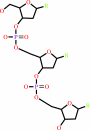 DNA(n)
|
+
|
2'-deoxyribonucleoside 5'-triphosphate
|
=
|
DNA(n+1)
|
+
|
 diphosphate
|
|
|
|
|
|
|
|
|
|
Enzyme class 2:
|
|
E.C.3.1.21.-
- ?????
|
|
|
|
|
|
|
|
|
|
Note, where more than one E.C. class is given (as above), each may
correspond to a different protein domain or, in the case of polyprotein
precursors, to a different mature protein.
|
|
|
|
Molecule diagrams generated from .mol files obtained from the
KEGG ftp site
|
|
|
|
|
|
|
|
|
|
|
|
|
|
 |
|
|
|
|
|
|
| |
|
|
| |
|
|
Nucleic Acids Res
35:4914-4926
(2007)
|
|
PubMed id:
|
|
|
|
|
|
| |
|
Determinants for DNA target structure selectivity of the human LINE-1 retrotransposon endonuclease.
|
|
K.Repanas,
N.Zingler,
L.E.Layer,
G.G.Schumann,
A.Perrakis,
O.Weichenrieder.
|
|
|
|
|
| |
ABSTRACT
|
|
|
|
| |
|
|
The human LINE-1 endonuclease (L1-EN) is the targeting endonuclease encoded by
the human LINE-1 (L1) retrotransposon. L1-EN guides the genomic integration of
new L1 and Alu elements that presently account for approximately 28% of the
human genome. L1-EN bears considerable technological interest, because its
target selectivity may ultimately be engineered to allow the site-specific
integration of DNA into defined genomic locations. Based on the crystal
structure, we generated L1-EN mutants to analyze and manipulate DNA target site
recognition. Crystal structures and their dynamic and functional analysis show
entire loop grafts to be feasible, resulting in altered specificity, while
individual point mutations do not change the nicking pattern of L1-EN.
Structural parameters of the DNA target seem more important for recognition than
the nucleotide sequence, and nicking profiles on DNA oligonucleotides in vitro
are less well defined than the respective integration site consensus in vivo.
This suggests that additional factors other than the DNA nicking specificity of
L1-EN contribute to the targeted integration of non-LTR retrotransposons.
|
|
|
|
|
|
|
|
|
|
|
|
|
|
|
|
|
|
 |
 |
 |
|
Literature references that cite this PDB file's key reference
|
|
|
| |
PubMed id
|
|
Reference
|
|
|
|
|
|
E.Khazina,
V.Truffault,
R.Büttner,
S.Schmidt,
M.Coles,
and
O.Weichenrieder
(2011).
Trimeric structure and flexibility of the L1ORF1 protein in human L1 retrotransposition.
|
| |
Nat Struct Mol Biol,
18,
1006-1014.
|
|
|
PDB codes:
|
|
|
|
|
|
|
|
I.V.Nesterova,
C.A.Bennett,
S.S.Erdem,
R.P.Hammer,
P.L.Deininger,
and
S.A.Soper
(2011).
Near-IR single fluorophore quenching system based on phthalocyanine (Pc) aggregation and its application for monitoring inhibitor/activator action on a therapeutic target: L1-EN.
|
| |
Analyst,
136,
1103-1105.
|
|
|
|
|
|
|
K.Yoshitake,
H.Aoyagi,
and
H.Fujiwara
(2010).
Creation of a novel telomere-cutting endonuclease based on the EN domain of telomere-specific non-long terminal repeat retrotransposon, TRAS1.
|
| |
Mob DNA,
1,
13.
|
|
|
|
|
|
|
S.H.Rangwala,
and
H.H.Kazazian
(2009).
The L1 retrotransposition assay: a retrospective and toolkit.
|
| |
Methods,
49,
219-226.
|
|
|
|
|
|
The most recent references are shown first.
Citation data come partly from CiteXplore and partly
from an automated harvesting procedure. Note that this is likely to be
only a partial list as not all journals are covered by
either method. However, we are continually building up the citation data
so more and more references will be included with time.
Where a reference describes a PDB structure, the PDB
codes are
shown on the right.
|
|


 Links
Links






