 |
PDBsum entry 2tsr

|
|
|
|
|
|

|

|

|

|
|

|
|

|
|

|
|

|
|

|
|

|
|
|
 |

|

|
|
|
|
|
|
|
|
|
|
|
|
|
|
|
|
|
|
|
|
|
|
|
|
|
|
|
|
|
|
|
|
|
|
|
Methyltransferase
|
PDB id
|
|
|
|
2tsr
|
|
|
|
|
|
|
|
|
|
|
|
|
|
|

|

|

|
|
|
|
|
|
|
|
 |
Contents |
 |
|
|
|
|
|
|
|
|
|
|
|
|
* Residue conservation analysis
|
|
|
|
|
|
PDB id:
|
|
|
|
| Name: |
|
Methyltransferase
|
|
|
Title:
|
|
Thymidylate synthase from rat in ternary complex with dump and tomudex
|
|
Structure:
|
|
Thymidylate synthase. Chain: a, b, c, d. Engineered: yes
|
|
Source:
|
|
Rattus norvegicus. Norway rat. Organism_taxid: 10116. Expressed in: escherichia coli. Expression_system_taxid: 562
|
|
Biol. unit:
|
|
 Dimer (from PDB file)
|
|
Resolution:
|
|
|
2.60Å
|
R-factor:
|
0.162
|
R-free:
|
0.222
|
|
|
Authors:
|
|
R.R.Sotelo-Mundo,J.Ciesla,J.M.Dzik,W.Rode,F.Maley,G.Maley,L.W.Hardy, W.R.Montfort
|
Key ref:

|
|
R.R.Sotelo-Mundo
et al.
(1999).
Crystal structures of rat thymidylate synthase inhibited by Tomudex, a potent anticancer drug.
Biochemistry,
38,
1087-1094.
PubMed id:
DOI:
|
|
|
Date:
|
|
|
19-Jun-98
|
Release date:
|
16-Feb-99
|
|
|
|
|
|
|
PROCHECK
|

|
|
|
|
|
Headers
|
|
|
|
References
|
|
|
|
|
|

|
|
P45352
(TYSY_RAT) -
Thymidylate synthase from Rattus norvegicus
|
|
|
|
Seq:
Struc:
|
|
|
|
307 a.a.
281 a.a.
|
|

|

|

|
|
|
|
|
|
|
|
|
|
|
Key: |
 |
PfamA domain |
|
|
 |
Secondary structure |
|
 |
CATH domain |
|
|
|
|
|
|
|
|
|
|
|
|
|
Enzyme class:
|
|
E.C.2.1.1.45
- thymidylate synthase.
|
|
|
|
|
|
|
Pathway:
|
|
Folate Coenzymes
|
|
|
|
|
|
Reaction:
|
|
dUMP + (6R)-5,10-methylene-5,6,7,8-tetrahydrofolate = 7,8-dihydrofolate + dTMP
|
|
|
|
|
|
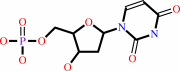 dUMP
dUMP
|
+
|
(6R)-5,10-methylene-5,6,7,8-tetrahydrofolate
Bound ligand (Het Group name = )
corresponds exactly
|
=
|
7,8-dihydrofolate
Bound ligand (Het Group name = )
matches with 45.45% similarity
|
+
|
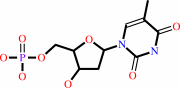 dTMP
dTMP
|
|
|
|
|
|
|
|
|
|
|
|
|
Molecule diagrams generated from .mol files obtained from the
KEGG ftp site
|
|
|
|
|
|
|
|
|
|
|
|
|
|
 |
|
|
|
|
|
|
| |
|
|
| |
|
DOI no:
|
Biochemistry
38:1087-1094
(1999)
|
|
PubMed id:
|
|
|
|
|
|
| |
|
Crystal structures of rat thymidylate synthase inhibited by Tomudex, a potent anticancer drug.
|
|
R.R.Sotelo-Mundo,
J.Ciesla,
J.M.Dzik,
W.Rode,
F.Maley,
G.F.Maley,
L.W.Hardy,
W.R.Montfort.
|
|
|
|
|
| |
ABSTRACT
|
|
|
|
| |
|
|
Two crystal structures of rat thymidylate synthase (TS) complexed with dUMP and
the anticancer drug Tomudex (ZD1694) have been determined to resolutions of 3.3
and 2.6 A. Tomudex is one of several new antifolates targeted to TS and the
first to be approved for clinical use. The structures represent the first views
of any mammalian TS bound to ligands and suggest that the rat protein undergoes
a ligand-induced conformational change similar to that of the Escherichia coli
protein. Surprisingly, Tomudex does not induce the "closed" conformation in rat
TS that is seen on binding to E. coli TS, resulting in inhibitor atoms that
differ in position by more than 1.5 A. Several species-specific differences in
sequence may be the reason for this. Phe 74 shifts to a new position in the rat
complex and is in van der Waals contact with the inhibitor, while in the E. coli
protein the equivalent amino acid (His 51) hydrogen bonds to the glutamate
portion of the inhibitor. Amino acids Arg 101, Asn 106, and Met 305 make no
contacts with the inhibitor in the open conformation, unlike the equivalent
residues in the E. coli protein (Thr 78, Trp 83, and Val 262). dUMP binding is
similar in both proteins, except that there is no covalent adduct to the active
site cysteine (Cys 189) in the rat structures. Two insertions in the rat protein
are clearly seen, but the N-termini (residues 1-20) and C-termini (residues
301-307) are disordered in both crystal forms.
|
|
|
|
|
|
|
|
|
|
|
|
|
|
|
|
|
|
 |
 |
 |
|
Literature references that cite this PDB file's key reference
|
|
|
| |
PubMed id
|
|
Reference
|
|
|
|
|
|
D.Cardinale,
O.M.Salo-Ahen,
G.Guaitoli,
S.Ferrari,
A.Venturelli,
S.Franchini,
R.Battini,
G.Ponterini,
R.C.Wade,
and
M.P.Costi
(2010).
Design and characterization of a mutation outside the active site of human thymidylate synthase that affects ligand binding.
|
| |
Protein Eng Des Sel,
23,
81-89.
|
|
|
|
|
|
|
V.Srivastava,
S.P.Gupta,
M.I.Siddiqi,
and
B.N.Mishra
(2010).
Molecular docking studies on quinazoline antifolate derivatives as human thymidylate synthase inhibitors.
|
| |
Bioinformation,
4,
357-365.
|
|
|
|
|
|
|
X.Huang,
L.M.Gibson,
B.J.Bell,
L.L.Lovelace,
M.M.Peña,
F.G.Berger,
S.H.Berger,
and
L.Lebioda
(2010).
Replacement of Val3 in human thymidylate synthase affects its kinetic properties and intracellular stability .
|
| |
Biochemistry,
49,
2475-2482.
|
|
|
PDB codes:
|
|
|
|
|
|
|
|
W.E.Martucci,
M.A.Vargo,
and
K.S.Anderson
(2008).
Explaining an unusually fast parasitic enzyme: folate tail-binding residues dictate substrate positioning and catalysis in Cryptosporidium hominis thymidylate synthase.
|
| |
Biochemistry,
47,
8902-8911.
|
|
|
PDB codes:
|
|
|
|
|
|
|
|
S.Jantová,
S.Letasiová,
A.Repický,
R.Ovádeková,
and
B.Lakatos
(2006).
The effect of 3-(5-nitro-2-thienyl)-9-chloro-5-morpholin-4-yl[1,2,4]triazolo[4,3-c]quinazoline on cell growth, cell cycle, induction of DNA fragmentation, and activity of caspase 3 in murine leukemia L1210 cells and fibroblast NIH-3T3 cells.
|
| |
Cell Biochem Funct,
24,
519-530.
|
|
|
|
|
|
|
J.S.Finer-Moore,
A.C.Anderson,
R.H.O'Neil,
M.P.Costi,
S.Ferrari,
J.Krucinski,
and
R.M.Stroud
(2005).
The structure of Cryptococcus neoformans thymidylate synthase suggests strategies for using target dynamics for species-specific inhibition.
|
| |
Acta Crystallogr D Biol Crystallogr,
61,
1320-1334.
|
|
|
PDB codes:
|
|
|
|
|
|
|
|
J.Yuvaniyama,
P.Chitnumsub,
S.Kamchonwongpaisan,
J.Vanichtanankul,
W.Sirawaraporn,
P.Taylor,
M.D.Walkinshaw,
and
Y.Yuthavong
(2003).
Insights into antifolate resistance from malarial DHFR-TS structures.
|
| |
Nat Struct Biol,
10,
357-365.
|
|
|
PDB codes:
|
|
|
|
|
|
|
|
R.H.O'Neil,
R.H.Lilien,
B.R.Donald,
R.M.Stroud,
and
A.C.Anderson
(2003).
Phylogenetic classification of protozoa based on the structure of the linker domain in the bifunctional enzyme, dihydrofolate reductase-thymidylate synthase.
|
| |
J Biol Chem,
278,
52980-52987.
|
|
|
PDB code:
|
|
|
|
|
|
|
|
B.Gołos,
J.M.Dzik,
Z.Kazimierczuk,
J.Cieśla,
Z.Zieliński,
J.Jankowska,
A.Kraszewski,
J.Stawiński,
W.Rode,
and
D.Shugar
(2001).
Interaction of thymidylate synthase with the 5'-thiophosphates, 5'-dithiophosphates, 5'-H-phosphonates and 5'-S-thiosulfates of 2'-deoxyuridine, thymidine and 5-fluoro-2'-deoxyuridine.
|
| |
Biol Chem,
382,
1439-1445.
|
|
|
|
|
|
|
J.Phan,
S.Koli,
W.Minor,
R.B.Dunlap,
S.H.Berger,
and
L.Lebioda
(2001).
Human thymidylate synthase is in the closed conformation when complexed with dUMP and raltitrexed, an antifolate drug.
|
| |
Biochemistry,
40,
1897-1902.
|
|
|
PDB code:
|
|
|
|
|
|
|
|
R.Almog,
C.A.Waddling,
F.Maley,
G.F.Maley,
and
P.Van Roey
(2001).
Crystal structure of a deletion mutant of human thymidylate synthase Delta (7-29) and its ternary complex with Tomudex and dUMP.
|
| |
Protein Sci,
10,
988-996.
|
|
|
PDB codes:
|
|
|
|
|
|
|
The most recent references are shown first.
Citation data come partly from CiteXplore and partly
from an automated harvesting procedure. Note that this is likely to be
only a partial list as not all journals are covered by
either method. However, we are continually building up the citation data
so more and more references will be included with time.
Where a reference describes a PDB structure, the PDB
codes are
shown on the right.
|
|


 Links
Links


