 |
PDBsum entry 2q9c

|
|
|
|
|
|

|

|

|

|
|

|
|

|
|

|
|

|
|

|
|

|
|
|
 |

|

|
|
|
|
|
|
|
|
|
|
|
|
|
|
|
|
|
|
|
|
|
|
|
|
|
|
|
|
|
|
|
|
|
|
|
Signaling protein
|
PDB id
|
|
|
|
2q9c
|
|
|
|
|
|
|
|
|
|
|
|
|
|
|

|

|

|
|
|
|
|
|
|
|
 |
Contents |
 |
|
|
|
|
|
|
|
|
|
|
|
|
* Residue conservation analysis
|
|
|
|
|
|
|
|
|
|
|
Enzyme class:
|
|
E.C.3.6.5.4
- signal-recognition-particle GTPase.
|
|
|
|
|
|
|
Reaction:
|
|
GTP + H2O = GDP + phosphate + H+
|
|
|
|
|
|
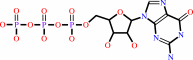 GTP
GTP
|
+
|
H2O
|
=
|
GDP
Bound ligand (Het Group name = )
matches with 81.82% similarity
|
+
|
 phosphate
|
+
|
H(+)
|
|
|
|
|
|
|
|
|
|
|
|
|
Molecule diagrams generated from .mol files obtained from the
KEGG ftp site
|
|
|
|
|
|
|
|
|
|
|
|
|
|
 |
|
|
|
|
|
|
| |
|
|
| |
|
|
Plos One
2:e607
(2007)
|
|
PubMed id:
|
|
|
|
|
|
| |
|
X-ray structures of the signal recognition particle receptor reveal targeting cycle intermediates.
|
|
C.L.Reyes,
E.Rutenber,
P.Walter,
R.M.Stroud.
|
|
|
|
|
| |
ABSTRACT
|
|
|
|
| |
|
|
The signal recognition particle (SRP) and its conjugate receptor (SR) mediate
cotranslational targeting of a subclass of proteins destined for secretion to
the endoplasmic reticulum membrane in eukaryotes or to the plasma membrane in
prokaryotes. Conserved active site residues in the GTPase domains of both SRP
and SR mediate discrete conformational changes during formation and dissociation
of the SRP.SR complex. Here, we describe structures of the prokaryotic SR, FtsY,
as an apo protein and in two different complexes with a non-hydrolysable GTP
analog (GMPPNP). These structures reveal intermediate conformations of FtsY
containing GMPPNP and explain how the conserved active site residues position
the nucleotide into a non-catalytic conformation. The basis for the lower
specificity of binding of nucleotide in FtsY prior to heterodimerization with
the SRP conjugate Ffh is also shown. We propose that these structural changes
represent discrete conformational states assumed by FtsY during targeting
complex formation and dissociation.
|
|
|
|
|
|
|
|
|
|
|
|
|
|
|
|
|
|
 |
 |
 |
|
Literature references that cite this PDB file's key reference
|
|
|
| |
PubMed id
|
|
Reference
|
|
|
|
|
|
S.F.Ataide,
N.Schmitz,
K.Shen,
A.Ke,
S.O.Shan,
J.A.Doudna,
and
N.Ban
(2011).
The crystal structure of the signal recognition particle in complex with its receptor.
|
| |
Science,
331,
881-886.
|
|
|
PDB code:
|
|
|
|
|
|
|
|
M.Yang,
X.Zhang,
and
K.Han
(2010).
Molecular dynamics simulation of SRP GTPases: towards an understanding of the complex formation from equilibrium fluctuations.
|
| |
Proteins,
78,
2222-2237.
|
|
|
|
|
|
|
O.Doppelt-Azeroual,
F.Delfaud,
F.Moriaud,
and
A.G.de Brevern
(2010).
Fast and automated functional classification with MED-SuMo: an application on purine-binding proteins.
|
| |
Protein Sci,
19,
847-867.
|
|
|
|
|
|
|
A.J.Driessen,
and
N.Nouwen
(2008).
Protein translocation across the bacterial cytoplasmic membrane.
|
| |
Annu Rev Biochem,
77,
643-667.
|
|
|
|
|
|
|
P.F.Egea,
H.Tsuruta,
G.P.de Leon,
J.Napetschnig,
P.Walter,
and
R.M.Stroud
(2008).
Structures of the signal recognition particle receptor from the archaeon Pyrococcus furiosus: implications for the targeting step at the membrane.
|
| |
PLoS ONE,
3,
e3619.
|
|
|
PDB codes:
|
|
|
|
|
|
|
|
S.B.Neher,
N.Bradshaw,
S.N.Floor,
J.D.Gross,
and
P.Walter
(2008).
SRP RNA controls a conformational switch regulating the SRP-SRP receptor interaction.
|
| |
Nat Struct Mol Biol,
15,
916-923.
|
|
|
|
|
|
|
U.D.Ramirez,
P.J.Focia,
and
D.M.Freymann
(2008).
Nucleotide-binding flexibility in ultrahigh-resolution structures of the SRP GTPase Ffh.
|
| |
Acta Crystallogr D Biol Crystallogr,
64,
1043-1053.
|
|
|
PDB codes:
|
|
|
|
|
|
|
The most recent references are shown first.
Citation data come partly from CiteXplore and partly
from an automated harvesting procedure. Note that this is likely to be
only a partial list as not all journals are covered by
either method. However, we are continually building up the citation data
so more and more references will be included with time.
Where a reference describes a PDB structure, the PDB
code is
shown on the right.
|
|


 Links
Links


