|
PDBsum entry 2o1h

|
|
|
|
|
 |
Contents |
 |
|
|
|
|
|
|
|
|
|
|
|
|
|
|
* Residue conservation analysis
|
|
|
|
|
|
|
|
|
|
|
Enzyme class 1:
|
|
E.C.2.4.1.37
- fucosylgalactoside 3-alpha-galactosyltransferase.
|
|
|
|
|
|
|
Reaction:
|
|
an alpha-L-fucosyl-(1->2)-beta-D-galactosyl derivative + UDP-alpha-D- galactose = an alpha-D-galactosyl-(1->3)-[alpha-L-fucosyl-(1->2)]-beta-D- galactosyl derivative + UDP + H+
|
|
|
|
|
|
alpha-L-fucosyl-(1->2)-beta-D-galactosyl derivative
|
+
|
UDP-alpha-D- galactose
|
=
|
alpha-D-galactosyl-(1->3)-[alpha-L-fucosyl-(1->2)]-beta-D- galactosyl derivative
|
+
|
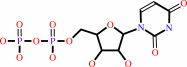 UDP
UDP
|
+
|
H(+)
Bound ligand (Het Group name = )
corresponds exactly
|
|
|
|
|
|
|
|
|
|
Enzyme class 2:
|
|
E.C.2.4.1.40
- glycoprotein-fucosylgalactoside alpha-N-acetylgalactosaminyltransferase.
|
|
|
|
|
|
|
Reaction:
|
|
an alpha-L-fucosyl-(1->2)-beta-D-galactosyl derivative + UDP-N-acetyl- alpha-D-galactosamine = an N-acetyl-alpha-D-galactosaminyl-(1->3)-[alpha- L-fucosyl-(1->2)]-beta-D-galactosyl derivative + UDP + H+
|
|
|
|
|
|
alpha-L-fucosyl-(1->2)-beta-D-galactosyl derivative
|
+
|
UDP-N-acetyl- alpha-D-galactosamine
|
=
|
N-acetyl-alpha-D-galactosaminyl-(1->3)-[alpha- L-fucosyl-(1->2)]-beta-D-galactosyl derivative
|
+
|
UDP
|
+
|
H(+)
Bound ligand (Het Group name = )
corresponds exactly
|
|
|
|
|
|
|
|
|
|
|
|
|
Note, where more than one E.C. class is given (as above), each may
correspond to a different protein domain or, in the case of polyprotein
precursors, to a different mature protein.
|
|
|
|
Molecule diagrams generated from .mol files obtained from the
KEGG ftp site
|
|
|
|
|
|
|
|
|
|
|
|
|
|
 |
|
|
|
|
|
|
| |
|
|
| |
|
DOI no:
|
J Biol Chem
282:9564-9570
(2007)
|
|
PubMed id:
|
|
|
|
|
|
| |
|
Structural effects of naturally occurring human blood group B galactosyltransferase mutations adjacent to the DXD motif.
|
|
M.Persson,
J.A.Letts,
B.Hosseini-Maaf,
S.N.Borisova,
M.M.Palcic,
S.V.Evans,
M.L.Olsson.
|
|
|
|
|
| |
ABSTRACT
|
|
|
|
| |
|
|
Human blood group A and B antigens are produced by two closely related
glycosyltransferase enzymes. An N-acetylgalactosaminyltransferase (GTA) utilizes
UDP-GalNAc to extend H antigen acceptors (Fuc alpha(1-2)Gal beta-OR) producing A
antigens, whereas a galactosyltransferase (GTB) utilizes UDP-Gal as a donor to
extend H structures producing B antigens. GTA and GTB have a characteristic
(211)DVD(213) motif that coordinates to a Mn(2+) ion shown to be critical in
donor binding and catalysis. Three GTB mutants, M214V, M214T, and M214R, with
alterations adjacent to the (211)DVD(213) motif have been identified in blood
banking laboratories. From serological phenotyping, individuals with the M214R
mutation show the B(el) variant expressing very low levels of B antigens,
whereas those with M214T and M214V mutations give rise to A(weak)B phenotypes.
Kinetic analysis of recombinant mutant GTB enzymes revealed that M214R has a
1200-fold decrease in k(cat) compared with wild type GTB. The crystal structure
of M214R showed that DVD motif coordination to Mn(2+) was disrupted by Arg-214
causing displacement of the metal by a water molecule. Kinetic characterizations
of the M214T and M214V mutants revealed they both had GTA and GTB activity
consistent with the serology. The crystal structure of the M214T mutant showed
no change in DVD coordination to Mn(2+). Instead a critical residue, Met-266,
which is responsible for determining donor specificity, had adopted alternate
conformations. The conformation with the highest occupancy opens up the active
site to accommodate the larger A-specific donor, UDP-GalNAc, accounting for the
dual specificity.
|
|
|
|
|
|
| |
Selected figure(s)
|
|
|
|
| |
|
|

|
|

|
|
Figure 3.
FIGURE 3. Electron density surrounding Met-266 in M214T,
showing the alternate conformations that this residue adopts.
Electron density is contoured at 1.00  (cyan) and 2.50 (blue).
The major conformation is shown in green and the minor
conformations in yellow and magenta. Atoms are colored by
element: carbon, white; oxygen, red; nitrogen, blue; sulfur,
yellow. (cyan) and 2.50 (blue).
The major conformation is shown in green and the minor
conformations in yellow and magenta. Atoms are colored by
element: carbon, white; oxygen, red; nitrogen, blue; sulfur,
yellow.
|
|
Figure 5.
FIGURE 5. a, wild type GTB showing the position of Met-214
and Met-266 relative to bound UDP-Gal. b, M214T showing the
position of Thr-214 and Met-266 relative to bound UDP-Gal. The
predominant conformation of Met-266 (green) opens up the active
site. c, M214T modeled with UDP-GalNAc. The larger A-donor,
UDP-GalNAc, can be accommodated by the high occupancy
conformation of Met-266 (green) and not the low occupancy, wild
type conformation (yellow). Atoms are colored by element:
carbon, white; oxygen, red; nitrogen, blue; sulfur/phosphorous,
yellow. The modeled Gal and GalNAc of the donors are shown with
magenta bonds.
|
|
|
|
|
|
| |
The above figures are
reprinted
by permission from the ASBMB:
J Biol Chem
(2007,
282,
9564-9570)
copyright 2007.
|
|
| |
Figures were
selected
by an automated process.
|
|
|
|
|
|
|
|
|
|
|
|
|
|
|
|
 |
 |
 |
|
Literature references that cite this PDB file's key reference
|
|
|
| |
PubMed id
|
|
Reference
|
|
|
|
|
|
P.Tumbale,
and
K.Brew
(2009).
Characterization of a metal-independent CAZy family 6 glycosyltransferase from Bacteroides ovatus.
|
| |
J Biol Chem,
284,
25126-25134.
|
|
|
|
|
|
|
L.L.Lairson,
B.Henrissat,
G.J.Davies,
and
S.G.Withers
(2008).
Glycosyltransferases: structures, functions, and mechanisms.
|
| |
Annu Rev Biochem,
77,
521-555.
|
|
|
|
|
|
The most recent references are shown first.
Citation data come partly from CiteXplore and partly
from an automated harvesting procedure. Note that this is likely to be
only a partial list as not all journals are covered by
either method. However, we are continually building up the citation data
so more and more references will be included with time.
|
|


 Links
Links