 |
PDBsum entry 2k4h

|
|
|
|
|
|

|

|

|

|
|

|
|

|
|

|
|

|
|

|
|
|
 |

|

|
|
|
|
|
|
|
|
|
|
|
|
|
|
|
|
|
|
|
|
|
|
|
|
|
|
|
|
|
|
|
|
|
|
Structural protein
|
PDB id
|
|
|
|
2k4h
|
|
|
|
|
|
|
|
|
|
|
|
|
|
|

|

|

|
|
|
|
|
|
|
|
 |
Contents |
 |
|
|
|
|
|
|
|
|
|
|
* Residue conservation analysis
|
|
|
|
|
|
PDB id:
|
|
|
|
| Name: |
|
Structural protein
|
|
|
Title:
|
|
Solution structure of the HIV-2 myristoylated matrix protein
|
|
Structure:
|
|
HIV-2 myristoylated matrix protein. Chain: a. Fragment: unp residues 2 to 135. Synonym: matrix protein p17. Engineered: yes
|
|
Source:
|
|
Human immunodeficiency virus type 2. HIV-2. Organism_taxid: 11720. Strain: prod10. Gene: gag-pol. Expressed in: escherichia coli.
|
|
NMR struc:
|
|
20 models
|
|
|
Authors:
|
|
J.S.Saad,S.D.Ablan,R.H.Ghanam,A.Kim,K.Andrews,K.Nagashima,E.O.Freed, M.F.Summers
|
Key ref:

|
|
J.S.Saad
et al.
(2008).
Structure of the myristylated human immunodeficiency virus type 2 matrix protein and the role of phosphatidylinositol-(4,5)-bisphosphate in membrane targeting.
J Mol Biol,
382,
434-447.
PubMed id:
DOI:

|
|
|
Date:
|
|
|
08-Jun-08
|
Release date:
|
12-Aug-08
|
|
|
|
|
|
|
PROCHECK
|

|
|
|
|
|
Headers
|
|
|
|
References
|
|
|
|
|
|

|
|
P04584
(POL_HV2RO) -
Gag-Pol polyprotein from Human immunodeficiency virus type 2 subtype A (isolate ROD)
|
|
|
|
Seq:
Struc:
|
|
|
|
1464 a.a.
134 a.a.
|
|

|

|

|
|
|
|
|
|
|
|
|
|
|
Key: |
|
 |
Secondary structure |
|
 |
CATH domain |
|
|
|
|
|
|
|
|
|
|
|
|
|
Enzyme class 1:
|
|
E.C.2.7.7.-
- ?????
|
|
|
|
|
|
|
Enzyme class 2:
|
|
E.C.2.7.7.49
- RNA-directed Dna polymerase.
|
|
|
|
|
|
|
Reaction:
|
|
DNA(n) + a 2'-deoxyribonucleoside 5'-triphosphate = DNA(n+1) + diphosphate
|
|
|
|
|
|
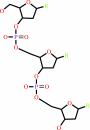 DNA(n)
|
+
|
2'-deoxyribonucleoside 5'-triphosphate
|
=
|
DNA(n+1)
|
+
|
 diphosphate
|
|
|
|
|
|
|
|
|
|
Enzyme class 3:
|
|
E.C.2.7.7.7
- DNA-directed Dna polymerase.
|
|
|
|
|
|
|
Reaction:
|
|
DNA(n) + a 2'-deoxyribonucleoside 5'-triphosphate = DNA(n+1) + diphosphate
|
|
|
|
|
|
DNA(n)
|
+
|
2'-deoxyribonucleoside 5'-triphosphate
|
=
|
DNA(n+1)
|
+
|
diphosphate
|
|
|
|
|
|
|
|
|
|
Enzyme class 4:
|
|
E.C.3.1.-.-
|
|
|
|
|
|
|
Enzyme class 5:
|
|
E.C.3.1.13.2
- exoribonuclease H.
|
|
|
|
|
|
|
Reaction:
|
|
Exonucleolytic cleavage to 5'-phosphomonoester oligonucleotides in both 5'- to 3'- and 3'- to 5'-directions.
|
|
|
|
|
|
Enzyme class 6:
|
|
E.C.3.1.26.13
- retroviral ribonuclease H.
|
|
|
|
|
|
|
Enzyme class 7:
|
|
E.C.3.4.23.47
- HIV-2 retropepsin.
|
|
|
|
|
|
|
|
|
|
Note, where more than one E.C. class is given (as above), each may
correspond to a different protein domain or, in the case of polyprotein
precursors, to a different mature protein.
|
|
|
|
Molecule diagrams generated from .mol files obtained from the
KEGG ftp site
|
|
|
|
|
|
|
|
|
|
|
|
|
|
 |
|
|
|
|
|
|
| |
|
|
| |
|
DOI no:
|
J Mol Biol
382:434-447
(2008)
|
|
PubMed id:
|
|
|
|
|
|
| |
|
Structure of the myristylated human immunodeficiency virus type 2 matrix protein and the role of phosphatidylinositol-(4,5)-bisphosphate in membrane targeting.
|
|
J.S.Saad,
S.D.Ablan,
R.H.Ghanam,
A.Kim,
K.Andrews,
K.Nagashima,
F.Soheilian,
E.O.Freed,
M.F.Summers.
|
|
|
|
|
| |
ABSTRACT
|
|
|
|
| |
|
|
During the late phase of retroviral replication, newly synthesized Gag proteins
are targeted to the plasma membrane (PM), where they assemble and bud to form
immature virus particles. Membrane targeting by human immunodeficiency virus
type 1 (HIV-1) Gag is mediated by the PM marker molecule
phosphatidylinositol-(4,5)-bisphosphate [PI(4,5)P(2)], which is capable of
binding to the matrix (MA) domain of Gag in an extended lipid conformation and
of triggering myristate exposure. Here, we show that, as observed previously for
HIV-1 MA, the myristyl group of HIV-2 MA is partially sequestered within a
narrow hydrophobic tunnel formed by side chains of helices 1, 2, 3, and 5.
However, the myristate of HIV-2 MA is more tightly sequestered than that of the
HIV-1 protein and does not exhibit concentration-dependent exposure. Soluble
PI(4,5)P(2) analogs containing truncated acyl chains bind HIV-2 MA and induce
minor long-range structural changes but do not trigger myristate exposure.
Despite these differences, the site of HIV-2 assembly in vivo can be manipulated
by enzymes that regulate PI(4,5)P(2) localization. Our findings indicate that
HIV-1 and HIV-2 are both targeted to the PM for assembly via a
PI(4,5)P(2)-dependent mechanism, despite differences in the sensitivity of the
MA myristyl switch, and suggest a potential mechanism that may contribute to the
poor replication kinetics of HIV-2.
|
|
|
|
|
|
| |
Selected figure(s)
|
|
|
|
| |
|
|

|
|

|
|
Figure 4.
Fig. 4. A representative structure of HIV-2 myr(+)MA (slate)
and comparison with the HIV-1 myr(+)MA protein (sand). (a)
Semitransparent surface representation of MA showing the
penetration of the myr group (red sticks) and interactions with
the side chains of Val7, Leu8, Leu16, Ile34, and ILe85 (green
sticks). (b) Cartoon representation of the HIV-2 and HIV-1
myr(+)MA proteins comparing the sequestration of the myristate
group (red) in the hydrophobic cavity formed by residues Val7,
Leu8, Leu16, Ile34, and Ile85 (green spheres). (c)
Superimposition of representative structures of HIV-2 and HIV-1
myr(+)MA. Myristate groups of HIV-2 and HIV-1 myr(+)MA proteins
are packing against Leu16 and Trp16, respectively. NMR data
revealed that helix 6 is flexible for both proteins. (d) An
expanded view of the protein core of HIV-2 and HIV-1 myr(+)MA
showing the myristate packing against side chains of Leu16 and
Trp16, respectively.
|
|
Figure 7.
Fig. 7. Structure of the HIV-2 myr(+)MA/di-C[4]-PI(4,5)P[2]
complex. (a,b) Interactions between di-C[4]-PI(4,5)P[2] (sticks)
and MA (colored according to electrostatic surface potential)
showing the 2′-fatty acid inserting in a preexisting cleft and
the inositol ring packing against a basic patch of the protein.
(c) PI(4,5)P[2] binding to the β-II–V cleft. (d) A network of
interactions implicated in PI(4,5)P[2] binding.
|
|
|
|
|
|
| |
The above figures are
reprinted
from an Open Access publication published by Elsevier:
J Mol Biol
(2008,
382,
434-447)
copyright 2008.
|
|
| |
Figures were
selected
by the author.
|
|
|
|
|
|
|
|
|
|
|
|
|
|
|
|
 |
 |
 |
|
Literature references that cite this PDB file's key reference
|
|
|
| |
PubMed id
|
|
Reference
|
|
|
|
|
|
E.Hamard-Peron,
and
D.Muriaux
(2011).
Retroviral matrix and lipids, the intimate interaction.
|
| |
Retrovirology,
8,
15.
|
|
|
|
|
|
|
A.A.Waheed,
and
E.O.Freed
(2010).
The Role of Lipids in Retrovirus Replication.
|
| |
Viruses,
2,
1146-1180.
|
|
|
|
|
|
|
A.Ono
(2010).
Relationships between plasma membrane microdomains and HIV-1 assembly.
|
| |
Biol Cell,
102,
335-350.
|
|
|
|
|
|
|
B.G.Luttge,
and
E.O.Freed
(2010).
FIV Gag: virus assembly and host-cell interactions.
|
| |
Vet Immunol Immunopathol,
134,
3.
|
|
|
|
|
|
|
C.S.Adamson,
and
E.O.Freed
(2010).
Novel approaches to inhibiting HIV-1 replication.
|
| |
Antiviral Res,
85,
119-141.
|
|
|
|
|
|
|
E.Hamard-Peron,
F.Juillard,
J.S.Saad,
C.Roy,
P.Roingeard,
M.F.Summers,
J.L.Darlix,
C.Picart,
and
D.Muriaux
(2010).
Targeting of murine leukemia virus gag to the plasma membrane is mediated by PI(4,5)P2/PS and a polybasic region in the matrix.
|
| |
J Virol,
84,
503-515.
|
|
|
|
|
|
|
J.H.Hurley,
E.Boura,
L.A.Carlson,
and
B.Różycki
(2010).
Membrane budding.
|
| |
Cell,
143,
875-887.
|
|
|
|
|
|
|
V.Chukkapalli,
S.J.Oh,
and
A.Ono
(2010).
Opposing mechanisms involving RNA and lipids regulate HIV-1 Gag membrane binding through the highly basic region of the matrix domain.
|
| |
Proc Natl Acad Sci U S A,
107,
1600-1605.
|
|
|
|
|
|
|
A.A.Waheed,
and
E.O.Freed
(2009).
Lipids and membrane microdomains in HIV-1 replication.
|
| |
Virus Res,
143,
162-176.
|
|
|
|
|
|
|
A.Joshi,
S.D.Ablan,
F.Soheilian,
K.Nagashima,
and
E.O.Freed
(2009).
Evidence that productive human immunodeficiency virus type 1 assembly can occur in an intracellular compartment.
|
| |
J Virol,
83,
5375-5387.
|
|
|
|
|
|
|
A.Ono
(2009).
HIV-1 Assembly at the Plasma Membrane: Gag Trafficking and Localization.
|
| |
Future Virol,
4,
241-257.
|
|
|
|
|
|
|
M.Aoki,
D.J.Venzon,
Y.Koh,
H.Aoki-Ogata,
T.Miyakawa,
K.Yoshimura,
K.Maeda,
and
H.Mitsuya
(2009).
Non-cleavage site gag mutations in amprenavir-resistant human immunodeficiency virus type 1 (HIV-1) predispose HIV-1 to rapid acquisition of amprenavir resistance but delay development of resistance to other protease inhibitors.
|
| |
J Virol,
83,
3059-3068.
|
|
|
|
|
|
The most recent references are shown first.
Citation data come partly from CiteXplore and partly
from an automated harvesting procedure. Note that this is likely to be
only a partial list as not all journals are covered by
either method. However, we are continually building up the citation data
so more and more references will be included with time.
|
|


 Links
Links


