 |
PDBsum entry 2k1k

|
|
|
|
|
|

|

|

|

|
|

|
|

|
|

|
|

|
|
|
 |

|

|
|
|
|
|
|
|
|
|
|
|
|
|
|
|
|
|
|
|
|
|
|
|
|
|
|
|
|
|
|
|
|
|
Signaling protein
|
PDB id
|
|
|
|
2k1k
|
|
|
|
|
|
|
|
|
|
|
|
|
|
|

|

|

|
|
|
|
|
|
|
|
|
Enzyme class:
|
|
E.C.2.7.10.1
- receptor protein-tyrosine kinase.
|
|
|
|
|
|
|
Reaction:
|
|
L-tyrosyl-[protein] + ATP = O-phospho-L-tyrosyl-[protein] + ADP + H+
|
|
|
|
|
|
L-tyrosyl-[protein]
|
+
|
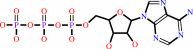 ATP
ATP
|
=
|
O-phospho-L-tyrosyl-[protein]
|
+
|
 ADP
ADP
|
+
|
H(+)
|
|
|
|
|
|
|
|
|
|
|
|
|
Molecule diagrams generated from .mol files obtained from the
KEGG ftp site
|
|
|
|
|
|
|
|
|
|
|
|
|
|
 |
|
|
|
|
|
|
| |
|
|
| |
|
DOI no:
|
J Biol Chem
283:29385-29395
(2008)
|
|
PubMed id:
|
|
|
|
|
|
| |
|
Spatial Structure and pH-dependent Conformational Diversity of Dimeric Transmembrane Domain of the Receptor Tyrosine Kinase EphA1.
|
|
E.V.Bocharov,
M.L.Mayzel,
P.E.Volynsky,
M.V.Goncharuk,
Y.S.Ermolyuk,
A.A.Schulga,
E.O.Artemenko,
R.G.Efremov,
A.S.Arseniev.
|
|
|
|
|
| |
ABSTRACT
|
|
|
|
| |
|
|
Eph receptors are found in a wide variety of cells in developing and mature
tissues and represent the largest family of receptor tyrosine kinases,
regulating cell shape, movements, and attachment. The receptor tyrosine kinases
conduct biochemical signals across plasma membrane via lateral dimerization in
which their transmembrane domains play an important role. Structural-dynamic
properties of the homodimeric transmembrane domain of the EphA1 receptor were
investigated with the aid of solution NMR in lipid bicelles and molecular
dynamics in explicit lipid bilayer. EphA1 transmembrane segments associate in a
right-handed parallel alpha-helical bundle, region (544-569)(2), through the
N-terminal glycine zipper motif A(550)X(3)G(554)X(3)G(558). Under acidic
conditions, the N terminus of the transmembrane helix is stabilized by an
N-capping box formed by the uncharged carboxyl group of Glu(547), whereas its
deprotonation results in a rearrangement of hydrogen bonds, fractional unfolding
of the helix, and a realignment of the helix-helix packing with appearance of
additional minor dimer conformation utilizing seemingly the C-terminal GG4-like
dimerization motif A(560)X(3)G(564). This can be interpreted as the ability of
the EphA1 receptor to adjust its response to ligand binding according to
extracellular pH. The dependence of the pK(a) value of Glu(547) and the dimer
conformational equilibrium on the lipid head charge suggests that both local
environment and membrane surface potential can modulate dimerization and
activation of the receptor. This makes the EphA1 receptor unique among the Eph
family, implying its possible physiological role as an "extracellular pH
sensor," and can have relevant physiological implications.
|
|
|
|
|
|
| |
Selected figure(s)
|
|
|
|
| |
|
|

|
|

|
|
Figure 4.
Helix packing perturbations in the EphA1tm dimer caused by
deprotonation of Glu^547 carboxyl group. A and B, ribbon
diagrams of the NMR-derived spatial structures of the EphA1tm
dimer before (A) and after (B) MD relaxation in explicit lipid
bilayer. The dimer structures (superimposed on one subunit)
obtained for EphA1tm embedded in the DMPC/DHPC bicelles at pH
4.3 and 6.3 are shown in light and dark gray, respectively. C
and D, the EphA1tm helix packing interface after MD relaxation
in explicit lipid bilayer. Hydrophobicity maps (on the left) for
EphA1tm helix surface with contour isolines encircling
hydrophobic regions with high values of molecular hydrophobicity
potential are covered by areas of dark points indicating the
N-terminal dimerization interface realized in the major
right-handed dimer conformation at pH 4.3 (C) and pH 6.3 (D). A
possible C-terminal dimerization interface implying a
left-handed crossing of the EphA1tm TM helices is highlighted by
dashed curved lines (D). The helix packing contact areas per
EphA1tm residue averaged over the equilibrium part (last 2 ns)
of restrained MD relaxation of the dimer structure are presented
at the right of the maps. The spreads of the contact area are
shown by bars. deg., degree.
|
|
Figure 5.
N-cap configurations of the EphA1tm helix depending on the
ionization state of Glu^547 carboxyl group. Possible transient
hydrogen bond connections in the N terminus of the TM helix
observed during MD relaxation of the NMR-derived structures of
the EphA1tm dimer embedded in the DMPC/DHPC bicelles at pH 4.3
(A) and 6.3 (B) are shown by dashed lines.
|
|
|
|
|
|
| |
The above figures are
reprinted
from an Open Access publication published by the ASBMB:
J Biol Chem
(2008,
283,
29385-29395)
copyright 2008.
|
|
| |
Figures were
selected
by an automated process.
|
|
|
|
|
|
|
|
|
|
|
|
|
|
|
|
 |
 |
 |
|
Literature references that cite this PDB file's key reference
|
|
|
| |
PubMed id
|
|
Reference
|
|
|
|
|
|
G.King,
J.Oates,
D.Patel,
H.A.van den Berg,
and
A.M.Dixon
(2011).
Towards a structural understanding of the smallest known oncoprotein: Investigation of the bovine papillomavirus E5 protein using solution-state NMR.
|
| |
Biochim Biophys Acta,
1808,
1493-1501.
|
|
|
|
|
|
|
T.A.Cross,
M.Sharma,
M.Yi,
and
H.X.Zhou
(2011).
Influence of solubilizing environments on membrane protein structures.
|
| |
Trends Biochem Sci,
36,
117-125.
|
|
|
|
|
|
|
E.Li,
and
K.Hristova
(2010).
Receptor tyrosine kinase transmembrane domains: Function, dimer structure and dimerization energetics.
|
| |
Cell Adh Migr,
4,
249-254.
|
|
|
|
|
|
|
E.Seiradake,
K.Harlos,
G.Sutton,
A.R.Aricescu,
and
E.Y.Jones
(2010).
An extracellular steric seeding mechanism for Eph-ephrin signaling platform assembly.
|
| |
Nat Struct Mol Biol,
17,
398-402.
|
|
|
PDB code:
|
|
|
|
|
|
|
|
E.V.Bocharov,
M.L.Mayzel,
P.E.Volynsky,
K.S.Mineev,
E.N.Tkach,
Y.S.Ermolyuk,
A.A.Schulga,
R.G.Efremov,
and
A.S.Arseniev
(2010).
Left-handed dimer of EphA2 transmembrane domain: Helix packing diversity among receptor tyrosine kinases.
|
| |
Biophys J,
98,
881-889.
|
|
|
PDB code:
|
|
|
|
|
|
|
|
E.V.Bocharov,
P.E.Volynsky,
K.V.Pavlov,
R.G.Efremov,
and
A.S.Arseniev
(2010).
Structure elucidation of dimeric transmembrane domains of bitopic proteins.
|
| |
Cell Adh Migr,
4,
284-298.
|
|
|
|
|
|
|
P.E.Volynsky,
E.A.Mineeva,
M.V.Goncharuk,
Y.S.Ermolyuk,
A.S.Arseniev,
and
R.G.Efremov
(2010).
Computer simulations and modeling-assisted ToxR screening in deciphering 3D structures of transmembrane alpha-helical dimers: ephrin receptor A1.
|
| |
Phys Biol,
7,
16014.
|
|
|
|
|
|
|
P.Hubert,
P.Sawma,
J.P.Duneau,
J.Khao,
J.Hénin,
D.Bagnard,
and
J.Sturgis
(2010).
Single-spanning transmembrane domains in cell growth and cell-cell interactions: More than meets the eye?
|
| |
Cell Adh Migr,
4,
313-324.
|
|
|
|
|
|
|
T.S.Ulmer
(2010).
Structural basis of transmembrane domain interactions in integrin signaling.
|
| |
Cell Adh Migr,
4,
243-248.
|
|
|
|
|
|
|
H.J.Kim,
S.C.Howell,
W.D.Van Horn,
Y.H.Jeon,
and
C.R.Sanders
(2009).
Recent Advances in the Application of Solution NMR Spectroscopy to Multi-Span Integral Membrane Proteins.
|
| |
Prog Nucl Magn Reson Spectrosc,
55,
335-360.
|
|
|
|
|
|
|
R.Soong,
M.Merzlyakov,
and
K.Hristova
(2009).
Hill coefficient analysis of transmembrane helix dimerization.
|
| |
J Membr Biol,
230,
49-55.
|
|
|
|
|
|
|
T.L.Lau,
C.Kim,
M.H.Ginsberg,
and
T.S.Ulmer
(2009).
The structure of the integrin alphaIIbbeta3 transmembrane complex explains integrin transmembrane signalling.
|
| |
EMBO J,
28,
1351-1361.
|
|
|
PDB code:
|
|
|
|
|
|
|
The most recent references are shown first.
Citation data come partly from CiteXplore and partly
from an automated harvesting procedure. Note that this is likely to be
only a partial list as not all journals are covered by
either method. However, we are continually building up the citation data
so more and more references will be included with time.
Where a reference describes a PDB structure, the PDB
code is
shown on the right.
|
|


 Links
Links


