 |
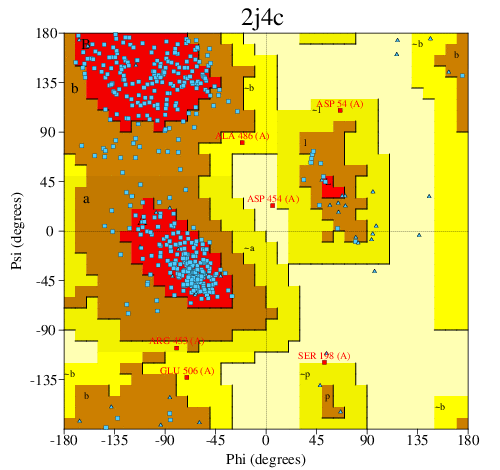
PDBsum entry 2j4c

|
|
|
|
|
 |
Contents |
 |
|
|
|
|
|
|
|
|
|
|
|
|
|
|
* Residue conservation analysis
|
|
|
|
|
|
PDB id:
|
|
|
|
| Name: |
|
Hydrolase
|
|
|
Title:
|
|
Structure of human butyrylcholinesterase in complex with 10mm hgcl2
|
|
Structure:
|
|
Cholinesterase. Chain: a. Synonym: acylcholine acylhydrolase, choline esterase ii, butyrylcholine esterase, pseudocholinesterase. Engineered: yes. Mutation: yes. Other_details: atypical bond between catalytic residue ser198 and ligand bty5 (butyrate)
|
|
Source:
|
|
Homo sapiens. Human. Organism_taxid: 9606. Expressed in: cricetulus griseus. Expression_system_taxid: 10029. Expression_system_cell_line: ovary cells
|
|
Resolution:
|
|
|
2.75Å
|
R-factor:
|
0.184
|
R-free:
|
0.231
|
|
|
Authors:
|
|
J.P.Colletier,M.F.Frasco,F.Carvalho,L.Guilhermino,J.Stojan, D.Fournier,M.Weik
|
|
Key ref:
|
|
M.F.Frasco
et al.
(2007).
Mechanisms of cholinesterase inhibition by inorganic mercury.
Febs J,
274,
1849-1861.
PubMed id:
|
|
|
Date:
|
|
|
28-Aug-06
|
Release date:
|
27-Mar-07
|
|
|
|
|
|
|
PROCHECK
|
|
|
|
|
|
Headers
|
|
|
|
References
|
|
|
|
|
|

|
|
P06276
(CHLE_HUMAN) -
Cholinesterase from Homo sapiens
|
|
|
|
Seq:
Struc:
|
|
|
|
602 a.a.
524 a.a.*
|
|

|

|
|
|
|
|
|
|
|
|
|
|
|
Key: |
 |
PfamA domain |
|
|
 |
Secondary structure |
|
 |
CATH domain |
|
|
*
PDB and UniProt seqs differ
at 4 residue positions (black
crosses)
|
|
|
|
|
|
|
|
|
|
|
|
|
Enzyme class:
|
|
E.C.3.1.1.8
- cholinesterase.
|
|
|
|
|
|
|
Reaction:
|
|
an acylcholine + H2O = a carboxylate + choline + H+
|
|
|
|
|
|
acylcholine
Bound ligand (Het Group name = )
matches with 46.67% similarity
|
+
|
H2O
|
=
|
carboxylate
Bound ligand (Het Group name = )
matches with 42.86% similarity
|
+
|
 choline
|
+
|
H(+)
|
|
|
|
|
|
|
|
|
|
|
|
|
Molecule diagrams generated from .mol files obtained from the
KEGG ftp site
|
|
|
|
|
|
|
|
|
|
|
|
|
|
 |
|
|
|
|
|
|
| |
|
|
| |
|
|
Febs J
274:1849-1861
(2007)
|
|
PubMed id:
|
|
|
|
|
|
| |
|
Mechanisms of cholinesterase inhibition by inorganic mercury.
|
|
M.F.Frasco,
J.P.Colletier,
M.Weik,
F.Carvalho,
L.Guilhermino,
J.Stojan,
D.Fournier.
|
|
|
|
|
| |
ABSTRACT
|
|
|
|
| |
|
|
The poorly known mechanism of inhibition of cholinesterases by inorganic mercury
(HgCl2) has been studied with a view to using these enzymes as biomarkers or as
biological components of biosensors to survey polluted areas. The inhibition of
a variety of cholinesterases by HgCl2 was investigated by kinetic studies, X-ray
crystallography, and dynamic light scattering. Our results show that when a free
sensitive sulfhydryl group is present in the enzyme, as in Torpedo californica
acetylcholinesterase, inhibition is irreversible and follows pseudo-first-order
kinetics that are completed within 1 h in the micromolar range. When the free
sulfhydryl group is not sensitive to mercury (Drosophila melanogaster
acetylcholinesterase and human butyrylcholinesterase) or is otherwise absent
(Electrophorus electricus acetylcholinesterase), then inhibition occurs in the
millimolar range. Inhibition follows a slow binding model, with successive
binding of two mercury ions to the enzyme surface. Binding of mercury ions has
several consequences: reversible inhibition, enzyme denaturation, and protein
aggregation, protecting the enzyme from denaturation. Mercury-induced
inactivation of cholinesterases is thus a rather complex process. Our results
indicate that among the various cholinesterases that we have studied, only
Torpedo californica acetylcholinesterase is suitable for mercury detection using
biosensors, and that a careful study of cholinesterase inhibition in a species
is a prerequisite before using it as a biomarker to survey mercury in the
environment.
|
|
|
|
|
|
|
|
|
|
|
|
|
|
|
|
|
|
 |
 |
 |
|
Literature references that cite this PDB file's key reference
|
|
|
| |
PubMed id
|
|
Reference
|
|
|
|
|
|
J.Valentini,
J.Vicentini,
D.Grotto,
R.Tonello,
S.C.Garcia,
and
F.Barbosa
(2010).
Sub-chronic exposure to methylmercury at low levels decreases butyrylcholinesterase activity in rats.
|
| |
Basic Clin Pharmacol Toxicol,
106,
95-99.
|
|
|
|
|
|
|
M.V.Yigit,
A.Mishra,
R.Tong,
J.Cheng,
G.C.Wong,
and
Y.Lu
(2009).
Inorganic mercury detection and controlled release of chelating agents from ion-responsive liposomes.
|
| |
Chem Biol,
16,
937-942.
|
|
|
|
|
|
The most recent references are shown first.
Citation data come partly from CiteXplore and partly
from an automated harvesting procedure. Note that this is likely to be
only a partial list as not all journals are covered by
either method. However, we are continually building up the citation data
so more and more references will be included with time.
|
|


 Links
Links


