 |
PDBsum entry 2j1h
 |
|
|
|
|
|
|
Enzyme class:
|
|
E.C.2.7.10.1
- receptor protein-tyrosine kinase.
|
|
|
|
|
|
|
Reaction:
|
|
L-tyrosyl-[protein] + ATP = O-phospho-L-tyrosyl-[protein] + ADP + H+
|
|
|
|
|
|
L-tyrosyl-[protein]
|
+
|
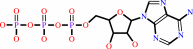 ATP
ATP
|
=
|
O-phospho-L-tyrosyl-[protein]
|
+
|
 ADP
ADP
|
+
|
H(+)
|
|
|
|
|
|
|
|
|
|
|
|
|
Molecule diagrams generated from .mol files obtained from the
KEGG ftp site
|
|
|
|
|
|
|
|
|
|
|
|
|
|
 |
|
|
|
|
|
|
| |
|
|
| |
|
DOI no:
|
J Mol Biol
361:945-953
(2006)
|
|
PubMed id:
|
|
|
|
|
|
| |
|
The transmembrane domain of the oncogenic mutant ErbB-2 receptor: a structure obtained from site-specific infrared dichroism and molecular dynamics.
|
|
A.J.Beevers,
A.Kukol.
|
|
|
|
|
| |
ABSTRACT
|
|
|
|
| |
|
|
ErbB-2 is a member of the family of epidermal growth factor receptors, which
shows an oncogenic mutation in the rat gene neu, Val664Glu in the transmembrane
domain that causes permanent dimerisation and subsequently leads to
uncontrollable cell division and tumour formation. We have obtained the
alpha-helical structure of the mutant transmembrane domain dimer experimentally
with site-specific infrared dichroism (SSID) based on six transmembrane peptides
with 13C18O carbonyl group-labelled residues. The derived orientational data
indicate a local helix tilt ranging from 28(+/-6) degrees to 22(+/-4) degrees.
Altogether using orientational constraints from SSID and experimental
alpha-helical constraints while performing a systematic conformational search
including molecular dynamics simulation in a lipid bilayer, we have obtained a
unique experimentally defined atomic structure. The resulting structure consists
of a right handed alpha-helical bundle with the residues Ile659, Val663, Leu667,
Ile671, Val674 and Leu679 in the dimerisation interface. The right-handed bundle
is in contrast to the left-handed structures obtained in previous modelling
efforts. In order to facilitate tight helical packing, the spacious Glu664
residues do not interact directly but with water molecules that enter the
bilayer.
|
|
|
|
|
|
| |
Selected figure(s)
|
|
|
|
| |
|
|

|
|

|
|
Figure 1.
Figure 1. Infrared spectra for each peptide containing a ^13C =
^18O label in the position indicated in the top left. The amide
I area is displayed, while the inset shows the magnified amide
I absorption band of the label. Figure 1. Infrared spectra
for each peptide containing a ^13C = ^18O label in the position
indicated in the top left. The amide I area is displayed, while
the inset shows the magnified amide I absorption band of the
label.
|
|
Figure 3.
Figure 3. Structure of the ErbB-2 transmembrane domain obtained
by SSID constrained MD simulations. (a) The structure in ribbon
representation with Glu residues displayed. (b) Space-fill
rendering of the structure, Glu is black and labelled residues
are dark grey. (c) A detailed view of the Glu interaction with
water molecules. (d) A view of the Glu residue packing from the
top of the helix. Figure 3. Structure of the ErbB-2
transmembrane domain obtained by SSID constrained MD
simulations. (a) The structure in ribbon representation with Glu
residues displayed. (b) Space-fill rendering of the structure,
Glu is black and labelled residues are dark grey. (c) A detailed
view of the Glu interaction with water molecules. (d) A view of
the Glu residue packing from the top of the helix. All Figures
were created with VMD.[3]^43
|
|
|
|
|
|
| |
The above figures are
reprinted
by permission from Elsevier:
J Mol Biol
(2006,
361,
945-953)
copyright 2006.
|
|
| |
Figures were
selected
by an automated process.
|
|
|
|
|
|
|
|
|
|
|
|
|
|
|
|
 |
 |
 |
|
Literature references that cite this PDB file's key reference
|
|
|
| |
PubMed id
|
|
Reference
|
|
|
|
|
|
E.V.Bocharov,
P.E.Volynsky,
K.V.Pavlov,
R.G.Efremov,
and
A.S.Arseniev
(2010).
Structure elucidation of dimeric transmembrane domains of bitopic proteins.
|
| |
Cell Adh Migr,
4,
284-298.
|
|
|
|
|
|
|
F.Cymer,
and
D.Schneider
(2010).
Transmembrane helix-helix interactions involved in ErbB receptor signaling.
|
| |
Cell Adh Migr,
4,
299-312.
|
|
|
|
|
|
|
E.V.Bocharov,
K.S.Mineev,
P.E.Volynsky,
Y.S.Ermolyuk,
E.N.Tkach,
A.G.Sobol,
V.V.Chupin,
M.P.Kirpichnikov,
R.G.Efremov,
and
A.S.Arseniev
(2008).
Spatial structure of the dimeric transmembrane domain of the growth factor receptor ErbB2 presumably corresponding to the receptor active state.
|
| |
J Biol Chem,
283,
6950-6956.
|
|
|
PDB code:
|
|
|
|
|
|
|
|
R.G.Hanshaw,
R.V.Stahelin,
and
B.D.Smith
(2008).
Noncovalent keystone interactions controlling biomembrane structure.
|
| |
Chemistry,
14,
1690-1697.
|
|
|
|
|
|
|
A.J.Beevers,
and
A.Kukol
(2007).
Phospholemman transmembrane structure reveals potential interactions with Na+/K+-ATPase.
|
| |
J Biol Chem,
282,
32742-32748.
|
|
|
PDB code:
|
|
|
|
|
|
|
The most recent references are shown first.
Citation data come partly from CiteXplore and partly
from an automated harvesting procedure. Note that this is likely to be
only a partial list as not all journals are covered by
either method. However, we are continually building up the citation data
so more and more references will be included with time.
Where a reference describes a PDB structure, the PDB
code is
shown on the right.
|
|


 Links
Links





