 |
PDBsum entry 2ipc

|
|
|
|
|
|

|

|

|

|
|

|
|

|
|

|
|

|
|

|
|
|
 |

|

|
|
|
|
|
|
|
|
|
|
|
|
|
|
|
|
|
|
|
|
|
|
|
|
|
|
|
|
|
|
|
|
|
|
Transport protein
|
PDB id
|
|
|
|
2ipc
|
|
|
|
|
|
|
|
|
|
|
|
|
|
|

|

|

|
|
|
|
|
|
|
|
 |
Contents |
 |
|
|
|
|
|
|
|
|
|
|
* Residue conservation analysis
|
|
|
|
|
|
PDB id:
|
|
|
|
| Name: |
|
Transport protein
|
|
|
Title:
|
|
Crystal structure of the translocation atpase seca from thermus thermophilus reveals a parallel, head-to-head dimer
|
|
Structure:
|
|
Preprotein translocase seca subunit. Chain: a, b, c, d. Engineered: yes
|
|
Source:
|
|
Thermus thermophilus. Organism_taxid: 300852. Strain: hb8. Gene: seca. Expressed in: escherichia coli. Expression_system_taxid: 562.
|
|
Resolution:
|
|
|
2.80Å
|
R-factor:
|
0.221
|
R-free:
|
0.255
|
|
|
Authors:
|
|
D.G.Vassylyev,H.Mori,M.N.Vassylyeva,T.Tsukazaki,Y.Kimura,T.H.Tahirov, K.Ito,Riken Structural Genomics/proteomics Initiative (Rsgi)
|
Key ref:

|
|
D.G.Vassylyev
et al.
(2006).
Crystal structure of the translocation ATPase SecA from Thermus thermophilus reveals a parallel, head-to-head dimer.
J Mol Biol,
364,
248-258.
PubMed id:
DOI:

|
|
|
Date:
|
|
|
12-Oct-06
|
Release date:
|
28-Nov-06
|
|
|
|
|
|
|
PROCHECK
|

|
|
|
|
|
Headers
|
|
|
|
References
|
|
|
|
|
|

|
|
Q5SIW3
(SECA_THET8) -
Protein translocase subunit SecA from Thermus thermophilus (strain ATCC 27634 / DSM 579 / HB8)
|
|
|
|
Seq:
Struc:
|
|
|
|
997 a.a.
939 a.a.
|
|

|

|

|
|
|
|
|
|
|
|
|
|
|
Key: |
 |
PfamA domain |
|
|
 |
Secondary structure |
|
|
|
|
|
|
|
|
|
|
|
|
|
Enzyme class:
|
|
E.C.7.4.2.8
- protein-secreting ATPase.
|
|
|
|
|
|
|
Reaction:
|
|
ATP + H2O + cellular proteinSide 1 = ADP + phosphate + cellular proteinSide 2
|
|
|
|
|
|
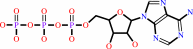 ATP
ATP
|
+
|
H2O
|
+
|
cellular proteinSide 1
|
=
|
 ADP
ADP
|
+
|
 phosphate
|
+
|
cellular proteinSide 2
|
|
|
|
|
|
|
|
|
|
|
|
|
Molecule diagrams generated from .mol files obtained from the
KEGG ftp site
|
|
|
|
|
|
|
|
|
|
|
|
|
|
 |
|
|
|
|
|
|
| |
|
|
| |
|
DOI no:
|
J Mol Biol
364:248-258
(2006)
|
|
PubMed id:
|
|
|
|
|
|
| |
|
Crystal structure of the translocation ATPase SecA from Thermus thermophilus reveals a parallel, head-to-head dimer.
|
|
D.G.Vassylyev,
H.Mori,
M.N.Vassylyeva,
T.Tsukazaki,
Y.Kimura,
T.H.Tahirov,
K.Ito.
|
|
|
|
|
| |
ABSTRACT
|
|
|
|
| |
|
|
The mechanism of pre-protein export through the bacterial cytoplasmic membrane,
in which the SecA ATPase plays a crucial role as an "energy supplier",
is poorly understood. In particular, biochemical and structural studies provide
contradictory data as to the oligomeric state of SecA when it is integrated into
the active trans-membrane translocase. Here, we report the 2.8 A resolution
crystal structure of the Thermus thermophilus SecA protein (TtSecA). Whereas the
structure of the TtSecA monomer closely resembles that from other bacteria, the
oligomeric state of TtSecA is strikingly distinct. In contrast to the
antiparallel (head-to-tail) dimerization reported previously for the other
bacterial systems, TtSecA forms parallel (head-to-head) dimers that are
reminiscent of open scissors. The dimer interface is abundant in bulky Arg and
Lys side-chains from both subunits, which stack on one another to form an
unusual "basic zipper" that is highly conserved, as revealed by
homology modeling and sequence analysis. The basic zipper is sealed on both ends
by two pairs of the salt bridges formed between the basic side-chains from the
zipper and two invariant acidic residues. The organization of the dimers, in
which the two pre-protein binding domains are located proximal to each other at
the tip of the "scissors", might allow a concerted mode of substrate
recognition while the opening/closing of the scissors might facilitate
translocation.
|
|
|
|
|
|
| |
Selected figure(s)
|
|
|
|
| |
|
|

|
|

|
|
Figure 1.
Figure 1. The TtSecA structure. (a) The ribbon diagram of
the parallel dimer. The two distinct views are shown. BH, the
bridge helix. (b) Superposition of the TtSecA and RNA polymerase
bridge helices.
|
|
Figure 4.
Figure 4. Implications for translocation. (a) The surface
representation of the TtSecA dimer (gray) showing the cavity
formed between the PPXD and C-terminal domains exposing a large
number of the hydrophobic residues (yellow) that might
constitute a putative pre-protein (red ellipse) binding site.
(b) Sequence alignment showing conservation of the hydrophobic
residues (yellow boxes) in the cavity.
|
|
|
|
|
|
| |
The above figures are
reprinted
by permission from Elsevier:
J Mol Biol
(2006,
364,
248-258)
copyright 2006.
|
|
| |
Figures were
selected
by the author.
|
|
|
|
|
|
|
|
|
|
|
|
|
|
|
|
 |
 |
 |
|
Literature references that cite this PDB file's key reference
|
|
|
| |
PubMed id
|
|
Reference
|
|
|
|
|
|
A.J.Wowor,
D.Yu,
D.A.Kendall,
and
J.L.Cole
(2011).
Energetics of SecA dimerization.
|
| |
J Mol Biol,
408,
87-98.
|
|
|
|
|
|
|
D.Huber,
N.Rajagopalan,
S.Preissler,
M.A.Rocco,
F.Merz,
G.Kramer,
and
B.Bukau
(2011).
SecA interacts with ribosomes in order to facilitate posttranslational translocation in bacteria.
|
| |
Mol Cell,
41,
343-353.
|
|
|
|
|
|
|
I.Kusters,
G.van den Bogaart,
A.Kedrov,
V.Krasnikov,
F.Fulyani,
B.Poolman,
and
A.J.Driessen
(2011).
Quaternary structure of SecA in solution and bound to SecYEG probed at the single molecule level.
|
| |
Structure,
19,
430-439.
|
|
|
|
|
|
|
S.M.Auclair,
J.P.Moses,
M.Musial-Siwek,
D.A.Kendall,
D.B.Oliver,
and
I.Mukerji
(2010).
Mapping of the signal peptide-binding domain of Escherichia coli SecA using Förster resonance energy transfer.
|
| |
Biochemistry,
49,
782-792.
|
|
|
|
|
|
|
C.Mao,
S.J.Hardy,
and
L.L.Randall
(2009).
Maximal efficiency of coupling between ATP hydrolysis and translocation of polypeptides mediated by SecB requires two protomers of SecA.
|
| |
J Bacteriol,
191,
978-984.
|
|
|
|
|
|
|
A.J.Driessen,
and
N.Nouwen
(2008).
Protein translocation across the bacterial cytoplasmic membrane.
|
| |
Annu Rev Biochem,
77,
643-667.
|
|
|
|
|
|
|
D.B.Cooper,
V.F.Smith,
J.M.Crane,
H.C.Roth,
A.A.Lilly,
and
L.L.Randall
(2008).
SecA, the motor of the secretion machine, binds diverse partners on one interactive surface.
|
| |
J Mol Biol,
382,
74-87.
|
|
|
|
|
|
|
E.M.Clérico,
J.L.Maki,
and
L.M.Gierasch
(2008).
Use of synthetic signal sequences to explore the protein export machinery.
|
| |
Biopolymers,
90,
307-319.
|
|
|
|
|
|
|
T.Tsukazaki,
H.Mori,
S.Fukai,
R.Ishitani,
T.Mori,
N.Dohmae,
A.Perederina,
Y.Sugita,
D.G.Vassylyev,
K.Ito,
and
O.Nureki
(2008).
Conformational transition of Sec machinery inferred from bacterial SecYE structures.
|
| |
Nature,
455,
988-991.
|
|
|
PDB codes:
|
|
|
|
|
|
|
|
Y.Chen,
X.Pan,
Y.Tang,
S.Quan,
P.C.Tai,
and
S.F.Sui
(2008).
Full-length Escherichia coli SecA dimerizes in a closed conformation in solution as determined by cryo-electron microscopy.
|
| |
J Biol Chem,
283,
28783-28787.
|
|
|
|
|
|
|
A.R.Osborne,
and
T.A.Rapoport
(2007).
Protein translocation is mediated by oligomers of the SecY complex with one SecY copy forming the channel.
|
| |
Cell,
129,
97.
|
|
|
|
|
|
|
E.Or,
and
T.Rapoport
(2007).
Cross-linked SecA dimers are not functional in protein translocation.
|
| |
FEBS Lett,
581,
2616-2620.
|
|
|
|
|
|
|
E.Papanikou,
S.Karamanou,
and
A.Economou
(2007).
Bacterial protein secretion through the translocase nanomachine.
|
| |
Nat Rev Microbiol,
5,
839-851.
|
|
|
|
|
|
|
I.Gelis,
A.M.Bonvin,
D.Keramisanou,
M.Koukaki,
G.Gouridis,
S.Karamanou,
A.Economou,
and
C.G.Kalodimos
(2007).
Structural basis for signal-sequence recognition by the translocase motor SecA as determined by NMR.
|
| |
Cell,
131,
756-769.
|
|
|
PDB code:
|
|
|
|
|
|
|
|
M.Alami,
K.Dalal,
B.Lelj-Garolla,
S.G.Sligar,
and
F.Duong
(2007).
Nanodiscs unravel the interaction between the SecYEG channel and its cytosolic partner SecA.
|
| |
EMBO J,
26,
1995-2004.
|
|
|
|
|
|
|
V.A.Gold,
A.Robson,
A.R.Clarke,
and
I.Collinson
(2007).
Allosteric regulation of SecA: magnesium-mediated control of conformation and activity.
|
| |
J Biol Chem,
282,
17424-17432.
|
|
|
|
|
|
The most recent references are shown first.
Citation data come partly from CiteXplore and partly
from an automated harvesting procedure. Note that this is likely to be
only a partial list as not all journals are covered by
either method. However, we are continually building up the citation data
so more and more references will be included with time.
Where a reference describes a PDB structure, the PDB
codes are
shown on the right.
|
|


 Links
Links


