 |
PDBsum entry 2frd

|
|
|
|
|
|

|

|

|

|
|

|
|

|
|

|
|

|
|

|
|

|
|
|
 |

|

|
|
|
|
|
|
|
|
|
|
|
|
|
|
|
|
|
|
|
|
|
|
|
|
|
|
|
|
|
|
|
|
|
|
|
Oxidoreductase
|
PDB id
|
|
|
|
2frd
|
|
|
|
|
|
|
|
|
|
|
|
|
|
|

|

|

|
|
|
|
|
|
|
|
 |
Contents |
 |
|
|
|
|
|
|
|
|
|
|
|
|
* Residue conservation analysis
|
|
|
|
|
|
PDB id:
|
|
|
|
| Name: |
|
Oxidoreductase
|
|
|
Title:
|
|
Structure of transhydrogenase (di.S138a.Nadh)2(diii.NADPH)1 asymmetric complex
|
|
Structure:
|
|
NAD(p) transhydrogenase subunit alpha part 1. Chain: a, b. Synonym: pyridine nucleotide transhydrogenase subunit alpha 1, nicotinamide nucleotide transhydrogenase subunit alpha 1, proton- translocating transhydrogenase component 1, di. Engineered: yes. Mutation: yes. NAD(p) transhydrogenase subunit beta. Chain: c.
|
|
Source:
|
|
Rhodospirillum rubrum. Organism_taxid: 1085. Gene: pntaa, nnta1. Expressed in: escherichia coli. Expression_system_taxid: 562. Gene: pntb, nntb. Expressed in: escherichia coli bl21(de3). Expression_system_taxid: 469008.
|
|
Biol. unit:
|
|
Trimer (from
)
|
|
Resolution:
|
|
|
3.20Å
|
R-factor:
|
0.219
|
R-free:
|
0.272
|
|
|
Authors:
|
|
T.H.Brondijk,G.I.Van Boxel,O.C.Mather,P.G.Quirk,S.A.White,J.B.Jackson
|
Key ref:

|
|
T.H.Brondijk
et al.
(2006).
The role of invariant amino acid residues at the hydride transfer site of proton-translocating transhydrogenase.
J Biol Chem,
281,
13345-13354.
PubMed id:
DOI:

|
|
|
Date:
|
|
|
19-Jan-06
|
Release date:
|
28-Feb-06
|
|
|
|
|
|
|
PROCHECK
|

|
|
|
|
|
Headers
|
|
|
|
References
|
|
|
|
|
|
|
|
|
|
|
|
Enzyme class:
|
|
Chains A, B, C:
E.C.7.1.1.1
- proton-translocating NAD(P)(+) transhydrogenase.
|
|
|
|
|
|
|
Reaction:
|
|
NAD+ + NADPH + H+(in) = NADH + NADP+ + H+(out)
|
|
|
|
|
|
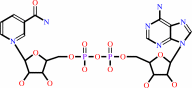 NAD(+)
|
+
|
NADPH
Bound ligand (Het Group name = )
corresponds exactly
|
+
|
H(+)(in)
Bound ligand (Het Group name = )
corresponds exactly
|
=
|
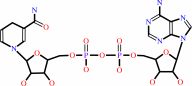 NADH
NADH
|
+
|
 NADP(+)
|
+
|
H(+)(out)
|
|
|
|
|
|
|
|
|
|
|
|
|
Molecule diagrams generated from .mol files obtained from the
KEGG ftp site
|
|
|
|
|
|
|
|
|
|
|
|
|
|
 |
|
|
|
|
|
|
| |
|
|
| |
|
DOI no:
|
J Biol Chem
281:13345-13354
(2006)
|
|
PubMed id:
|
|
|
|
|
|
| |
|
The role of invariant amino acid residues at the hydride transfer site of proton-translocating transhydrogenase.
|
|
T.H.Brondijk,
G.I.van Boxel,
O.C.Mather,
P.G.Quirk,
S.A.White,
J.B.Jackson.
|
|
|
|
|
| |
ABSTRACT
|
|
|
|
| |
|
|
Transhydrogenase couples proton translocation across a membrane to hydride
transfer between NADH and NADP+. Previous x-ray structures of complexes of the
nucleotide-binding components of transhydrogenase ("dI2dIII1"
complexes) indicate that the dihydronicotinamide ring of NADH can move from a
distal position relative to the nicotinamide ring of NADP+ to a proximal
position. The movement might be responsible for gating hydride transfer during
proton translocation. We have mutated three invariant amino acids, Arg-127,
Asp-135, and Ser-138, in the NAD(H)-binding site of Rhodospirillum rubrum
transhydrogenase. In each mutant, turnover by the intact enzyme is strongly
inhibited. Stopped-flow experiments using dI2dIII1 complexes show that
inhibition results from a block in the steps associated with hydride transfer.
Mutation of Asp-135 and Ser-138 had no effect on the binding affinity of either
NAD+ or NADH, but mutation of Arg-127 led to much weaker binding of NADH and
slightly weaker binding of NAD+. X-ray structures of dI2dIII1 complexes carrying
the mutations showed that their effects were restricted to the locality of the
bound NAD(H). The results are consistent with the suggestion that in wild-type
protein movement of the Arg-127 side chain, and its hydrogen bonding to Asp-135
and Ser-138, stabilizes the dihydronicotinamide of NADH in the proximal position
for hydride transfer.
|
|
|
|
|
|
| |
Selected figure(s)
|
|
|
|
| |
|
|

|
|

|
|
Figure 1.
FIGURE 1. The component structure of transhydrogenase. The
gray shaded regions represent the dI[2]dIII[1] complex. The two
dI polypeptides each comprise two domains, dI.1 (residues 1-137
and 328-384 in R. rubrum) and dI.2 (residues 138-327), which are
separated by a deep cleft. The dIII component comprises a single
domain. The dI polypeptide in the complex whose cleft is not
associated with dIII is designated dI(A), and the dI polypeptide
which is closely associated with dIII is designated dI(B). The
predicted organization of transhydrogenase components that are
absent in the dI[2]dIII[1] complex is shown by the dotted lines.
The dashed arrows depict "forward" transhydrogenation and the
thick solid arrows, the corresponding direction of proton
translocation.
|
|
Figure 6.
FIGURE 6. Detail of the hydride transfer site of wild-type
dI[2]dIII[1] complex and (dI.S138A). Atoms are shown in standard
colors except C-4(N) atoms of the nicotinamide rings which are
shown in pale yellow. A, detail from the dI(A) polypeptide of
wild-type dI[2]dIII[1] complex (PDB, 1U2D (20)). The
dihydronicotinamide ring of the bound NADH is in the distal
position. B, detail from the interface of the dI(B) polypeptide
and the dIII polypeptide of 1U2D. The dihydronicotinamide ring
of the bound NADH is in the proximal position relative to the
NADPH in dIII. C, detail from the interface of the dI(B)
polypeptide and the dIII polypeptide of (dI.S138A)[2]dIII[1]
complex (2FRD). The 2F[o]-F[c] electron density is contoured at
0.75  . Density for the
dihydronicotinamide ring of the bound NADH is weak but indicates
a distal position, as shown by the nucleotide in standard atom
colors (but yellow for C-4(N)). For comparison, the nucleotide
in cyan is in a proximal position; it is taken from the dI(B)
polypeptide of 1U2D and superimposed at the adenine ring. The
views in A-C are selected such that . Density for the
dihydronicotinamide ring of the bound NADH is weak but indicates
a distal position, as shown by the nucleotide in standard atom
colors (but yellow for C-4(N)). For comparison, the nucleotide
in cyan is in a proximal position; it is taken from the dI(B)
polypeptide of 1U2D and superimposed at the adenine ring. The
views in A-C are selected such that  -sheet positions of the
dI.2 domains superimpose and are shown with the adenine rings of
the NADH in an alignment (black dashed line). The green dotted
lines represent H-bonds. The polypeptide chain of dIII in (B and
C) is not shown. -sheet positions of the
dI.2 domains superimpose and are shown with the adenine rings of
the NADH in an alignment (black dashed line). The green dotted
lines represent H-bonds. The polypeptide chain of dIII in (B and
C) is not shown.
|
|
|
|
|
|
| |
The above figures are
reprinted
by permission from the ASBMB:
J Biol Chem
(2006,
281,
13345-13354)
copyright 2006.
|
|
| |
Figures were
selected
by an automated process.
|
|
|
|
|
|
|
|
|
|
|
|
|
|
|
|
 |
 |
 |
|
Literature references that cite this PDB file's key reference
|
|
|
| |
PubMed id
|
|
Reference
|
|
|
|
|
|
A.Pedersen,
G.B.Karlsson,
and
J.Rydström
(2008).
Proton-translocating transhydrogenase: an update of unsolved and controversial issues.
|
| |
J Bioenerg Biomembr,
40,
463-473.
|
|
|
|
|
|
|
O.Okhrimenko,
and
I.Jelesarov
(2008).
A survey of the year 2006 literature on applications of isothermal titration calorimetry.
|
| |
J Mol Recognit,
21,
1.
|
|
|
|
|
|
The most recent references are shown first.
Citation data come partly from CiteXplore and partly
from an automated harvesting procedure. Note that this is likely to be
only a partial list as not all journals are covered by
either method. However, we are continually building up the citation data
so more and more references will be included with time.
|
|
|


 Links
Links


