 |
PDBsum entry 2ez2

|
|
|
|
|
 |
Contents |
 |
|
|
|
|
|
|
|
|
|
|
|
|
|
|
* Residue conservation analysis
|
|
|
|
|
|
|
|
|
|
|
Enzyme class:
|
|
E.C.4.1.99.2
- tyrosine phenol-lyase.
|
|
|
|
|
|
|
Reaction:
|
|
L-tyrosine + H2O = phenol + pyruvate + NH4+
|
|
|
|
|
|
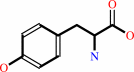 L-tyrosine
|
+
|
H2O
|
=
|
 phenol
|
+
|
 pyruvate
|
+
|
NH4(+)
|
|
|
|
|
|
|
|
|
|
Cofactor:
|
|
Pyridoxal 5'-phosphate
|
|
|
|
|
|
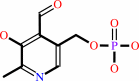 Pyridoxal 5'-phosphate
|
|
|
|
|
|
|
Molecule diagrams generated from .mol files obtained from the
KEGG ftp site
|
|
|
|
|
|
|
|
|
|
|
|
|
|
 |
|
|
|
|
|
|
| |
|
|
| |
|
DOI no:
|
Biochemistry
45:7544-7552
(2006)
|
|
PubMed id:
|
|
|
|
|
|
| |
|
Structures of apo- and holo-tyrosine phenol-lyase reveal a catalytically critical closed conformation and suggest a mechanism for activation by K+ ions.
|
|
D.Milić,
D.Matković-Calogović,
T.V.Demidkina,
V.V.Kulikova,
N.I.Sinitzina,
A.A.Antson.
|
|
|
|
|
| |
ABSTRACT
|
|
|
|
| |
|
|
Tyrosine phenol-lyase, a tetrameric pyridoxal 5'-phosphate dependent enzyme,
catalyzes the reversible hydrolytic cleavage of L-tyrosine to phenol and
ammonium pyruvate. Here we describe the crystal structure of the Citrobacter
freundii holoenzyme at 1.9 A resolution. The structure reveals a network of
protein interactions with the cofactor, pyridoxal 5'-phosphate, and details of
coordination of the catalytically important K+ ion. We also present the
structure of the apoenzyme at 1.85 A resolution. Both structures were determined
using crystals grown at pH 8.0, which is close to the pH of the maximal
enzymatic activity (8.2). Comparison of the apoenzyme structure with the one
previously determined at pH 6.0 reveals significant differences. The data
suggest that the decrease of the enzymatic activity at pH 6.0 may be caused by
conformational changes in the active site residues Tyr71, Tyr291, and Arg381 and
in the monovalent cation binding residue Glu69. Moreover, at pH 8.0 we observe
two different active site conformations: open, which was characterized before,
and closed, which is observed for the first time in beta-eliminating lyases. In
the closed conformation a significant part of the small domain undergoes an
extraordinary motion of up to 12 A toward the large domain, closing the active
site cleft and bringing the catalytically important Arg381 and Phe448 into the
active site. The closed conformation allows rationalization of the results of
previous mutational studies and suggests that the observed active site closure
is critical for the course of the enzymatic reaction and for the enzyme's
specificity toward its physiological substrate. Finally, the closed conformation
allows us to model keto(imino)quinonoid, the key transition intermediate.
|
|
|
|
|
|
|
|
|
|
|
|
|
|
|
|
|
|
 |
 |
 |
|
Literature references that cite this PDB file's key reference
|
|
|
| |
PubMed id
|
|
Reference
|
|
|
|
|
|
K.Nishio,
K.Ogasahara,
Y.Morimoto,
T.Tsukihara,
S.J.Lee,
and
K.Yutani
(2010).
Large conformational changes in the Escherichia coli tryptophan synthase beta(2) subunit upon pyridoxal 5'-phosphate binding.
|
| |
FEBS J,
277,
2157-2170.
|
|
|
PDB codes:
|
|
|
|
|
|
|
|
E.Rha,
S.Kim,
S.L.Choi,
S.P.Hong,
M.H.Sung,
J.J.Song,
and
S.G.Lee
(2009).
Simultaneous improvement of catalytic activity and thermal stability of tyrosine phenol-lyase by directed evolution.
|
| |
FEBS J,
276,
6187-6194.
|
|
|
|
|
|
|
D.Milić,
T.V.Demidkina,
N.G.Faleev,
D.Matković-Calogović,
and
A.A.Antson
(2008).
Insights into the catalytic mechanism of tyrosine phenol-lyase from X-ray structures of quinonoid intermediates.
|
| |
J Biol Chem,
283,
29206-29214.
|
|
|
PDB codes:
|
|
|
|
|
|
|
|
N.Tsesin,
A.Kogan,
G.Y.Gdalevsky,
J.P.Himanen,
R.Cohen-Luria,
A.H.Parola,
Y.Goldgur,
and
O.Almog
(2007).
The structure of apo tryptophanase from Escherichia coli reveals a wide-open conformation.
|
| |
Acta Crystallogr D Biol Crystallogr,
63,
969-974.
|
|
|
PDB code:
|
|
|
|
|
|
|
The most recent references are shown first.
Citation data come partly from CiteXplore and partly
from an automated harvesting procedure. Note that this is likely to be
only a partial list as not all journals are covered by
either method. However, we are continually building up the citation data
so more and more references will be included with time.
Where a reference describes a PDB structure, the PDB
codes are
shown on the right.
|
|


 Links
Links


