 |
PDBsum entry 2c7q

|
|
|
|
|
|

|

|

|

|
|

|
|

|
|

|
|

|
|

|
|
|
 |

|

|
|
|
|
|
|
|
|
|
|
|
|
|
|
|
|
|
|
|
|
|
|
|
|
|
|
|
|
|
|
|
|
|
|
Transferase/DNA
|
PDB id
|
|
|
|
2c7q
|
|
|
|
|
|
|
|
|
|
|
|
|
|
|

|

|

|
|
|
|
|
|
|
|
 |
Contents |
 |
|
|
|
|
|
|
|
|
|
|
|
|
|
|
* Residue conservation analysis
|
|
|
|
|
|
|
|
|
|
|
Enzyme class:
|
|
E.C.2.1.1.37
- Dna (cytosine-5-)-methyltransferase.
|
|
|
|
|
|
|
Reaction:
|
|
a 2'-deoxycytidine in DNA + S-adenosyl-L-methionine = a 5-methyl- 2'-deoxycytidine in DNA + S-adenosyl-L-homocysteine + H+
|
|
|
|
|
|
2'-deoxycytidine in DNA
|
+
|
 S-adenosyl-L-methionine
|
=
|
5-methyl- 2'-deoxycytidine in DNA
|
+
|
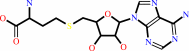 S-adenosyl-L-homocysteine
|
+
|
H(+)
Bound ligand (Het Group name = )
corresponds exactly
|
|
|
|
|
|
|
|
|
|
|
|
|
Molecule diagrams generated from .mol files obtained from the
KEGG ftp site
|
|
|
|
|
|
|
|
|
|
|
|
|
|
 |
|
|
|
|
|
|
| |
|
|
| |
|
|
Nucleic Acids Res
33:6953-6960
(2005)
|
|
PubMed id:
|
|
|
|
|
|
| |
|
Time-resolved fluorescence of 2-aminopurine as a probe of base flipping in M.HhaI-DNA complexes.
|
|
R.K.Neely,
D.Daujotyte,
S.Grazulis,
S.W.Magennis,
D.T.Dryden,
S.Klimasauskas,
A.C.Jones.
|
|
|
|
|
| |
ABSTRACT
|
|
|
|
| |
|
|
DNA base flipping is an important mechanism in molecular enzymology, but its
study is limited by the lack of an accessible and reliable diagnostic technique.
A series of crystalline complexes of a DNA methyltransferase, M.HhaI, and its
cognate DNA, in which a fluorescent nucleobase analogue, 2-aminopurine (AP),
occupies defined positions with respect the target flipped base, have been
prepared and their structures determined at higher than 2 A resolution. From
time-resolved fluorescence measurements of these single crystals, we have
established that the fluorescence decay function of AP shows a pronounced,
characteristic response to base flipping: the loss of the very short
(approximately 100 ps) decay component and the large increase in the amplitude
of the long (approximately 10 ns) component. When AP is positioned at sites
other than the target site, this response is not seen. Most significantly, we
have shown that the same clear response is apparent when M.HhaI complexes with
DNA in solution, giving an unambiguous signal of base flipping. Analysis of the
AP fluorescence decay function reveals conformational heterogeneity in the
DNA-enzyme complexes that cannot be discerned from the present X-ray structures.
|
|
|
|
|
|
| |
Selected figure(s)
|
|
|
|
| |
|
|

|
|

|
|
Figure 2.
Detailed view of the H-bond interactions between the M.HhaI enzyme and the
APtarget duplex. DNA and protein residues are shown as sticks, a bound solvent molecule
(presumed water) is shown as a red ball.
|
|
Figure 3.
Interaction of M.HhaI with duplexes where AP is opposite or adjacent to the
target base. (a) The sequences of the 10 bp at the centre of the APadj duplex (left) and
APopp duplex (right). Bases in the M.HhaI recognition sequence are shown in
boldface/italic; the target base is circled; AP is denoted P and is in red; M is 5-methyl
cytosine (used to direct enzyme binding to the opposite strand of the duplex). (b) Crystal
structures of the complexes of the M.HhaI enzyme with the APadj duplex (left) and the
APopp duplex (right), showing the molecular structure in the vicinity of the recognition
sequence. (c) Detailed view of the H-bond interactions between the M.HhaI enzyme and the
APadj duplex (left) and the APopp duplex (right).
|
|
|
|
| |
Figures were
selected
by an automated process.
|
|
|
|
|
|
|
|
|
|
|
|
|
|
|
|
 |
 |
 |
|
Literature references that cite this PDB file's key reference
|
|
|
| |
PubMed id
|
|
Reference
|
|
|
|
|
|
A.C.Fogarty,
A.C.Jones,
and
P.J.Camp
(2011).
Extraction of lifetime distributions from fluorescence decays with application to DNA-base analogues.
|
| |
Phys Chem Chem Phys,
13,
3819-3830.
|
|
|
|
|
|
|
U.K.Madhusoodanan,
and
D.N.Rao
(2010).
Diversity of DNA methyltransferases that recognize asymmetric target sequences.
|
| |
Crit Rev Biochem Mol Biol,
45,
125-145.
|
|
|
|
|
|
|
C.J.Campbell,
C.P.Mountford,
H.C.Stoquert,
A.H.Buck,
P.Dickinson,
E.Ferapontova,
J.G.Terry,
J.S.Beattie,
A.J.Walton,
J.Crain,
P.Ghazal,
and
A.R.Mount
(2009).
A DNA nanoswitch incorporating the fluorescent base analogue 2-aminopurine detects single nucleotide mismatches in unlabelled targets.
|
| |
Analyst,
134,
1873-1879.
|
|
|
|
|
|
|
D.U.Li,
R.Walker,
J.Richardson,
B.Rae,
A.Buts,
D.Renshaw,
and
R.Henderson
(2009).
Hardware implementation and calibration of background noise for an integration-based fluorescence lifetime sensing algorithm.
|
| |
J Opt Soc Am A Opt Image Sci Vis,
26,
804-814.
|
|
|
|
|
|
|
J.A.Means,
C.M.Simson,
S.Zhou,
A.A.Rachford,
J.J.Rack,
and
J.V.Hines
(2009).
Fluorescence probing of T box antiterminator RNA: insights into riboswitch discernment of the tRNA discriminator base.
|
| |
Biochem Biophys Res Commun,
389,
616-621.
|
|
|
|
|
|
|
R.K.Neely,
G.Tamulaitis,
K.Chen,
M.Kubala,
V.Siksnys,
and
A.C.Jones
(2009).
Time-resolved fluorescence studies of nucleotide flipping by restriction enzymes.
|
| |
Nucleic Acids Res,
37,
6859-6870.
|
|
|
|
|
|
|
B.Youngblood,
E.Bonnist,
D.T.Dryden,
A.C.Jones,
and
N.O.Reich
(2008).
Differential stabilization of reaction intermediates: specificity checkpoints for M.EcoRI revealed by transient fluorescence and fluorescence lifetime studies.
|
| |
Nucleic Acids Res,
36,
2917-2925.
|
|
|
|
|
|
|
D.Daujotyte,
Z.Liutkeviciūte,
G.Tamulaitis,
and
S.Klimasauskas
(2008).
Chemical mapping of cytosines enzymatically flipped out of the DNA helix.
|
| |
Nucleic Acids Res,
36,
e57.
|
|
|
|
|
|
|
E.Y.Bonnist,
and
A.C.Jones
(2008).
Long-wavelength fluorescence from 2-aminopurine-nucleobase dimers in DNA.
|
| |
Chemphyschem,
9,
1121-1129.
|
|
|
|
|
|
|
J.L.Lorieau,
L.A.Day,
and
A.E.McDermott
(2008).
Conformational dynamics of an intact virus: order parameters for the coat protein of Pf1 bacteriophage.
|
| |
Proc Natl Acad Sci U S A,
105,
10366-10371.
|
|
|
|
|
|
|
P.Sandin,
K.Börjesson,
H.Li,
J.Mårtensson,
T.Brown,
L.M.Wilhelmsson,
and
B.Albinsson
(2008).
Characterization and use of an unprecedentedly bright and structurally non-perturbing fluorescent DNA base analogue.
|
| |
Nucleic Acids Res,
36,
157-167.
|
|
|
|
|
|
|
B.Bouvier,
and
H.Grubmüller
(2007).
A molecular dynamics study of slow base flipping in DNA using conformational flooding.
|
| |
Biophys J,
93,
770-786.
|
|
|
|
|
|
|
G.Tamulaitis,
M.Zaremba,
R.H.Szczepanowski,
M.Bochtler,
and
V.Siksnys
(2007).
Nucleotide flipping by restriction enzymes analyzed by 2-aminopurine steady-state fluorescence.
|
| |
Nucleic Acids Res,
35,
4792-4799.
|
|
|
|
|
|
|
J.D.Ballin,
S.Bharill,
E.J.Fialcowitz-White,
I.Gryczynski,
Z.Gryczynski,
and
G.M.Wilson
(2007).
Site-specific variations in RNA folding thermodynamics visualized by 2-aminopurine fluorescence.
|
| |
Biochemistry,
46,
13948-13960.
|
|
|
|
|
|
|
R.K.Neely,
S.W.Magennis,
S.Parsons,
and
A.C.Jones
(2007).
Photophysics and X-ray structure of crystalline 2-aminopurine.
|
| |
Chemphyschem,
8,
1095-1102.
|
|
|
|
|
|
|
S.R.Bellamy,
K.Krusong,
and
G.S.Baldwin
(2007).
A rapid reaction analysis of uracil DNA glycosylase indicates an active mechanism of base flipping.
|
| |
Nucleic Acids Res,
35,
1478-1487.
|
|
|
|
|
|
|
M.Bochtler,
R.H.Szczepanowski,
G.Tamulaitis,
S.Grazulis,
H.Czapinska,
E.Manakova,
and
V.Siksnys
(2006).
Nucleotide flips determine the specificity of the Ecl18kI restriction endonuclease.
|
| |
EMBO J,
25,
2219-2229.
|
|
|
PDB codes:
|
|
|
|
|
|
|
|
R.K.Walker,
A.K.McCullough,
and
R.S.Lloyd
(2006).
Uncoupling of nucleotide flipping and DNA bending by the t4 pyrimidine dimer DNA glycosylase.
|
| |
Biochemistry,
45,
14192-14200.
|
|
|
|
|
|
The most recent references are shown first.
Citation data come partly from CiteXplore and partly
from an automated harvesting procedure. Note that this is likely to be
only a partial list as not all journals are covered by
either method. However, we are continually building up the citation data
so more and more references will be included with time.
Where a reference describes a PDB structure, the PDB
codes are
shown on the right.
|
|


 Links
Links


