 |
PDBsum entry 2c3y

|
|
|
|
|
|

|

|

|

|
|

|
|

|
|

|
|

|
|

|
|

|
|

|
|
|
 |

|

|
|
|
|
|
|
|
|
|
|
|
|
|
|
|
|
|
|
|
|
|
|
|
|
|
|
|
|
|
|
|
|
|
|
|
|
Oxidoreductase
|
PDB id
|
|
|
|
2c3y
|
|
|
|
|
|
|
|
|
|
|
|
|
|
|

|

|

|
|
|
|
|
|
|
|
 |
Contents |
 |
|
|
|
|
|
|
|
|
|
|
|
|
|
|
* Residue conservation analysis
|
|
|
|
|
|
PDB id:
|
|
|
|
| Name: |
|
Oxidoreductase
|
|
|
Title:
|
|
Crystal structure of the radical form of pyruvate:ferredoxin oxidoreductase from desulfovibrio africanus
|
|
Structure:
|
|
Pyruvate-ferredoxin oxidoreductase. Chain: a, b. Other_details: complexed with iron/sulfur cluster, thiamin diphosphate, crystal soaked overnight with pyruvate
|
|
Source:
|
|
Desulfovibrio africanus. Organism_taxid: 873
|
|
Biol. unit:
|
|
Dimer (from PDB file)
|
|
Resolution:
|
|
|
1.93Å
|
R-factor:
|
0.186
|
R-free:
|
0.228
|
|
|
Authors:
|
|
C.Cavazza,C.Contreras-Martel,L.Pieulle,E.Chabriere,E.C.Hatchikian, J.C.Fontecilla-Camps
|
Key ref:

|
|
C.Cavazza
et al.
(2006).
Flexibility of thiamine diphosphate revealed by kinetic crystallographic studies of the reaction of pyruvate-ferredoxin oxidoreductase with pyruvate.
Structure,
14,
217-224.
PubMed id:
DOI:

|
|
|
Date:
|
|
|
13-Oct-05
|
Release date:
|
15-Feb-06
|
|
|
|
|
|
|
PROCHECK
|

|
|
|
|
|
Headers
|
|
|
|
References
|
|
|
|
|
|

|
|
P94692
(PFOR_DESAF) -
Pyruvate:ferredoxin oxidoreductase from Desulfocurvibacter africanus
|
|
|
|
Seq:
Struc:
|
|
|
|
1232 a.a.
1231 a.a.
|
|

|

|
|
|
|
|
|
|
|
|
|
|
|
Key: |
 |
PfamA domain |
|
|
 |
Secondary structure |
|
 |
CATH domain |
|
|
|
|
|
|
|
|
|
|
|
|
|
Enzyme class:
|
|
E.C.1.2.7.1
- pyruvate synthase.
|
|
|
|
|
|
|
Reaction:
|
|
2 oxidized [2Fe-2S]-[ferredoxin] + pyruvate + CoA = 2 reduced [2Fe-2S]- [ferredoxin] + acetyl-CoA + CO2 + H+
|
|
|
|
|
|
2
×
oxidized [2Fe-2S]-[ferredoxin]
|
+
|
 pyruvate
|
+
|
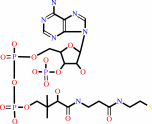 CoA
CoA
|
=
|
2
×
reduced [2Fe-2S]- [ferredoxin]
|
+
|
acetyl-CoA
Bound ligand (Het Group name = )
corresponds exactly
|
+
|
 CO2
CO2
|
+
|
H(+)
|
|
|
|
|
|
|
|
|
|
Cofactor:
|
|
Iron-sulfur; Thiamine diphosphate
|
|
|
|
|
|
 Iron-sulfur
|
Thiamine diphosphate
Bound ligand (Het Group name =
HTL)
matches with 89.66% similarity
|
|
|
|
|
|
|
Molecule diagrams generated from .mol files obtained from the
KEGG ftp site
|
|
|
|
|
|
|
|
|
|
|
|
|
|
 |
|
|
|
|
|
|
| |
|
|
| |
|
DOI no:
|
Structure
14:217-224
(2006)
|
|
PubMed id:
|
|
|
|
|
|
| |
|
Flexibility of thiamine diphosphate revealed by kinetic crystallographic studies of the reaction of pyruvate-ferredoxin oxidoreductase with pyruvate.
|
|
C.Cavazza,
C.Contreras-Martel,
L.Pieulle,
E.Chabrière,
E.C.Hatchikian,
J.C.Fontecilla-Camps.
|
|
|
|
|
| |
ABSTRACT
|
|
|
|
| |
|
|
Pyruvate-ferredoxin oxidoreductases (PFOR) are unique among thiamine
pyrophosphate (ThDP)-containing enzymes in giving rise to a rather stable
cofactor-based free-radical species upon the decarboxylation of their first
substrate, pyruvate. We have obtained snapshots of unreacted and partially
reacted (probably as a tetrahedral intermediate) pyruvate-PFOR complexes at
different time intervals. We conclude that pyruvate decarboxylation involves
very limited substrate-to-product movements but a significant displacement of
the thiazolium moiety of ThDP. In this respect, PFOR seems to differ
substantially from other ThDP-containing enzymes, such as transketolase and
pyruvate decarboxylase. In addition, exposure of PFOR to oxygen in the presence
of pyruvate results in significant inhibition of catalytic activity, both in
solution and in the crystals. Examination of the crystal structure of inhibited
PFOR suggests that the loss of activity results from oxime formation at the 4'
amino substituent of the pyrimidine moiety of ThDP.
|
|
|
|
|
|
| |
Selected figure(s)
|
|
|
|
| |
|
|

|
|
Figure 2.
Figure 2. Electron Density Map of Oxygen-Inhibited PFOR
Pyruvate was excluded from phase and structure factor
calculations (omit map). The electron density peak next to N4'
of the aminopyrimidine ring may represent the oxygen atom of an
oxime moiety. This and the displacement of a water molecule are
the only differences between inhibited and active PFORs (see
Figure 3A). This figure and Figure 3 and Figure 6 were prepared
with TURBO (Roussel and Cambillaud, 1989).
|
|
|
|
|
|
| |
The above figure is
reprinted
by permission from Cell Press:
Structure
(2006,
14,
217-224)
copyright 2006.
|
|
| |
Figure was
selected
by an automated process.
|
|
|
|
|
|
|
|
|
|
|
|
|
|
|
|
 |
 |
 |
|
Literature references that cite this PDB file's key reference
|
|
|
| |
PubMed id
|
|
Reference
|
|
|
|
|
|
K.Agyei-Owusu,
and
F.J.Leeper
(2009).
Thiamin diphosphate in biological chemistry: analogues of thiamin diphosphate in studies of enzymes and riboswitches.
|
| |
FEBS J,
276,
2905-2916.
|
|
|
|
|
|
|
G.S.Brandt,
N.Nemeria,
S.Chakraborty,
M.J.McLeish,
A.Yep,
G.L.Kenyon,
G.A.Petsko,
F.Jordan,
and
D.Ringe
(2008).
Probing the active center of benzaldehyde lyase with substitutions and the pseudosubstrate analogue benzoylphosphonic acid methyl ester.
|
| |
Biochemistry,
47,
7734-7743.
|
|
|
PDB code:
|
|
|
|
|
|
|
|
S.W.Ragsdale,
and
E.Pierce
(2008).
Acetogenesis and the Wood-Ljungdahl pathway of CO(2) fixation.
|
| |
Biochim Biophys Acta,
1784,
1873-1898.
|
|
|
|
|
|
|
V.I.Bunik,
and
D.Degtyarev
(2008).
Structure-function relationships in the 2-oxo acid dehydrogenase family: substrate-specific signatures and functional predictions for the 2-oxoglutarate dehydrogenase-like proteins.
|
| |
Proteins,
71,
874-890.
|
|
|
|
|
|
|
M.Kriek,
F.Martins,
R.Leonardi,
S.A.Fairhurst,
D.J.Lowe,
and
P.L.Roach
(2007).
Thiazole synthase from Escherichia coli: an investigation of the substrates and purified proteins required for activity in vitro.
|
| |
J Biol Chem,
282,
17413-17423.
|
|
|
|
|
|
|
P.S.Hoffman,
G.Sisson,
M.A.Croxen,
K.Welch,
W.D.Harman,
N.Cremades,
and
M.G.Morash
(2007).
Antiparasitic drug nitazoxanide inhibits the pyruvate oxidoreductases of Helicobacter pylori, selected anaerobic bacteria and parasites, and Campylobacter jejuni.
|
| |
Antimicrob Agents Chemother,
51,
868-876.
|
|
|
|
|
|
|
S.O.Mansoorabadi,
J.Seravalli,
C.Furdui,
V.Krymov,
G.J.Gerfen,
T.P.Begley,
J.Melnick,
S.W.Ragsdale,
and
G.H.Reed
(2006).
EPR spectroscopic and computational characterization of the hydroxyethylidene-thiamine pyrophosphate radical intermediate of pyruvate:ferredoxin oxidoreductase.
|
| |
Biochemistry,
45,
7122-7131.
|
|
|
|
|
|
The most recent references are shown first.
Citation data come partly from CiteXplore and partly
from an automated harvesting procedure. Note that this is likely to be
only a partial list as not all journals are covered by
either method. However, we are continually building up the citation data
so more and more references will be included with time.
Where a reference describes a PDB structure, the PDB
code is
shown on the right.
|
|


 Links
Links


