 |
PDBsum entry 2c3h

|
|
|
|
|
|

|

|

|

|
|

|
|

|
|

|
|

|
|

|
|
|
 |

|

|
|
|
|
|
|
|
|
|
|
|
|
|
|
|
|
|
|
|
|
|
|
|
|
|
|
|
|
|
|
|
|
|
|
Carbohydrate-binding module
|
PDB id
|
|
|
|
2c3h
|
|
|
|
|
|
|
|
|
|
|
|
|
|
|

|

|

|
|
|
|
|
|
|
|
 |
Contents |
 |
|
|
|
|
|
|
|
|
|
|
|
|
* Residue conservation analysis
|
|
|
|
|
|
PDB id:
|
|
|
|
| Name: |
|
Carbohydrate-binding module
|
|
|
Title:
|
|
Structure of cbm26 from bacillus halodurans amylase in complex with maltose
|
|
Structure:
|
|
Alpha-amylase g-6. Chain: a, b, c, d, e, f, g, h. Fragment: carbohydrate-binding module, residues 771-863. Synonym: family 26 carbohydrate-binding module. Engineered: yes
|
|
Source:
|
|
Bacillus halodurans. Organism_taxid: 272558. Strain: c-125. Atcc: baa-125. Expressed in: escherichia coli. Expression_system_taxid: 469008.
|
|
Resolution:
|
|
|
2.24Å
|
R-factor:
|
0.207
|
R-free:
|
0.279
|
|
|
Authors:
|
|
A.B.Boraston,M.Healey,J.Klassen,E.Ficko-Blean,A.Lammerts Van Bueren, V.Law
|
Key ref:

|
|
A.B.Boraston
et al.
(2006).
A structural and functional analysis of alpha-glucan recognition by family 25 and 26 carbohydrate-binding modules reveals a conserved mode of starch recognition.
J Biol Chem,
281,
587-598.
PubMed id:
DOI:

|
|
|
Date:
|
|
|
07-Oct-05
|
Release date:
|
17-Oct-05
|
|
|
|
|
|
|
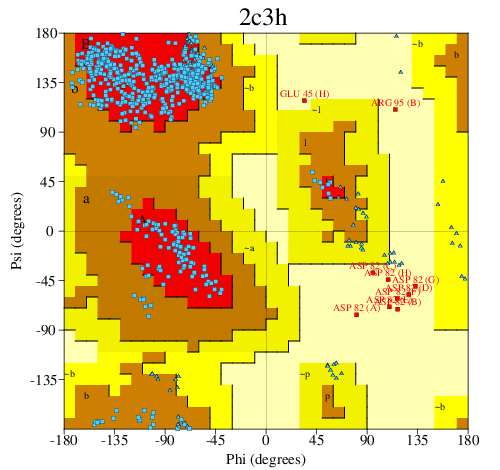
PROCHECK
|
|
|
|
|
|
Headers
|
|
|
|
References
|
|
|
|
|
|

|
|
Q9KFR4
(Q9KFR4_BACHD) -
Alpha-amylase G-6 from Halalkalibacterium halodurans (strain ATCC BAA-125 / DSM 18197 / FERM 7344 / JCM 9153 / C-125)
|
|
|
|
Seq:
Struc:
|
|
|
|
958 a.a.
93 a.a.*
|
|

|

|

|
|
|
|
|
|
|
|
|
|
|
Key: |
 |
PfamA domain |
|
|
 |
Secondary structure |
|
 |
CATH domain |
|
|
*
PDB and UniProt seqs differ
at 1 residue position (black
cross)
|
|
|
|
|
|
|
|
|
|
|
|
|
|
|
|
|
 |
|
|
|
|
|
|
| |
|
DOI no:
|
J Biol Chem
281:587-598
(2006)
|
|
PubMed id:
|
|
|
|
|
|
| |
|
A structural and functional analysis of alpha-glucan recognition by family 25 and 26 carbohydrate-binding modules reveals a conserved mode of starch recognition.
|
|
A.B.Boraston,
M.Healey,
J.Klassen,
E.Ficko-Blean,
A.Lammerts van Bueren,
V.Law.
|
|
|
|
|
| |
ABSTRACT
|
|
|
|
| |
|
|
Starch-hydrolyzing enzymes lacking alpha-glucan-specific carbohydrate-binding
modules (CBMs) typically have lowered activity on granular starch relative to
their counterparts with CBMs. Thus, consideration of starch recognition by CBMs
is a key factor in understanding granular starch hydrolysis. To this end, we
have dissected the modular structure of the maltohexaose-forming amylase from
Bacillus halodurans (C-125). This five-module protein comprises an N-terminal
family 13 catalytic module followed in order by two modules of unknown function,
a family 26 CBM (BhCBM26), and a family 25 CBM (BhCBM25). Here we present a
comprehensive structure-function analysis of starch and
alpha-glucooligosaccharide recognition by BhCBM25 and BhCBM26 using UV methods,
isothermal titration calorimetry, and x-ray crystallography. The results reveal
that the two CBMs bind alpha-glucooligosaccharides, particularly those
containing alpha-1,6 linkages, with different affinities but have similar
abilities to bind granular starch. Notably, these CBMs appear to recognize the
same binding sites in granular starch. The enhanced affinity of the tandem CBMs
for granular starch is suggested to be the main biological advantage for this
enzyme to contain two CBMs. Structural studies of the native and ligand-bound
forms of BhCBM25 and BhCBM26 show a structurally conserved mode of ligand
recognition but through non-sequence-conserved residues. Comparison of these CBM
structures with other starch-specific CBM structures reveals a generally
conserved mode of starch recognition.
|
|
|
|
|
|
| |
Selected figure(s)
|
|
|
|
| |
|
|

|
|

|
|
Figure 5.
FIGURE 5. Phasing and structures of BhCBM25 and BhCBM26. A,
anomalous difference peaks (red) and representative electron
density (blue; 0.39 electrons/Å3) contoured around the
iodotyrosine heavy atom sites used for SAD phasing of BhCBM25.
B, anomalous difference peaks (red) and representative electron
density (blue; 0.37 electrons/Å3) contoured around the
cadmium sites used for SAD phasing of BhCBM26. C, the overall
secondary structure of BhCBM25 as representative of the fold and
topology of both BhCBM25 and BhCBM26. Selected amino acid side
chains are shown in a "licorice" representation. Electron
density maps are maximum likelihood (29)/  [A] (44) weighted 2F[o]
- F[c] electron density maps. [A] (44) weighted 2F[o]
- F[c] electron density maps.
|
|
Figure 6.
FIGURE 6. Observed electron density for maltotetraose bound
to BhCBM25 in the P2[1] crystal form (A), maltotetraose bound to
BhCBM25 in the P4[3]2[1]2 crystal form (symmetry-related
molecules are colored blue and green) (B), and maltose bound to
BhCBM26 (C). The mobile binding loop of BhCBM26 discussed
throughout is shown in violet. Relevant amino acid side chains
are shown in a "licorice" representation and labeled. All maps
are maximum likelihood (29)/ [A] (44) weighted 2F[o]
- F[c] electron density maps contoured at 1 (0.30, 0.15, and 0.14
electrons/Å3 in A, B, and C, respectively).
|
|
|
|
|
|
| |
The above figures are
reprinted
by permission from the ASBMB:
J Biol Chem
(2006,
281,
587-598)
copyright 2006.
|
|
| |
Figures were
selected
by an automated process.
|
|
|
|
|
|
|
|
|
|
|
|
|
|
|
|
 |
 |
 |
|
Literature references that cite this PDB file's key reference
|
|
|
| |
PubMed id
|
|
Reference
|
|
|
|
|
|
M.A.Glaring,
M.J.Baumann,
M.Abou Hachem,
H.Nakai,
N.Nakai,
D.Santelia,
B.W.Sigurskjold,
S.C.Zeeman,
A.Blennow,
and
B.Svensson
(2011).
Starch-binding domains in the CBM45 family--low-affinity domains from glucan, water dikinase and α-amylase involved in plastidial starch metabolism.
|
| |
FEBS J,
278,
1175-1185.
|
|
|
|
|
|
|
D.W.Abbott,
M.A.Higgins,
S.Hyrnuik,
B.Pluvinage,
A.Lammerts van Bueren,
and
A.B.Boraston
(2010).
The molecular basis of glycogen breakdown and transport in Streptococcus pneumoniae.
|
| |
Mol Microbiol,
77,
183-199.
|
|
|
PDB codes:
|
|
|
|
|
|
|
|
N.M.Koropatkin,
and
T.J.Smith
(2010).
SusG: a unique cell-membrane-associated alpha-amylase from a prominent human gut symbiont targets complex starch molecules.
|
| |
Structure,
18,
200-215.
|
|
|
PDB codes:
|
|
|
|
|
|
|
|
C.Christiansen,
M.Abou Hachem,
S.Janecek,
A.Viksø-Nielsen,
A.Blennow,
and
B.Svensson
(2009).
The carbohydrate-binding module family 20--diversity, structure, and function.
|
| |
FEBS J,
276,
5006-5029.
|
|
|
|
|
|
|
R.Rodríguez-Sanoja,
N.Oviedo,
L.Escalante,
B.Ruiz,
and
S.Sánchez
(2009).
A single residue mutation abolishes attachment of the CBM26 starch-binding domain from Lactobacillus amylovorus alpha-amylase.
|
| |
J Ind Microbiol Biotechnol,
36,
341-346.
|
|
|
|
|
|
|
O.Okhrimenko,
and
I.Jelesarov
(2008).
A survey of the year 2006 literature on applications of isothermal titration calorimetry.
|
| |
J Mol Recognit,
21,
1.
|
|
|
|
|
|
|
A.L.van Bueren,
M.Higgins,
D.Wang,
R.D.Burke,
and
A.B.Boraston
(2007).
Identification and structural basis of binding to host lung glycogen by streptococcal virulence factors.
|
| |
Nat Struct Mol Biol,
14,
76-84.
|
|
|
PDB codes:
|
|
|
|
|
|
|
|
D.Guillén,
M.Santiago,
L.Linares,
R.Pérez,
J.Morlon,
B.Ruiz,
S.Sánchez,
and
R.Rodríguez-Sanoja
(2007).
Alpha-amylase starch binding domains: cooperative effects of binding to starch granules of multiple tandemly arranged domains.
|
| |
Appl Environ Microbiol,
73,
3833-3837.
|
|
|
|
|
|
|
H.Watanabe,
T.Nishimoto,
M.Kubota,
H.Chaen,
and
S.Fukuda
(2006).
Cloning, sequencing, and expression of the genes encoding an isocyclomaltooligosaccharide glucanotransferase and an alpha-amylase from a Bacillus circulans strain.
|
| |
Biosci Biotechnol Biochem,
70,
2690-2702.
|
|
|
|
|
|
The most recent references are shown first.
Citation data come partly from CiteXplore and partly
from an automated harvesting procedure. Note that this is likely to be
only a partial list as not all journals are covered by
either method. However, we are continually building up the citation data
so more and more references will be included with time.
Where a reference describes a PDB structure, the PDB
codes are
shown on the right.
|
|


 Links
Links



