 |
PDBsum entry 2aeh

|
|
|
|
|
 |
Contents |
 |
|
|
|
|
|
|
|
|
|
|
* Residue conservation analysis
|
|
|
|
|
|
|
|
|
|
|
Enzyme class:
|
|
E.C.2.7.10.2
- non-specific protein-tyrosine kinase.
|
|
|
|
|
|
|
Reaction:
|
|
L-tyrosyl-[protein] + ATP = O-phospho-L-tyrosyl-[protein] + ADP + H+
|
|
|
|
|
|
L-tyrosyl-[protein]
|
+
|
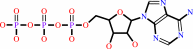 ATP
ATP
|
=
|
O-phospho-L-tyrosyl-[protein]
|
+
|
 ADP
ADP
|
+
|
H(+)
|
|
|
|
|
|
|
|
|
|
|
|
|
Molecule diagrams generated from .mol files obtained from the
KEGG ftp site
|
|
|
|
|
|
|
|
|
|
|
|
|
|
 |
|
|
|
|
|
|
| |
|
|
| |
|
DOI no:
|
J Biol Chem
281:252-259
(2006)
|
|
PubMed id:
|
|
|
|
|
|
| |
|
Crystal structure of the FERM domain of focal adhesion kinase.
|
|
D.F.Ceccarelli,
H.K.Song,
F.Poy,
M.D.Schaller,
M.J.Eck.
|
|
|
|
|
| |
ABSTRACT
|
|
|
|
| |
|
|
Focal adhesion kinase (FAK) is a non-receptor tyrosine kinase that localizes to
focal adhesions in adherent cells. Through phosphorylation of proteins assembled
at the cytoplasmic tails of integrins, FAK promotes signaling events that
modulate cellular growth, survival, and migration. The amino-terminal region of
FAK contains a region of sequence homology with band 4.1 and
ezrin/radixin/moesin (ERM) proteins termed a FERM domain. FERM domains are found
in a variety of signaling and cytoskeletal proteins and are thought to mediate
intermolecular interactions with partner proteins and phospholipids at the
plasma membrane and intramolecular regulatory interactions. Here we report two
crystal structures of an NH2-terminal fragment of avian FAK containing the FERM
domain and a portion of the regulatory linker that connects the FERM and kinase
domains. The tertiary folds of the three subdomains (F1, F2, and F3) are similar
to those of known FERM structures despite low sequence conservation. Differences
in the sequence and relative orientation of the F3 subdomain alters the nature
of the interdomain interface, and the phosphoinositide binding site found in ERM
family FERM domains is not present in FAK. A putative protein interaction site
on the F3 lobe is masked by the proximal region of the linker. Additionally, in
one structure the adjacent Src SH3 and SH2 binding sites in the linker associate
with the surfaces of the F3 and F1 lobes, respectively. These structural
features suggest the possibility that protein interactions of the FAK FERM
domain can be regulated by binding of Src kinases to the linker segment.
|
|
|
|
|
|
| |
Selected figure(s)
|
|
|
|
| |
|
|

|
|

|
|
Figure 4.
FIGURE 4. Detailed view of the F3 lobe highlighting the
linker interaction. A, ribbon diagram of the FAK F3 lobe with
the proximal portion of the linker shown in stick form and
colored magenta. The details of this interaction are shown
schematically in panel C. B, the radixin F3 lobe (yellow) bound
to a peptide representing the cytoplasmic tail of ICAM-2 (gray).
C, schematic detailing the interactions of the linker with the
putative ligand binding groove on the F3 lobe. Linker residues
are indicated in magenta, FERM domain residues in cyan. Dashed
lines indicate hydrogen bond interactions and semicircles
indicate hydrophobic interactions. Note that the linker also
contacts the F1 lobe as indicated.
|
|
Figure 5.
FIGURE 5. Portions of the FERM kinase linker including the
Src SH3 binding site and the Tyr397 autophosphorylation site are
tethered across the surface of the F1 and F3 subdomains in the
FAK405 structure. A, ribbon and transparent surface
representation of the FAK FERM domain. The Src SH3 binding site
is shown in green (residues 363-375) and the Tyr397-containing
segment (residues 394-403) is colored in pink. B, detail of the
interactions between the Src SH3-binding site and the surface of
F3. Hydrogen bonds between the RXXPXXP motif (residues Arg368 to
Pro374) and the F3 lobe are indicated by dashed lines and
involve the side chains of Gln303 and Gln317 on the F3 lobe. C,
details of the interaction between the FAK autophosphorylation
Tyr397 segment and the F1 lobe. Hydrogen bonds are indicated
with dashed lines and involve the side chains of Glu403 with
His41 and Ser54 bonds. Tyr397 is surface exposed and not
phosphorylated in the structure.
|
|
|
|
|
|
| |
The above figures are
reprinted
by permission from the ASBMB:
J Biol Chem
(2006,
281,
252-259)
copyright 2006.
|
|
| |
Figures were
selected
by the author.
|
|
|
|
|
|
|
|
|
|
|
|
|
|
|
|
 |
 |
 |
|
Literature references that cite this PDB file's key reference
|
|
|
| |
PubMed id
|
|
Reference
|
|
|
|
|
|
P.J.Lupardus,
G.Skiniotis,
A.J.Rice,
C.Thomas,
S.Fischer,
T.Walz,
and
K.C.Garcia
(2011).
Structural snapshots of full-length Jak1, a transmembrane gp130/IL-6/IL-6Rα cytokine receptor complex, and the receptor-Jak1 holocomplex.
|
| |
Structure,
19,
45-55.
|
|
|
|
|
|
|
B.T.Goult,
M.Bouaouina,
P.R.Elliott,
N.Bate,
B.Patel,
A.R.Gingras,
J.G.Grossmann,
G.C.Roberts,
D.A.Calderwood,
D.R.Critchley,
and
I.L.Barsukov
(2010).
Structure of a double ubiquitin-like domain in the talin head: a role in integrin activation.
|
| |
EMBO J,
29,
1069-1080.
|
|
|
PDB codes:
|
|
|
|
|
|
|
|
C.A.Lipinski,
and
J.C.Loftus
(2010).
Targeting Pyk2 for therapeutic intervention.
|
| |
Expert Opin Ther Targets,
14,
95.
|
|
|
|
|
|
|
M.C.Frame,
H.Patel,
B.Serrels,
D.Lietha,
and
M.J.Eck
(2010).
The FERM domain: organizing the structure and function of FAK.
|
| |
Nat Rev Mol Cell Biol,
11,
802-814.
|
|
|
|
|
|
|
P.R.Elliott,
B.T.Goult,
P.M.Kopp,
N.Bate,
J.G.Grossmann,
G.C.Roberts,
D.R.Critchley,
and
I.L.Barsukov
(2010).
The Structure of the talin head reveals a novel extended conformation of the FERM domain.
|
| |
Structure,
18,
1289-1299.
|
|
|
PDB code:
|
|
|
|
|
|
|
|
D.Zheng,
E.Kurenova,
D.Ucar,
V.Golubovskaya,
A.Magis,
D.Ostrov,
W.G.Cance,
and
S.N.Hochwald
(2009).
Targeting of the protein interaction site between FAK and IGF-1R.
|
| |
Biochem Biophys Res Commun,
388,
301-305.
|
|
|
|
|
|
|
E.J.Cram,
K.M.Fontanez,
and
J.E.Schwarzbauer
(2008).
Functional characterization of KIN-32, the Caenorhabditis elegans homolog of focal adhesion kinase.
|
| |
Dev Dyn,
237,
837-846.
|
|
|
|
|
|
|
S.T.Lim,
D.Mikolon,
D.G.Stupack,
and
D.D.Schlaepfer
(2008).
FERM control of FAK function: implications for cancer therapy.
|
| |
Cell Cycle,
7,
2306-2314.
|
|
|
|
|
|
|
V.M.Golubovskaya,
C.Nyberg,
M.Zheng,
F.Kweh,
A.Magis,
D.Ostrov,
and
W.G.Cance
(2008).
A small molecule inhibitor, 1,2,4,5-benzenetetraamine tetrahydrochloride, targeting the y397 site of focal adhesion kinase decreases tumor growth.
|
| |
J Med Chem,
51,
7405-7416.
|
|
|
|
|
|
|
V.Ossovskaya,
S.T.Lim,
N.Ota,
D.D.Schlaepfer,
and
D.Ilic
(2008).
FAK nuclear export signal sequences.
|
| |
FEBS Lett,
582,
2402-2406.
|
|
|
|
|
|
|
X.Cai,
D.Lietha,
D.F.Ceccarelli,
A.V.Karginov,
Z.Rajfur,
K.Jacobson,
K.M.Hahn,
M.J.Eck,
and
M.D.Schaller
(2008).
Spatial and temporal regulation of focal adhesion kinase activity in living cells.
|
| |
Mol Cell Biol,
28,
201-214.
|
|
|
|
|
|
|
D.Lietha,
X.Cai,
D.F.Ceccarelli,
Y.Li,
M.D.Schaller,
and
M.J.Eck
(2007).
Structural basis for the autoinhibition of focal adhesion kinase.
|
| |
Cell,
129,
1177-1187.
|
|
|
PDB codes:
|
|
|
|
|
|
|
|
Q.Li,
M.R.Nance,
R.Kulikauskas,
K.Nyberg,
R.Fehon,
P.A.Karplus,
A.Bretscher,
and
J.J.Tesmer
(2007).
Self-masking in an intact ERM-merlin protein: an active role for the central alpha-helical domain.
|
| |
J Mol Biol,
365,
1446-1459.
|
|
|
PDB codes:
|
|
|
|
|
|
|
|
B.D.Cox,
M.Natarajan,
M.R.Stettner,
and
C.L.Gladson
(2006).
New concepts regarding focal adhesion kinase promotion of cell migration and proliferation.
|
| |
J Cell Biochem,
99,
35-52.
|
|
|
|
|
|
|
J.M.Corsi,
E.Rouer,
J.A.Girault,
and
H.Enslen
(2006).
Organization and post-transcriptional processing of focal adhesion kinase gene.
|
| |
BMC Genomics,
7,
198.
|
|
|
|
|
|
|
K.Kitano,
F.Yusa,
and
T.Hakoshima
(2006).
Structure of dimerized radixin FERM domain suggests a novel masking motif in C-terminal residues 295-304.
|
| |
Acta Crystallogr Sect F Struct Biol Cryst Commun,
62,
340-345.
|
|
|
PDB code:
|
|
|
|
|
|
|
|
S.K.Mitra,
and
D.D.Schlaepfer
(2006).
Integrin-regulated FAK-Src signaling in normal and cancer cells.
|
| |
Curr Opin Cell Biol,
18,
516-523.
|
|
|
|
|
|
|
S.Y.Chen,
and
H.C.Chen
(2006).
Direct interaction of focal adhesion kinase (FAK) with Met is required for FAK to promote hepatocyte growth factor-induced cell invasion.
|
| |
Mol Cell Biol,
26,
5155-5167.
|
|
|
|
|
|
The most recent references are shown first.
Citation data come partly from CiteXplore and partly
from an automated harvesting procedure. Note that this is likely to be
only a partial list as not all journals are covered by
either method. However, we are continually building up the citation data
so more and more references will be included with time.
Where a reference describes a PDB structure, the PDB
codes are
shown on the right.
|
|


 Links
Links


