
|
|
|
|
|
 |
Contents |
 |
|
|
|
|
|
|
|
|
|
|
|
|
* Residue conservation analysis
|
|
|
|
|
|
PDB id:
|
|
|
|
| Name: |
|
Transferase/inhibitor
|
|
|
Title:
|
|
Structure of pka-pkb chimera complexed with (s)-2-(4-chloro-phenyl)- 2-(4-1h-pyrazol-4-yl)-phenyl)-ethylamine
|
|
Structure:
|
|
Camp-dependent protein kinase, alpha-catalytic subunit. Chain: a. Synonym: protein kinase a, pka c-alpha. Engineered: yes. Mutation: yes. Camp-dependent protein kinase inhibitor alpha. Chain: i. Fragment: residues 5-24. Synonym: pki, pki-alpha, muscle/brain isoform.
|
|
Source:
|
|
Bos taurus. Bovine. Organism_taxid: 9913. Expressed in: escherichia coli. Expression_system_taxid: 562. Synthetic: yes. Homo sapiens. Human. Organism_taxid: 9606
|
|
Resolution:
|
|
|
2.23Å
|
R-factor:
|
0.192
|
R-free:
|
0.244
|
|
|
Authors:
|
|
T.G.Davies,G.Saxty,S.J.Woodhead,V.Berdini,M.L.Verdonk,P.G.Wyatt, R.G.Boyle,D.Barford,R.Downham,M.D.Garrett,R.A.Carr
|
|
Key ref:
|
|
G.Saxty
et al.
(2007).
Identification of inhibitors of protein kinase B using fragment-based lead discovery.
J Med Chem,
50,
2293-2296.
PubMed id:
|
|
|
Date:
|
|
|
19-Mar-07
|
Release date:
|
08-May-07
|
|
|
|
|
|
|
PROCHECK
|

|
|
|
|
|
Headers
|
|
|
|
References
|
|
|
|
|
|
|
|
|
|
|
|
Enzyme class:
|
|
Chain A:
E.C.2.7.11.11
- cAMP-dependent protein kinase.
|
|
|
|
|
|
|
Reaction:
|
|
|
1.
|
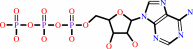
L-seryl-[protein] + ATP = O-phospho-L-seryl-[protein] + ADP + H+
|
|
2.
|
L-threonyl-[protein] + ATP = O-phospho-L-threonyl-[protein] + ADP + H+
|
|
|
|
|
|
|
L-seryl-[protein]
|
+
|
 ATP
ATP
|
=
|
O-phospho-L-seryl-[protein]
|
+
|
 ADP
ADP
|
+
|
H(+)
|
|
|
|
|
|
|
L-threonyl-[protein]
|
+
|
ATP
|
=
|
O-phospho-L-threonyl-[protein]
|
+
|
ADP
|
+
|
H(+)
|
|
|
|
|
|
|
|
|
|
|
|
|
Molecule diagrams generated from .mol files obtained from the
KEGG ftp site
|
|
|
|
|
|
|
|
|
|
|
|
|
|
 |
|
|
|
|
|
|
| |
|
|
| |
|
|
J Med Chem
50:2293-2296
(2007)
|
|
PubMed id:
|
|
|
|
|
|
| |
|
Identification of inhibitors of protein kinase B using fragment-based lead discovery.
|
|
G.Saxty,
S.J.Woodhead,
V.Berdini,
T.G.Davies,
M.L.Verdonk,
P.G.Wyatt,
R.G.Boyle,
D.Barford,
R.Downham,
M.D.Garrett,
R.A.Carr.
|
|
|
|
|
| |
ABSTRACT
|
|
|
|
| |
|
|
Using fragment-based screening techniques, 5-methyl-4-phenyl-1H-pyrazole (IC50
80 microM) was identified as a novel, low molecular weight inhibitor of protein
kinase B (PKB). Herein we describe the rapid elaboration of highly potent and
ligand efficient analogues using a fragment growing approach. Iterative
structure-based design was supported by protein-ligand structure determinations
using a PKA-PKB "chimera" and a final protein-ligand structure of a lead
compound in PKBbeta itself.
|
|
|
|
|
|
|
|
|
|
|
|
|
|
|
|
|
|
 |
 |
 |
|
Literature references that cite this PDB file's key reference
|
|
|
| |
PubMed id
|
|
Reference
|
|
|
|
|
|
E.Cressina,
L.Chen,
M.Moulin,
F.J.Leeper,
C.Abell,
and
A.G.Smith
(2011).
Identification of novel ligands for thiamine pyrophosphate (TPP) riboswitches.
|
| |
Biochem Soc Trans,
39,
652-657.
|
|
|
|
|
|
|
F.Lang,
G.Chen,
L.Li,
J.Xing,
F.Han,
L.Cun,
and
J.Liao
(2011).
Rhodium-catalyzed highly enantioselective addition of arylboronic acids to 2-nitrostyrenes by tert-butanesulfinylphosphine ligand.
|
| |
Chemistry,
17,
5242-5245.
|
|
|
|
|
|
|
C.W.Murray,
and
T.L.Blundell
(2010).
Structural biology in fragment-based drug design.
|
| |
Curr Opin Struct Biol,
20,
497-507.
|
|
|
|
|
|
|
D.Lavogina,
E.Enkvist,
and
A.Uri
(2010).
Bisubstrate inhibitors of protein kinases: from principle to practical applications.
|
| |
ChemMedChem,
5,
23-34.
|
|
|
|
|
|
|
T.McHardy,
J.J.Caldwell,
K.M.Cheung,
L.J.Hunter,
K.Taylor,
M.Rowlands,
R.Ruddle,
A.Henley,
A.de Haven Brandon,
M.Valenti,
T.G.Davies,
L.Fazal,
L.Seavers,
F.I.Raynaud,
S.A.Eccles,
G.W.Aherne,
M.D.Garrett,
and
I.Collins
(2010).
Discovery of 4-amino-1-(7H-pyrrolo[2,3-d]pyrimidin-4-yl)piperidine-4-carboxamides as selective, orally active inhibitors of protein kinase B (Akt).
|
| |
J Med Chem,
53,
2239-2249.
|
|
|
PDB codes:
|
|
|
|
|
|
|
|
X.Zhang,
A.C.Gibbs,
C.H.Reynolds,
M.B.Peters,
and
L.M.Westerhoff
(2010).
Quantum mechanical pairwise decomposition analysis of protein kinase B inhibitors: validating a new tool for guiding drug design.
|
| |
J Chem Inf Model,
50,
651-661.
|
|
|
|
|
|
|
G.E.de Kloe,
D.Bailey,
R.Leurs,
and
I.J.de Esch
(2009).
Transforming fragments into candidates: small becomes big in medicinal chemistry.
|
| |
Drug Discov Today,
14,
630-646.
|
|
|
|
|
|
|
M.Orita,
K.Ohno,
and
T.Niimi
(2009).
Two 'Golden Ratio' indices in fragment-based drug discovery.
|
| |
Drug Discov Today,
14,
321-328.
|
|
|
|
|
|
|
Q.S.Du,
R.B.Huang,
Y.T.Wei,
Z.W.Pang,
L.Q.Du,
and
K.C.Chou
(2009).
Fragment-based quantitative structure-activity relationship (FB-QSAR) for fragment-based drug design.
|
| |
J Comput Chem,
30,
295-304.
|
|
|
|
|
|
|
R.L.van Montfort,
and
P.Workman
(2009).
Structure-based design of molecular cancer therapeutics.
|
| |
Trends Biotechnol,
27,
315-328.
|
|
|
|
|
|
|
C.Peifer,
and
D.R.Alessi
(2008).
Small-molecule inhibitors of PDK1.
|
| |
ChemMedChem,
3,
1810-1838.
|
|
|
|
|
|
|
M.L.Verdonk,
and
D.C.Rees
(2008).
Group efficiency: a guideline for hits-to-leads chemistry.
|
| |
ChemMedChem,
3,
1179-1180.
|
|
|
|
|
|
The most recent references are shown first.
Citation data come partly from CiteXplore and partly
from an automated harvesting procedure. Note that this is likely to be
only a partial list as not all journals are covered by
either method. However, we are continually building up the citation data
so more and more references will be included with time.
Where a reference describes a PDB structure, the PDB
codes are
shown on the right.
|
 |


 Links
Links


