 |
PDBsum entry 2p5n

|
|
|
|
|
|

|

|

|

|
|

|
|

|
|

|
|

|
|

|
|
|
 |

|

|
|
|
|
|
|
|
|
|
|
|
|
|
|
|
|
|
|
|
|
|
|
|
|
|
|
|
|
|
|
|
|
|
|
Oxidoreductase
|
PDB id
|
|
|
|
2p5n
|
|
|
|
|
|
|
|
|
|
|
|
|
|
|

|

|

|
|
|
|
|
|
|
|
 |
Contents |
 |
|
|
|
|
|
|
|
|
|
|
|
|
* Residue conservation analysis
|
|
|
|
|
|
|
|
|
|
|
Enzyme class 1:
|
|
E.C.1.1.1.-
- ?????
|
|
|
|
|
|
|
Enzyme class 2:
|
|
E.C.1.1.1.209
- 3(or 17)alpha-hydroxysteroid dehydrogenase.
|
|
|
|
|
|
|
Reaction:
|
|
|
1.
|
androsterone + NADP+ = 5alpha-androstan-3,17-dione + NADPH + H+
|
|
2.
|
androsterone + NAD+ = 5alpha-androstan-3,17-dione + NADH + H+
|
|
|
|
|
|
|
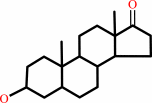 androsterone
|
+
|
 NADP(+)
|
=
|
5alpha-androstan-3,17-dione
|
+
|
 NADPH
NADPH
|
+
|
H(+)
|
|
|
|
|
|
|
androsterone
|
+
|
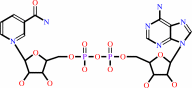 NAD(+)
|
=
|
5alpha-androstan-3,17-dione
|
+
|
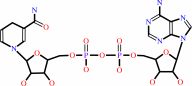 NADH
NADH
|
+
|
H(+)
|
|
|
|
|
|
|
|
|
|
|
|
|
Note, where more than one E.C. class is given (as above), each may
correspond to a different protein domain or, in the case of polyprotein
precursors, to a different mature protein.
|
|
|
|
Molecule diagrams generated from .mol files obtained from the
KEGG ftp site
|
|
|
|
|
|
|
|
|
|
|
|
|
|
 |
|
|
|
|
|
|
| |
|
|
| |
|
|
Acta Crystallogr Sect F Struct Biol Cryst Commun
63:825-830
(2007)
|
|
PubMed id:
|
|
|
|
|
|
| |
|
Structure of 3(17)alpha-hydroxysteroid dehydrogenase (AKR1C21) holoenzyme from an orthorhombic crystal form: an insight into the bifunctionality of the enzyme.
|
|
U.Dhagat,
V.Carbone,
R.P.Chung,
C.Schulze-Briese,
S.Endo,
A.Hara,
O.El-Kabbani.
|
|
|
|
|
| |
ABSTRACT
|
|
|
|
| |
|
|
Mouse 3(17)alpha-hydroxysteroid dehydrogenase (AKR1C21) is a bifunctional enzyme
that catalyses the oxidoreduction of the 3- and 17-hydroxy/keto groups of
steroid substrates such as oestrogens, androgens and neurosteroids. The
structure of the AKR1C21-NADPH binary complex was determined from an
orthorhombic crystal belonging to space group P2(1)2(1)2(1) at a resolution of
1.8 A. In order to identify the factors responsible for the bifunctionality of
AKR1C21, three steroid substrates including a 17-keto steroid, a 3-keto steroid
and a 3alpha-hydroxysteroid were docked into the substrate-binding cavity.
Models of the enzyme-coenzyme-substrate complexes suggest that Lys31, Gly225 and
Gly226 are important for ligand recognition and orientation in the active site.
|
|
|
|
|
|
|
|
|
|
|
|
|
|
|
|
|
|
 |
 |
 |
|


 Links
Links


