 |
PDBsum entry 20gs

|
|
|
|
|
 |
Contents |
 |
|
|
|
|
|
|
|
|
|
|
|
|
* Residue conservation analysis
|
|
|
|
|
|
|
|
|
|
|
Enzyme class:
|
|
E.C.2.5.1.18
- glutathione transferase.
|
|
|
|
|
|
|
Reaction:
|
|
RX + glutathione = an S-substituted glutathione + a halide anion + H+
|
|
|
|
|
|
 RX
RX
|
+
|
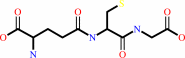 glutathione
|
=
|
S-substituted glutathione
|
+
|
halide anion
|
+
|
H(+)
|
|
|
|
|
|
|
|
|
|
|
|
|
Molecule diagrams generated from .mol files obtained from the
KEGG ftp site
|
|
|
|
|
|
|
|
|
|
|
|
|
|
 |
|
|
|
|
|
|
| |
|
|
| |
|
DOI no:
|
J Mol Biol
291:913-926
(1999)
|
|
PubMed id:
|
|
|
|
|
|
| |
|
The ligandin (non-substrate) binding site of human Pi class glutathione transferase is located in the electrophile binding site (H-site).
|
|
A.J.Oakley,
M.Lo Bello,
M.Nuccetelli,
A.P.Mazzetti,
M.W.Parker.
|
|
|
|
|
| |
ABSTRACT
|
|
|
|
| |
|
|
Glutathione S -transferases (GSTs) play a pivotal role in the detoxification of
foreign chemicals and toxic metabolites. They were originally termed ligandins
because of their ability to bind large molecules (molecular masses >400 Da),
possibly for storage and transport roles. The location of the ligandin site in
mammalian GSTs is still uncertain despite numerous studies in recent years. Here
we show by X-ray crystallography that the ligandin binding site in human pi
class GST P1-1 occupies part of one of the substrate binding sites. This work
has been extended to the determination of a number of enzyme complex crystal
structures which show that very large ligands are readily accommodated into this
substrate binding site and in all, but one case, causes no significant movement
of protein side-chains. Some of these molecules make use of a hitherto
undescribed binding site located in a surface pocket of the enzyme. This site is
conserved in most, but not all, classes of GSTs suggesting it may play an
important functional role.
|
|
|
|
|
|
| |
Selected figure(s)
|
|
|
|
| |
|
|

|
|

|
|
Figure 1.
Figure 1. Schematic representation of the inhibitors. (a)
Sulfasalazine. The numbering scheme is taken from [van der Sluis
and Spek 1990]. (b) S-Nonyl GSH; (c) Cibacron blue; (d)
bromosulfophthalein; (e) 2,4-dinitrophenyl GSH.
|
|
Figure 3.
Figure 3. A comparison of the binding locations of GSH
conjugates derived from the various crystal structures of pi
class GSTs presented here. The superposition was based on
overlaying the coordinates of the respective N-terminal domains.
The ligands are overlayed on a schematic of the N-terminal
domain of the human pi class enzyme. (a) Stereo view showing all
inhibitors described in the text. The inhibitors are coloured as
follows: SLZ, yellow;S-nonyl GSH, cyan; CB, dark blue; BS no.1,
red; BS no. 2, magenta; DNP GSH, green. The side-chains of
Phe8 and Tyr108 are shown. (b) Comparison of the binding
locations of DNP GSH (denoted by yellow bonds) and BS no. 1
(denoted by red bonds). These pictures were generated with the
program MOLSCRIPT [Kraulis 1991].
|
|
|
|
|
|
| |
The above figures are
reprinted
by permission from Elsevier:
J Mol Biol
(1999,
291,
913-926)
copyright 1999.
|
|
| |
Figures were
selected
by the author.
|
|
|
|
|
|
|
|
|
|
|
|
|
|
|
|
 |
 |
 |
|
Literature references that cite this PDB file's key reference
|
|
|
| |
PubMed id
|
|
Reference
|
|
|
|
|
|
A.Oakley
(2011).
Glutathione transferases: a structural perspective.
|
| |
Drug Metab Rev,
43,
138-151.
|
|
|
|
|
|
|
F.Morel,
and
C.Aninat
(2011).
The glutathione transferase kappa family.
|
| |
Drug Metab Rev,
43,
281-291.
|
|
|
|
|
|
|
J.U.Flanagan,
and
M.L.Smythe
(2011).
Sigma-class glutathione transferases.
|
| |
Drug Metab Rev,
43,
194-214.
|
|
|
|
|
|
|
F.Pavelcík,
and
J.Václavík
(2010).
Performance of phased rotation, conformation and translation function: accurate protein model building with tripeptidic and tetrapeptidic fragments.
|
| |
Acta Crystallogr D Biol Crystallogr,
66,
1012-1023.
|
|
|
|
|
|
|
E.H.Jang,
H.Park,
A.K.Park,
J.H.Moon,
Y.M.Chi,
and
I.Y.Ahn
(2008).
Crystallization and preliminary X-ray crystallographic studies of the rho-class glutathione S-transferase from the Antarctic clam Laternula elliptica.
|
| |
Acta Crystallogr Sect F Struct Biol Cryst Commun,
64,
1132-1134.
|
|
|
|
|
|
|
N.Kinsley,
Y.Sayed,
S.Mosebi,
R.N.Armstrong,
and
H.W.Dirr
(2008).
Characterization of the binding of 8-anilinonaphthalene sulfonate to rat class Mu GST M1-1.
|
| |
Biophys Chem,
137,
100-104.
|
|
|
|
|
|
|
P.Kapoli,
I.A.Axarli,
D.Platis,
M.Fragoulaki,
M.Paine,
J.Hemingway,
J.Vontas,
and
N.E.Labrou
(2008).
Engineering sensitive glutathione transferase for the detection of xenobiotics.
|
| |
Biosens Bioelectron,
24,
498-503.
|
|
|
|
|
|
|
S.Conn,
C.Curtin,
A.Bézier,
C.Franco,
and
W.Zhang
(2008).
Purification, molecular cloning, and characterization of glutathione S-transferases (GSTs) from pigmented Vitis vinifera L. cell suspension cultures as putative anthocyanin transport proteins.
|
| |
J Exp Bot,
59,
3621-3634.
|
|
|
|
|
|
|
H.W.Dirr,
T.Little,
D.C.Kuhnert,
and
Y.Sayed
(2005).
A conserved N-capping motif contributes significantly to the stabilization and dynamics of the C-terminal region of class Alpha glutathione S-transferases.
|
| |
J Biol Chem,
280,
19480-19487.
|
|
|
|
|
|
|
J.Li,
Z.Xia,
and
J.Ding
(2005).
Thioredoxin-like domain of human kappa class glutathione transferase reveals sequence homology and structure similarity to the theta class enzyme.
|
| |
Protein Sci,
14,
2361-2369.
|
|
|
PDB code:
|
|
|
|
|
|
|
|
F.Morel,
C.Rauch,
E.Petit,
A.Piton,
N.Theret,
B.Coles,
and
A.Guillouzo
(2004).
Gene and protein characterization of the human glutathione S-transferase kappa and evidence for a peroxisomal localization.
|
| |
J Biol Chem,
279,
16246-16253.
|
|
|
|
|
|
|
M.H.Hanigan,
and
P.Devarajan
(2003).
Cisplatin nephrotoxicity: molecular mechanisms.
|
| |
Cancer Ther,
1,
47-61.
|
|
|
|
|
|
|
S.Mosebi,
Y.Sayed,
J.Burke,
and
H.W.Dirr
(2003).
Residue 219 impacts on the dynamics of the C-terminal region in glutathione transferase A1-1: implications for stability and catalytic and ligandin functions.
|
| |
Biochemistry,
42,
15326-15332.
|
|
|
|
|
|
|
A.J.Oakley,
T.Harnnoi,
R.Udomsinprasert,
K.Jirajaroenrat,
A.J.Ketterman,
and
M.C.Wilce
(2001).
The crystal structures of glutathione S-transferases isozymes 1-3 and 1-4 from Anopheles dirus species B.
|
| |
Protein Sci,
10,
2176-2185.
|
|
|
PDB codes:
|
|
|
|
|
|
|
|
C.Micaloni,
A.P.Mazzetti,
M.Nuccetelli,
J.Rossjohn,
W.J.McKinstry,
G.Antonini,
A.M.Caccuri,
A.J.Oakley,
G.Federici,
G.Ricci,
M.W.Parker,
and
M.Lo Bello
(2000).
Valine 10 may act as a driver for product release from the active site of human glutathione transferase P1-1.
|
| |
Biochemistry,
39,
15961-15970.
|
|
|
|
|
|
The most recent references are shown first.
Citation data come partly from CiteXplore and partly
from an automated harvesting procedure. Note that this is likely to be
only a partial list as not all journals are covered by
either method. However, we are continually building up the citation data
so more and more references will be included with time.
Where a reference describes a PDB structure, the PDB
code is
shown on the right.
|
|


 Links
Links


