 |
PDBsum entry 1zdr

|
|
|
|
|
|

|

|

|

|
|

|
|

|
|

|
|

|
|
|
 |

|

|
|
|
|
|
|
|
|
|
|
|
|
|
|
|
|
|
|
|
|
|
|
|
|
|
|
|
|
|
|
|
|
|
Oxidoreductase
|
PDB id
|
|
|
|
1zdr
|
|
|
|
|
|
|
|
|
|
|
|
|
|
|

|

|

|
|
|
|
|
|
|
|
 |
Contents |
 |
|
|
|
|
|
|
|
|
|
|
|
|
* Residue conservation analysis
|
|
|
|
|
|
|
|
|
|
|
Enzyme class:
|
|
E.C.1.5.1.3
- dihydrofolate reductase.
|
|
|
|
|
|
|
Pathway:
|
|
Folate Coenzymes
|
|
|
|
|
|
Reaction:
|
|
(6S)-5,6,7,8-tetrahydrofolate + NADP+ = 7,8-dihydrofolate + NADPH + H+
|
|
|
|
|
|
(6S)-5,6,7,8-tetrahydrofolate
|
+
|
 NADP(+)
|
=
|
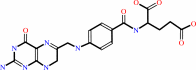 7,8-dihydrofolate
|
+
|
 NADPH
NADPH
|
+
|
H(+)
|
|
|
|
|
|
|
|
|
|
|
|
|
Molecule diagrams generated from .mol files obtained from the
KEGG ftp site
|
|
|
|
|
|
|
|
|
|
|
|
|
|
 |
|
|
|
|
|
|
| |
|
|
| |
|
DOI no:
|
Biochemistry
44:11428-11439
(2005)
|
|
PubMed id:
|
|
|
|
|
|
| |
|
Structure and hydride transfer mechanism of a moderate thermophilic dihydrofolate reductase from Bacillus stearothermophilus and comparison to its mesophilic and hyperthermophilic homologues.
|
|
H.S.Kim,
S.M.Damo,
S.Y.Lee,
D.Wemmer,
J.P.Klinman.
|
|
|
|
|
| |
ABSTRACT
|
|
|
|
| |
|
|
Dihydrofolate reductase (DHFR) from a moderate thermophilic organism, Bacillus
stearothermophilus, has been cloned and expressed. Physical characterization of
the protein (BsDHFR) indicates that it is a monomeric protein with a molecular
mass of 18,694.6 Da (0.8), coincident with the mass of 18 694.67 Da calculated
from the primary sequence. Determination of the X-ray structure of BsDHFR
provides the first structure for a monomeric DHFR from a thermophilic organism,
indicating a high degree of conservation of structure in relation to all
chromosomal DHFRs. Structurally based sequence alignment of DHFRs indicates the
following levels of sequence identity and similarity for BsDHFR: 38 and 58% with
Escherichia coli, 35 and 56% with Lactobacillus casei, and 23 and 40% with
Thermotoga maritima, respectively. Steady state kinetic isotope effect studies
indicate an ordered kinetic mechanism at elevated temperatures, with NADPH
binding first to the enzyme. This converts to a more random mechanism at reduced
temperatures, reflected in a greatly reduced K(m) for dihydrofolate at 20
degrees C in relation to that at 60 degrees C. A reduction in either temperature
or pH reduces the degree to which the hydride transfer step is rate-determining
for the second-order reaction of DHF with the enzyme-NADPH binary complex.
Transient state kinetics have been used to study the temperature dependence of
the isotope effect on hydride transfer at pH 9 between 10 and 50 degrees C. The
data support rate-limiting hydride transfer with a moderate enthalpy of
activation (E(a) = 5.5 kcal/mol) and a somewhat greater temperature dependence
for the kinetic isotope effect than predicted from classical behavior [A(H)/A(D)
= 0.57 (0.15)]. Comparison of kinetic parameters for BsDHFR to published data
for DHFR from E. coli and T. maritima shows a decreasing trend in efficiency of
hydride transfer with increasing thermophilicity of the protein. These results
are discussed in the context of the capacity of each enzyme to optimize
H-tunneling from donor (NADPH) to acceptor (DHF) substrates.
|
|
|
|
|
|
|
|
|
|
|
|
|
|
|
|
|
|
 |
 |
 |
|
Literature references that cite this PDB file's key reference
|
|
|
| |
PubMed id
|
|
Reference
|
|
|
|
|
|
C.Murakami,
E.Ohmae,
S.Tate,
K.Gekko,
K.Nakasone,
and
C.Kato
(2011).
Comparative study on dihydrofolate reductases from Shewanella species living in deep-sea and ambient atmospheric-pressure environments.
|
| |
Extremophiles,
15,
165-175.
|
|
|
|
|
|
|
Y.W.Tan,
and
H.Yang
(2011).
Seeing the forest for the trees: fluorescence studies of single enzymes in the context of ensemble experiments.
|
| |
Phys Chem Chem Phys,
13,
1709-1721.
|
|
|
|
|
|
|
O.A.Oyeyemi,
K.M.Sours,
T.Lee,
K.A.Resing,
N.G.Ahn,
and
J.P.Klinman
(2010).
Temperature dependence of protein motions in a thermophilic dihydrofolate reductase and its relationship to catalytic efficiency.
|
| |
Proc Natl Acad Sci U S A,
107,
10074-10079.
|
|
|
|
|
|
|
A.Yahashiri,
G.Nimrod,
N.Ben-Tal,
E.E.Howell,
and
A.Kohen
(2009).
The effect of electrostatic shielding on H tunneling in R67 dihydrofolate reductase.
|
| |
Chembiochem,
10,
2620-2623.
|
|
|
|
|
|
|
E.S.Bolstad,
and
A.C.Anderson
(2009).
In pursuit of virtual lead optimization: pruning ensembles of receptor structures for increased efficiency and accuracy during docking.
|
| |
Proteins,
75,
62-74.
|
|
|
|
|
|
|
A.Yahashiri,
E.E.Howell,
and
A.Kohen
(2008).
Tuning of the H-transfer coordinate in primitive versus well-evolved enzymes.
|
| |
Chemphyschem,
9,
980-982.
|
|
|
|
|
|
|
E.S.Bolstad,
and
A.C.Anderson
(2008).
In pursuit of virtual lead optimization: the role of the receptor structure and ensembles in accurate docking.
|
| |
Proteins,
73,
566-580.
|
|
|
|
|
|
|
L.Meinhold,
D.Clement,
M.Tehei,
R.Daniel,
J.L.Finney,
and
J.C.Smith
(2008).
Protein dynamics and stability: the distribution of atomic fluctuations in thermophilic and mesophilic dihydrofolate reductase derived using elastic incoherent neutron scattering.
|
| |
Biophys J,
94,
4812-4818.
|
|
|
|
|
|
|
M.C.Thielges,
D.A.Case,
and
F.E.Romesberg
(2008).
Carbon-deuterium bonds as probes of dihydrofolate reductase.
|
| |
J Am Chem Soc,
130,
6597-6603.
|
|
|
|
|
|
|
J.Pang,
and
R.K.Allemann
(2007).
Molecular dynamics simulation of thermal unfolding of Thermatoga maritima DHFR.
|
| |
Phys Chem Chem Phys,
9,
711-718.
|
|
|
|
|
|
The most recent references are shown first.
Citation data come partly from CiteXplore and partly
from an automated harvesting procedure. Note that this is likely to be
only a partial list as not all journals are covered by
either method. However, we are continually building up the citation data
so more and more references will be included with time.
|
|


 Links
Links


