|
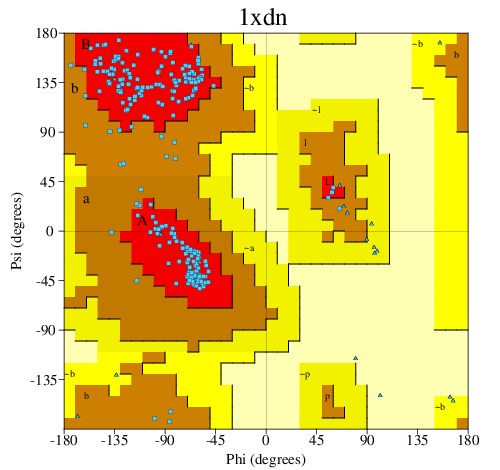
PDBsum entry 1xdn

|
|
|
|
|
 |
Contents |
 |
|
|
|
|
|
|
|
|
|
|
|
|
|
|
* Residue conservation analysis
|
|
|
|
|
|
|
|
|
|
|
Enzyme class:
|
|
E.C.6.5.1.3
- Rna ligase (ATP).
|
|
|
|
|
|
|
Reaction:
|
|
ATP + (ribonucleotide)n-3'-hydroxyl + 5'-phospho-(ribonucleotide)m = (ribonucleotide)n+m + AMP + diphosphate
|
|
|
|
|
|
ATP
Bound ligand (Het Group name = )
corresponds exactly
|
+
|
(ribonucleotide)n-3'-hydroxyl
|
+
|
5'-phospho-(ribonucleotide)m
|
=
|
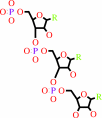 (ribonucleotide)n+m
|
+
|
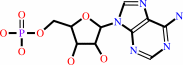 AMP
AMP
|
+
|
 diphosphate
|
|
|
|
|
|
|
|
|
|
|
|
|
Molecule diagrams generated from .mol files obtained from the
KEGG ftp site
|
|
|
|
|
|
|
|
|
|
|
|
|
|
 |
|
|
|
|
|
|
| |
|
|
| |
|
DOI no:
|
J Mol Biol
343:601-613
(2004)
|
|
PubMed id:
|
|
|
|
|
|
| |
|
High resolution crystal structure of a key editosome enzyme from Trypanosoma brucei: RNA editing ligase 1.
|
|
J.Deng,
A.Schnaufer,
R.Salavati,
K.D.Stuart,
W.G.Hol.
|
|
|
|
|
| |
ABSTRACT
|
|
|
|
| |
|
|
Trypanosomatids are causative agents of several devastating tropical diseases
such as African sleeping sickness, Chagas' disease and leishmaniasis. There are
no effective vaccines available to date for treatment of these protozoan
diseases, while current drugs have limited efficacy, significant toxicity and
suffer from increasing resistance. Trypanosomatids have several remarkable and
unique metabolic and structural features that are of great interest for
developing new anti-protozoan therapeutics. One such feature is "RNA
editing", an essential process in these pathogenic protozoa. Transcripts
for key trypanosomatid mitochondrial proteins undergo extensive
post-transcriptional RNA editing by specifically inserting or deleting
uridylates from pre-mature mRNA in order to create mature mRNAs that encode
functional proteins. The RNA editing process is carried out in a approximately
1.6 MDa multi-protein complex, the editosome. In Trypanosoma brucei, one of the
editosome's core enzymes, the RNA editing ligase 1 (TbREL1), has been shown to
be essential for survival of both insect and bloodstream forms of the parasite.
We report here the crystal structure of the catalytic domain of TbREL1 at 1.2 A
resolution, in complex with ATP and magnesium. The magnesium ion interacts with
the beta and gamma-phosphate groups and is almost perfectly octahedrally
coordinated by six phosphate and water oxygen atoms. ATP makes extensive direct
and indirect interactions with the ligase via essentially all its atoms while
extending its base into a deep pocket. In addition, the ATP makes numerous
interactions with residues that are conserved in the editing ligases only.
Further away from the active site, TbREL1 contains a unique loop containing
several hydrophobic residues that are highly conserved among trypanosomatid RNA
editing ligases which may play a role in protein-protein interactions in the
editosome. The distinct characteristics of the adenine-binding pocket, and the
absence of any close homolog in the human genome, bode well for the design of
selective inhibitors that will block the essential RNA ligase function in a
number of major protozoan pathogens.
|
|
|
|
|
|
| |
Selected figure(s)
|
|
|
|
| |
|
|

|
|

|
|
Figure 6.
Figure 6. Superposition of TbREL1-ATP and T4Rnl2-AMP in
stereo view. The two structures are superimposed on each other
based on AMP. TbREL1 and ATP are shown in atom color and the
TbREL1 residues near the ATP binding site as labeled. T4Rnl2
(PDB id 1s68) is shown in green and the AMP is shown in cyan.
Notice the hydrogen bonding between the backbone atoms of
residues I59 and I61 in TbREL1 and the sugar moiety and
a-phosphate group of the ATP, respectively, as shown in red
broken lines; these hydrogen bonds are absent from the
T4Rnl2-AMP complex.
|
|
Figure 7.
Figure 7. Electrostatic potential surface of TbREL1
generated by GRASP.50 Blue: positive; red: negative. ATP is
shown as ball-stick. Notice the negatively charged residue E60
near the ATP and the absence of extended positive potential
surfaces. Seven conserved trypanosomatid residues are labeled.
|
|
|
|
|
|
| |
The above figures are
reprinted
by permission from Elsevier:
J Mol Biol
(2004,
343,
601-613)
copyright 2004.
|
|
| |
Figures were
selected
by an automated process.
|
|
|
|
|
|
|
|
|
|
|
|
|
|
|
|
 |
 |
 |
|
Literature references that cite this PDB file's key reference
|
|
|
| |
PubMed id
|
|
Reference
|
|
|
|
|
|
J.D.Durrant,
and
J.A.McCammon
(2011).
BINANA: a novel algorithm for ligand-binding characterization.
|
| |
J Mol Graph Model,
29,
888-893.
|
|
|
|
|
|
|
M.Wu,
Y.J.Park,
E.Pardon,
S.Turley,
A.Hayhurst,
J.Deng,
J.Steyaert,
and
W.G.Hol
(2011).
Structures of a key interaction protein from the Trypanosoma brucei editosome in complex with single domain antibodies.
|
| |
J Struct Biol,
174,
124-136.
|
|
|
PDB codes:
|
|
|
|
|
|
|
|
A.Schnaufer,
M.Wu,
Y.J.Park,
T.Nakai,
J.Deng,
R.Proff,
W.G.Hol,
and
K.D.Stuart
(2010).
A protein-protein interaction map of trypanosome ~20S editosomes.
|
| |
J Biol Chem,
285,
5282-5295.
|
|
|
|
|
|
|
J.D.Durrant,
and
J.A.McCammon
(2010).
NNScore: a neural-network-based scoring function for the characterization of protein-ligand complexes.
|
| |
J Chem Inf Model,
50,
1865-1871.
|
|
|
|
|
|
|
J.D.Durrant,
L.Hall,
R.V.Swift,
M.Landon,
A.Schnaufer,
and
R.E.Amaro
(2010).
Novel naphthalene-based inhibitors of Trypanosoma brucei RNA editing ligase 1.
|
| |
PLoS Negl Trop Dis,
4,
e803.
|
|
|
|
|
|
|
M.M.Golas,
C.Böhm,
B.Sander,
K.Effenberger,
M.Brecht,
H.Stark,
and
H.U.Göringer
(2009).
Snapshots of the RNA editing machine in trypanosomes captured at different assembly stages in vivo.
|
| |
EMBO J,
28,
766-778.
|
|
|
|
|
|
|
M.Niemann,
H.Kaibel,
E.Schlüter,
K.Weitzel,
M.Brecht,
and
H.U.Göringer
(2009).
Kinetoplastid RNA editing involves a 3' nucleotidyl phosphatase activity.
|
| |
Nucleic Acids Res,
37,
1897-1906.
|
|
|
|
|
|
|
R.V.Swift,
J.Durrant,
R.E.Amaro,
and
J.A.McCammon
(2009).
Toward understanding the conformational dynamics of RNA ligation.
|
| |
Biochemistry,
48,
709-719.
|
|
|
|
|
|
|
R.V.Swift,
and
R.E.Amaro
(2009).
Discovery and design of DNA and RNA ligase inhibitors in infectious microorganisms.
|
| |
Expert Opin Drug Discov,
4,
1281-1294.
|
|
|
|
|
|
|
J.Deng,
P.A.Lewis,
E.Greggio,
E.Sluch,
A.Beilina,
and
M.R.Cookson
(2008).
Structure of the ROC domain from the Parkinson's disease-associated leucine-rich repeat kinase 2 reveals a dimeric GTPase.
|
| |
Proc Natl Acad Sci U S A,
105,
1499-1504.
|
|
|
PDB codes:
|
|
|
|
|
|
|
|
J.M.Pascal
(2008).
DNA and RNA ligases: structural variations and shared mechanisms.
|
| |
Curr Opin Struct Biol,
18,
96.
|
|
|
|
|
|
|
M.A.Brooks,
L.Meslet-Cladiére,
M.Graille,
J.Kuhn,
K.Blondeau,
H.Myllykallio,
and
H.van Tilbeurgh
(2008).
The structure of an archaeal homodimeric ligase which has RNA circularization activity.
|
| |
Protein Sci,
17,
1336-1345.
|
|
|
PDB code:
|
|
|
|
|
|
|
|
R.E.Amaro,
A.Schnaufer,
H.Interthal,
W.Hol,
K.D.Stuart,
and
J.A.McCammon
(2008).
Discovery of drug-like inhibitors of an essential RNA-editing ligase in Trypanosoma brucei.
|
| |
Proc Natl Acad Sci U S A,
105,
17278-17283.
|
|
|
|
|
|
|
R.E.Amaro,
R.Baron,
and
J.A.McCammon
(2008).
An improved relaxed complex scheme for receptor flexibility in computer-aided drug design.
|
| |
J Comput Aided Mol Des,
22,
693-705.
|
|
|
|
|
|
|
Y.Ma,
and
G.Lu
(2008).
Differential effects of Mg(ii) and N(alpha)-4-tosyl-l-arginine methyl ester hydrochloride on the recognition and catalysis in ATP hydrolysis.
|
| |
Dalton Trans,
(),
1081-1086.
|
|
|
|
|
|
|
J.Nandakumar,
P.A.Nair,
and
S.Shuman
(2007).
Last stop on the road to repair: structure of E. coli DNA ligase bound to nicked DNA-adenylate.
|
| |
Mol Cell,
26,
257-271.
|
|
|
PDB code:
|
|
|
|
|
|
|
|
R.E.Amaro,
R.V.Swift,
and
J.A.McCammon
(2007).
Functional and Structural Insights Revealed by Molecular Dynamics Simulations of an Essential RNA Editing Ligase in Trypanosoma brucei.
|
| |
PLoS Negl Trop Dis,
1,
e68.
|
|
|
|
|
|
|
D.Akey,
A.Martins,
J.Aniukwu,
M.S.Glickman,
S.Shuman,
and
J.M.Berger
(2006).
Crystal structure and nonhomologous end-joining function of the ligase component of Mycobacterium DNA ligase D.
|
| |
J Biol Chem,
281,
13412-13423.
|
|
|
PDB code:
|
|
|
|
|
|
|
|
K.El Omari,
J.Ren,
L.E.Bird,
M.K.Bona,
G.Klarmann,
S.F.LeGrice,
and
D.K.Stammers
(2006).
Molecular architecture and ligand recognition determinants for T4 RNA ligase.
|
| |
J Biol Chem,
281,
1573-1579.
|
|
|
PDB code:
|
|
|
|
|
|
|
|
L.K.Wang,
B.Schwer,
and
S.Shuman
(2006).
Structure-guided mutational analysis of T4 RNA ligase 1.
|
| |
RNA,
12,
2126-2134.
|
|
|
|
|
|
|
G.Gao,
A.M.Simpson,
X.Kang,
K.Rogers,
M.Nebohacova,
F.Li,
and
L.Simpson
(2005).
Functional complementation of Trypanosoma brucei RNA in vitro editing with recombinant RNA ligase.
|
| |
Proc Natl Acad Sci U S A,
102,
4712-4717.
|
|
|
|
|
|
|
J.Deng,
N.L.Ernst,
S.Turley,
K.D.Stuart,
and
W.G.Hol
(2005).
Structural basis for UTP specificity of RNA editing TUTases from Trypanosoma brucei.
|
| |
EMBO J,
24,
4007-4017.
|
|
|
PDB codes:
|
|
|
|
|
|
|
|
J.Nandakumar,
and
S.Shuman
(2005).
Dual mechanisms whereby a broken RNA end assists the catalysis of its repair by T4 RNA ligase 2.
|
| |
J Biol Chem,
280,
23484-23489.
|
|
|
|
|
|
|
K.D.Stuart,
A.Schnaufer,
N.L.Ernst,
and
A.K.Panigrahi
(2005).
Complex management: RNA editing in trypanosomes.
|
| |
Trends Biochem Sci,
30,
97.
|
|
|
|
|
|
|
L.K.Wang,
and
S.Shuman
(2005).
Structure-function analysis of yeast tRNA ligase.
|
| |
RNA,
11,
966-975.
|
|
|
|
|
|
|
P.H.Rehse,
and
T.H.Tahirov
(2005).
Structure of a putative 2'-5' RNA ligase from Pyrococcus horikoshii.
|
| |
Acta Crystallogr D Biol Crystallogr,
61,
1207-1212.
|
|
|
PDB code:
|
|
|
|
|
|
|
The most recent references are shown first.
Citation data come partly from CiteXplore and partly
from an automated harvesting procedure. Note that this is likely to be
only a partial list as not all journals are covered by
either method. However, we are continually building up the citation data
so more and more references will be included with time.
Where a reference describes a PDB structure, the PDB
codes are
shown on the right.
|
|


 Links
Links