 |
PDBsum entry 1wt0

|
|
|
|
|
 |
Contents |
 |
|
|
|
|
|
|
|
|
|
|
|
|
* Residue conservation analysis
|
|
|
|
|
|
PDB id:
|
|
|
|
| Name: |
|
Transferase
|
|
|
Title:
|
|
Mutant human abo(h) blood group glycosyltransferase a
|
|
Structure:
|
|
Histo-blood group abo system transferase. Chain: a. Fragment: residues 63-354. Synonym: abo(h) glycosyltransferase a, abo(h) blood group transferase a. Engineered: yes. Mutation: yes
|
|
Source:
|
|
Homo sapiens. Human. Organism_taxid: 9606. Expressed in: escherichia coli. Expression_system_taxid: 562
|
|
Biol. unit:
|
|
 Dimer (from
)
Dimer (from
)
|
|
Resolution:
|
|
|
1.80Å
|
R-factor:
|
0.207
|
R-free:
|
0.238
|
|
|
Authors:
|
|
H.J.Lee,C.H.Barry,S.N.Borisova,N.O.L.Seto,R.B.Zheng,A.Blancher, S.V.Evans,M.M.Palcic
|
Key ref:

|
|
H.J.Lee
et al.
(2005).
Structural basis for the inactivity of human blood group O2 glycosyltransferase.
J Biol Chem,
280,
525-529.
PubMed id:
DOI:

|
|
|
Date:
|
|
|
12-Nov-04
|
Release date:
|
07-Dec-04
|
|
|
|
|
|
|
PROCHECK
|

|
|
|
|
|
Headers
|
|
|
|
References
|
|
|
|
|
|

|
|
P16442
(BGAT_HUMAN) -
Histo-blood group ABO system transferase from Homo sapiens
|
|
|
|
Seq:
Struc:
|
|
|
|
354 a.a.
263 a.a.*
|
|

|

|

|
|
|
|
|
|
|
|
|
|
|
Key: |
 |
PfamA domain |
|
|
 |
Secondary structure |
|
 |
CATH domain |
|
|
*
PDB and UniProt seqs differ
at 3 residue positions (black
crosses)
|
|
|
|
|
|
|
|
|
|
|
|
|
Enzyme class 1:
|
|
E.C.2.4.1.37
- fucosylgalactoside 3-alpha-galactosyltransferase.
|
|
|
|
|
|
|
Reaction:
|
|
an alpha-L-fucosyl-(1->2)-beta-D-galactosyl derivative + UDP-alpha-D- galactose = an alpha-D-galactosyl-(1->3)-[alpha-L-fucosyl-(1->2)]-beta-D- galactosyl derivative + UDP + H+
|
|
|
|
|
|
alpha-L-fucosyl-(1->2)-beta-D-galactosyl derivative
|
+
|
UDP-alpha-D- galactose
|
=
|
alpha-D-galactosyl-(1->3)-[alpha-L-fucosyl-(1->2)]-beta-D- galactosyl derivative
|
+
|
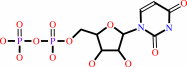 UDP
UDP
|
+
|
H(+)
|
|
|
|
|
|
|
|
|
|
Enzyme class 2:
|
|
E.C.2.4.1.40
- glycoprotein-fucosylgalactoside alpha-N-acetylgalactosaminyltransferase.
|
|
|
|
|
|
|
Reaction:
|
|
an alpha-L-fucosyl-(1->2)-beta-D-galactosyl derivative + UDP-N-acetyl- alpha-D-galactosamine = an N-acetyl-alpha-D-galactosaminyl-(1->3)-[alpha- L-fucosyl-(1->2)]-beta-D-galactosyl derivative + UDP + H+
|
|
|
|
|
|
alpha-L-fucosyl-(1->2)-beta-D-galactosyl derivative
|
+
|
UDP-N-acetyl- alpha-D-galactosamine
|
=
|
N-acetyl-alpha-D-galactosaminyl-(1->3)-[alpha- L-fucosyl-(1->2)]-beta-D-galactosyl derivative
|
+
|
UDP
|
+
|
H(+)
|
|
|
|
|
|
|
|
|
|
|
|
|
Note, where more than one E.C. class is given (as above), each may
correspond to a different protein domain or, in the case of polyprotein
precursors, to a different mature protein.
|
|
|
|
Molecule diagrams generated from .mol files obtained from the
KEGG ftp site
|
|
|
|
|
|
|
|
|
|
|
|
|
|
 |
|
|
|
|
|
|
| |
|
|
| |
|
DOI no:
|
J Biol Chem
280:525-529
(2005)
|
|
PubMed id:
|
|
|
|
|
|
| |
|
Structural basis for the inactivity of human blood group O2 glycosyltransferase.
|
|
H.J.Lee,
C.H.Barry,
S.N.Borisova,
N.O.Seto,
R.B.Zheng,
A.Blancher,
S.V.Evans,
M.M.Palcic.
|
|
|
|
|
| |
ABSTRACT
|
|
|
|
| |
|
|
The human ABO(H) blood group antigens are carbohydrate structures generated by
glycosyltransferase enzymes. Glycosyltransferase A (GTA) uses UDP-GalNAc as a
donor to transfer a monosaccharide residue to Fuc alpha1-2Gal beta-R
(H)-terminating acceptors. Similarly, glycosyltransferase B (GTB) catalyzes the
transfer of a monosaccharide residue from UDP-Gal to the same acceptors. These
are highly homologous enzymes differing in only four of 354 amino acids,
Arg/Gly-176, Gly/Ser-235, Leu/Met-266, and Gly/Ala-268. Blood group O usually
stems from the expression of truncated inactive forms of GTA or GTB. Recently,
an O(2) enzyme was discovered that was a full-length form of GTA with three
mutations, P74S, R176G, and G268R. We showed previously that the R176G mutation
increased catalytic activity with minor effects on substrate binding. Enzyme
kinetics and high resolution structural studies of mutant enzymes based on the
O(2) blood group transferase reveal that whereas the P74S mutation in the stem
region of the protein does not appear to play a role in enzyme inactivation, the
G268R mutation completely blocks the donor GalNAc-binding site leaving the
acceptor binding site unaffected.
|
|
|
|
|
|
| |
Selected figure(s)
|
|
|
|
| |
|
|

|
|

|
|
Figure 1.
FIG. 1. Active site of the O2 glycosyltransferase triple
mutant showing the observed electron density in the active site
of the unliganded enzyme with ordered Arg-268 side chain (a),
and the enzyme crystallized in the presence of the native H
antigen acceptor that causes the Arg-268 and Leu-266 side chains
to become disordered (b).
|
|
Figure 2.
FIG. 2. Overlap of the unliganded O2 enzyme showing Arg-268
and adjacent residues with the observed position of acceptor
(green) and UDP (magenta) of wild-type GTA. The position of the
GalNAc residue (magenta) has been modeled after Patenaude et al.
(6) and shows severe conflicts with the Arg-268 side chain that
completely blocks the sugar residue from the active site.
|
|
|
|
|
|
| |
The above figures are
reprinted
by permission from the ASBMB:
J Biol Chem
(2005,
280,
525-529)
copyright 2005.
|
|
| |
Figures were
selected
by an automated process.
|
|
|
|
|
|
|
|
|
|
|
|
|
|
|
|
 |
 |
 |
|
Literature references that cite this PDB file's key reference
|
|
|
| |
PubMed id
|
|
Reference
|
|
|
|
|
|
B.Schuman,
M.Persson,
R.C.Landry,
R.Polakowski,
J.T.Weadge,
N.O.Seto,
S.N.Borisova,
M.M.Palcic,
and
S.V.Evans
(2010).
Cysteine-to-serine mutants dramatically reorder the active site of human ABO(H) blood group B glycosyltransferase without affecting activity: structural insights into cooperative substrate binding.
|
| |
J Mol Biol,
402,
399-411.
|
|
|
PDB codes:
|
|
|
|
|
|
|
|
M.Kveiborg,
J.Jacobsen,
M.H.Lee,
H.Nagase,
U.M.Wewer,
and
G.Murphy
(2010).
Selective inhibition of ADAM12 catalytic activity through engineering of tissue inhibitor of metalloproteinase 2 (TIMP-2).
|
| |
Biochem J,
430,
79-86.
|
|
|
|
|
|
|
R.Hurtado-Guerrero,
T.Zusman,
S.Pathak,
A.F.Ibrahim,
S.Shepherd,
A.Prescott,
G.Segal,
and
D.M.van Aalten
(2010).
Molecular mechanism of elongation factor 1A inhibition by a Legionella pneumophila glycosyltransferase.
|
| |
Biochem J,
426,
281-292.
|
|
|
PDB codes:
|
|
|
|
|
|
|
|
R.Weinlich,
T.Brunner,
and
G.P.Amarante-Mendes
(2010).
Control of death receptor ligand activity by posttranslational modifications.
|
| |
Cell Mol Life Sci,
67,
1631-1642.
|
|
|
|
|
|
|
D.Christiansen,
J.Milland,
E.Mouhtouris,
H.Vaughan,
D.G.Pellicci,
M.J.McConville,
D.I.Godfrey,
and
M.S.Sandrin
(2008).
Humans lack iGb3 due to the absence of functional iGb3-synthase: implications for NKT cell development and transplantation.
|
| |
PLoS Biol,
6,
e172.
|
|
|
|
|
|
|
L.L.Lairson,
B.Henrissat,
G.J.Davies,
and
S.G.Withers
(2008).
Glycosyltransferases: structures, functions, and mechanisms.
|
| |
Annu Rev Biochem,
77,
521-555.
|
|
|
|
|
|
|
M.H.Yazer,
A.K.Hult,
A.Hellberg,
B.Hosseini-Maaf,
M.M.Palcic,
and
M.L.Olsson
(2008).
Investigation into A antigen expression on O2 heterozygous group O-labeled red blood cell units.
|
| |
Transfusion,
48,
1650-1657.
|
|
|
|
|
|
|
M.H.Yazer,
B.Hosseini-Maaf,
and
M.L.Olsson
(2008).
Blood grouping discrepancies between ABO genotype and phenotype caused by O alleles.
|
| |
Curr Opin Hematol,
15,
618-624.
|
|
|
|
|
|
|
T.Pesnot,
and
G.K.Wagner
(2008).
Novel derivatives of UDP-glucose: concise synthesis and fluorescent properties.
|
| |
Org Biomol Chem,
6,
2884-2891.
|
|
|
|
|
|
|
B.Hosseini-Maaf,
J.A.Letts,
M.Persson,
E.Smart,
P.Y.LePennec,
H.Hustinx,
Z.Zhao,
M.M.Palcic,
S.V.Evans,
M.A.Chester,
and
M.L.Olsson
(2007).
Structural basis for red cell phenotypic changes in newly identified, naturally occurring subgroup mutants of the human blood group B glycosyltransferase.
|
| |
Transfusion,
47,
864-875.
|
|
|
PDB code:
|
|
|
|
|
|
|
|
A.Seltsam,
C.Das Gupta,
C.Bade-Doeding,
and
R.Blasczyk
(2006).
A weak blood group A phenotype caused by a translation-initiator mutation in the ABO gene.
|
| |
Transfusion,
46,
434-440.
|
|
|
|
|
|
|
A.Seltsam,
and
R.Blasczyk
(2005).
Missense mutations outside the catalytic domain of the ABO glycosyltransferase can cause weak blood group A and B phenotypes.
|
| |
Transfusion,
45,
1663-1669.
|
|
|
|
|
|
|
M.H.Yazer,
G.A.Denomme,
N.L.Rose,
and
M.M.Palcic
(2005).
Amino-acid substitution in the disordered loop of blood group B-glycosyltransferase enzyme causes weak B phenotype.
|
| |
Transfusion,
45,
1178-1182.
|
|
|
|
|
|
|
M.L.Olsson,
B.Michalewska,
A.Hellberg,
A.Walaszczyk,
and
M.A.Chester
(2005).
A clue to the basis of allelic enhancement: occurrence of the Ax subgroup in the offspring of blood group O parents.
|
| |
Transfus Med,
15,
435-442.
|
|
|
|
|
|
The most recent references are shown first.
Citation data come partly from CiteXplore and partly
from an automated harvesting procedure. Note that this is likely to be
only a partial list as not all journals are covered by
either method. However, we are continually building up the citation data
so more and more references will be included with time.
Where a reference describes a PDB structure, the PDB
codes are
shown on the right.
|
|


 Links
Links


