 |
PDBsum entry 1wnh

|
|
|
|
|
|

|

|

|

|
|

|
|

|
|
|
 |

|

|
|
|
|
|
|
|
|
|
|
|
|
|
|
|
|
|
|
|
|
|
|
|
|
|
|
|
|
|
|
|
Hydrolase inhibitor
|
PDB id
|
|
|
|
1wnh
|
|
|
|
|
|
|
|
|
|
|
|
|
|
|

|

|

|
|
|
|
|
|
|
|
 |
Contents |
 |
|
|
|
|
|
|
|
|
|
|
* Residue conservation analysis
|
|
|
|
|
|
PDB id:
|
|
|
|
| Name: |
|
Hydrolase inhibitor
|
|
|
Title:
|
|
Crystal structure of mouse latexin (tissue carboxypeptidase inhibitor)
|
|
Structure:
|
|
Latexin. Chain: a. Synonym: carboxypeptidase inhibitor. Engineered: yes
|
|
Source:
|
|
Mus musculus. House mouse. Organism_taxid: 10090. Gene: lxn. Expressed in: escherichia coli. Expression_system_taxid: 562.
|
|
Biol. unit:
|
|
 Dimer (from
)
Dimer (from
)
|
|
Resolution:
|
|
|
1.83Å
|
R-factor:
|
0.211
|
R-free:
|
0.237
|
|
|
Authors:
|
|
A.Aagaard,P.Listwan,N.Cowieson,T.Huber,T.Ravasi,C.A.Wells, J.U.Flanagan,D.A.Hume,B.Kobe,J.L.Martin
|
Key ref:

|
|
A.Aagaard
et al.
(2005).
An inflammatory role for the mammalian carboxypeptidase inhibitor latexin: relationship to cystatins and the tumor suppressor TIG1.
Structure,
13,
309-317.
PubMed id:
DOI:

|
|
|
Date:
|
|
|
04-Aug-04
|
Release date:
|
15-Feb-05
|
|
|
|
|
|
|
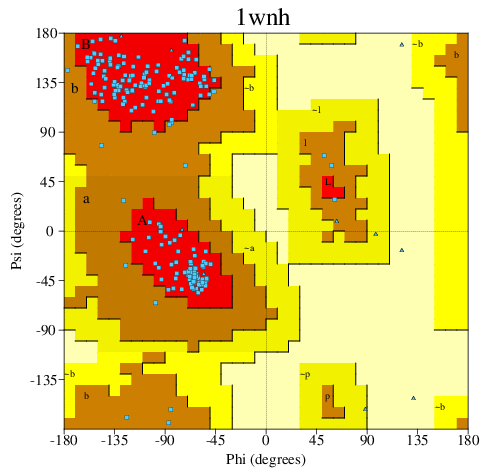
PROCHECK
|
|
|
|
|
|
Headers
|
|
|
|
References
|
|
|
|
|
|

|
|
P70202
(LXN_MOUSE) -
Latexin from Mus musculus
|
|
|
|
Seq:
Struc:
|
|
|
|
222 a.a.
220 a.a.
|
|

|

|
|
|
|
|
|
|
|
|
|
|
|
Key: |
 |
PfamA domain |
|
|
 |
Secondary structure |
|
 |
CATH domain |
|
|
|
|
|
|
|
|
|
|
|
|
|
|
|
|
|
 |
|
|
|
|
|
|
| |
|
DOI no:
|
Structure
13:309-317
(2005)
|
|
PubMed id:
|
|
|
|
|
|
| |
|
An inflammatory role for the mammalian carboxypeptidase inhibitor latexin: relationship to cystatins and the tumor suppressor TIG1.
|
|
A.Aagaard,
P.Listwan,
N.Cowieson,
T.Huber,
T.Ravasi,
C.A.Wells,
J.U.Flanagan,
S.Kellie,
D.A.Hume,
B.Kobe,
J.L.Martin.
|
|
|
|
|
| |
ABSTRACT
|
|
|
|
| |
|
|
Latexin, the only known mammalian carboxypeptidase inhibitor, has no detectable
sequence similarity with plant and parasite inhibitors, but it is related to a
human putative tumor suppressor protein, TIG1. Latexin is expressed in the
developing brain, and we find that it plays a role in inflammation, as it is
expressed at high levels and is inducible in macrophages in concert with other
protease inhibitors and potential protease targets. The crystal structure of
mouse latexin, solved at 1.83 A resolution, shows no structural relationship
with other carboxypeptidase inhibitors. Furthermore, despite a lack of
detectable sequence duplication, the structure incorporates two topologically
analogous domains related by pseudo two-fold symmetry. Surprisingly, these
domains share a cystatin fold architecture found in proteins that inhibit
cysteine proteases, suggesting an evolutionary and possibly functional
relationship. The structure of the tumor suppressor protein TIG1 was modeled,
revealing its putative membrane binding surface.
|
|
|
|
|
|
| |
Selected figure(s)
|
|
|
|
| |
|
|

|
|
Figure 4.
Figure 4. Diversity and Similarity in CP Inhibitors,
Cystatin, and Monellin
(A-F) Structures of CP inhibitors
from (A) potato (4CPA [Rees and Lipscomb, 1982]) and (B) leech
(1DTV [Reverter et al., 2000]) are very different from the
structure of mammalian CP inhibitor, (C) latexin. However,
latexin (N-terminal domain, [D]) is structurally related to
proteins in the (E) cystatin (cysteine protease inhibitor,
chicken cystatin) (1CEW [Bode et al., 1988]) and (F) monellin
(sweet-tasting protein) (1MOL [Somoza et al., 1993]) fold family.
|
|
|
|
|
|
| |
The above figure is
reprinted
by permission from Cell Press:
Structure
(2005,
13,
309-317)
copyright 2005.
|
|
| |
Figure was
selected
by the author.
|
|
|
|
|
|
|
|
|
|
|
|
|
|
|
|
 |
 |
 |
|
Literature references that cite this PDB file's key reference
|
|
|
| |
PubMed id
|
|
Reference
|
|
|
|
|
|
Y.Li,
Z.Basang,
H.Ding,
Z.Lu,
T.Ning,
H.Wei,
H.Cai,
and
Y.Ke
(2011).
Latexin expression is downregulated in human gastric carcinomas and exhibits tumor suppressor potential.
|
| |
BMC Cancer,
11,
121.
|
|
|
|
|
|
|
E.Pérez,
J.L.Gallegos,
L.Cortés,
K.G.Calderón,
J.C.Luna,
F.E.Cázares,
M.C.Velasquillo,
J.B.Kouri,
and
F.C.Hernández
(2010).
Identification of latexin by a proteomic analysis in rat normal articular cartilage.
|
| |
Proteome Sci,
8,
27.
|
|
|
|
|
|
|
D.Kordis,
and
V.Turk
(2009).
Phylogenomic analysis of the cystatin superfamily in eukaryotes and prokaryotes.
|
| |
BMC Evol Biol,
9,
266.
|
|
|
|
|
|
|
G.J.King,
K.E.Chen,
G.Robin,
J.K.Forwood,
B.Heras,
A.S.Thakur,
B.Kobe,
S.P.Blomberg,
and
J.L.Martin
(2009).
Interaction between plate make and protein in protein crystallisation screening.
|
| |
PLoS One,
4,
e7851.
|
|
|
|
|
|
|
G.Van Zant,
and
Y.Liang
(2009).
Natural genetic diversity as a means to uncover stem cell regulatory pathways.
|
| |
Ann N Y Acad Sci,
1176,
170-177.
|
|
|
|
|
|
|
M.L.Rose,
and
M.T.Hincke
(2009).
Protein constituents of the eggshell: eggshell-specific matrix proteins.
|
| |
Cell Mol Life Sci,
66,
2707-2719.
|
|
|
|
|
|
|
N.P.Cowieson,
A.J.Miles,
G.Robin,
J.K.Forwood,
B.Kobe,
J.L.Martin,
and
B.A.Wallace
(2008).
Evaluating protein:protein complex formation using synchrotron radiation circular dichroism spectroscopy.
|
| |
Proteins,
70,
1142-1146.
|
|
|
|
|
|
|
Y.Liang,
and
G.Van Zant
(2008).
Aging stem cells, latexin, and longevity.
|
| |
Exp Cell Res,
314,
1962-1972.
|
|
|
|
|
|
|
I.Pallarés,
C.Berenguer,
F.X.Avilés,
J.Vendrell,
and
S.Ventura
(2007).
Self-assembly of human latexin into amyloid-like oligomers.
|
| |
BMC Struct Biol,
7,
75.
|
|
|
|
|
|
|
R.Koike,
K.Kinoshita,
and
A.Kidera
(2007).
Probabilistic alignment detects remote homology in a pair of protein sequences without homologous sequence information.
|
| |
Proteins,
66,
655-663.
|
|
|
|
|
|
|
Y.Liang,
M.Jansen,
B.Aronow,
H.Geiger,
and
G.Van Zant
(2007).
The quantitative trait gene latexin influences the size of the hematopoietic stem cell population in mice.
|
| |
Nat Genet,
39,
178-188.
|
|
|
|
|
|
|
D.Keppler
(2006).
Towards novel anti-cancer strategies based on cystatin function.
|
| |
Cancer Lett,
235,
159-176.
|
|
|
|
|
|
|
P.R.Mittl,
and
M.G.Grütter
(2006).
Opportunities for structure-based design of protease-directed drugs.
|
| |
Curr Opin Struct Biol,
16,
769-775.
|
|
|
|
|
|
|
D.Keppler,
and
F.Sierra
(2005).
Role of cystatins in tumor neovascularization.
|
| |
Future Oncol,
1,
661-672.
|
|
|
|
|
|
The most recent references are shown first.
Citation data come partly from CiteXplore and partly
from an automated harvesting procedure. Note that this is likely to be
only a partial list as not all journals are covered by
either method. However, we are continually building up the citation data
so more and more references will be included with time.
|
|


 Links
Links


