|
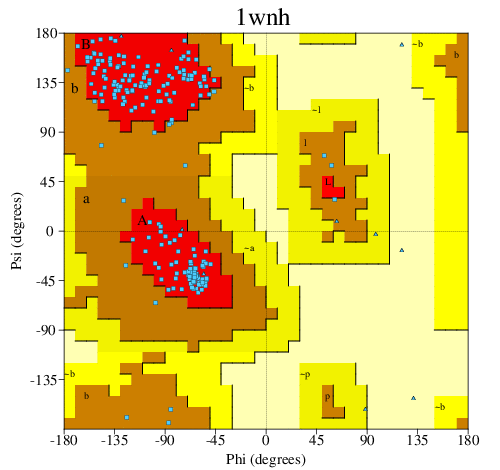
PDBsum entry 1wnh

|
|
|
|
|
|

|
|

|
|

|
|

|
|
|
 |

|

|
|
|
|
|
|
|
|
|
|
|
|
|
|
|
|
|
|
|
|
|
|
|
|
|
|
|
|
|
Hydrolase inhibitor
|
PDB id
|
|
|
|
1wnh
|
|
|
|
|
|
|
|
|
|
|
|
|
|
|

|

|

|
|
|
|
|
|
References listed in PDB file
|
|
|
Key reference
|
|
|
Title
|
|
An inflammatory role for the mammalian carboxypeptidase inhibitor latexin: relationship to cystatins and the tumor suppressor tig1.
|
|
|
Authors
|
|
A.Aagaard,
P.Listwan,
N.Cowieson,
T.Huber,
T.Ravasi,
C.A.Wells,
J.U.Flanagan,
S.Kellie,
D.A.Hume,
B.Kobe,
J.L.Martin.
|
|
|
Ref.
|
|
Structure, 2005,
13,
309-317.
[DOI no: ]
|
|
|
PubMed id
|
|
|
|
|
|
Abstract
|
|
|
Latexin, the only known mammalian carboxypeptidase inhibitor, has no detectable
sequence similarity with plant and parasite inhibitors, but it is related to a
human putative tumor suppressor protein, TIG1. Latexin is expressed in the
developing brain, and we find that it plays a role in inflammation, as it is
expressed at high levels and is inducible in macrophages in concert with other
protease inhibitors and potential protease targets. The crystal structure of
mouse latexin, solved at 1.83 A resolution, shows no structural relationship
with other carboxypeptidase inhibitors. Furthermore, despite a lack of
detectable sequence duplication, the structure incorporates two topologically
analogous domains related by pseudo two-fold symmetry. Surprisingly, these
domains share a cystatin fold architecture found in proteins that inhibit
cysteine proteases, suggesting an evolutionary and possibly functional
relationship. The structure of the tumor suppressor protein TIG1 was modeled,
revealing its putative membrane binding surface.
|
|
|
|

|
|
Figure 4.
Figure 4. Diversity and Similarity in CP Inhibitors,
Cystatin, and Monellin
(A-F) Structures of CP inhibitors
from (A) potato (4CPA [Rees and Lipscomb, 1982]) and (B) leech
(1DTV [Reverter et al., 2000]) are very different from the
structure of mammalian CP inhibitor, (C) latexin. However,
latexin (N-terminal domain, [D]) is structurally related to
proteins in the (E) cystatin (cysteine protease inhibitor,
chicken cystatin) (1CEW [Bode et al., 1988]) and (F) monellin
(sweet-tasting protein) (1MOL [Somoza et al., 1993]) fold family.
|
|
|
|
|
|
The above figure is
reprinted
by permission from Cell Press:
Structure
(2005,
13,
309-317)
copyright 2005.
|
|
|
|
|
|
|