|
PDBsum entry 1vsk

|
|
|
|
|
 |
Contents |
 |
|
|
|
|
|
|
|
|
|
|
* Residue conservation analysis
|
|
|
|
|
|
|
|
|
|
|
Enzyme class 2:
|
|
E.C.2.7.7.-
- ?????
|
|
|
|
|
|
|
Enzyme class 3:
|
|
E.C.2.7.7.49
- RNA-directed Dna polymerase.
|
|
|
|
|
|
|
Reaction:
|
|
DNA(n) + a 2'-deoxyribonucleoside 5'-triphosphate = DNA(n+1) + diphosphate
|
|
|
|
|
|
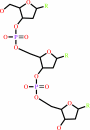 DNA(n)
|
+
|
2'-deoxyribonucleoside 5'-triphosphate
|
=
|
DNA(n+1)
|
+
|
 diphosphate
|
|
|
|
|
|
|
|
|
|
Enzyme class 4:
|
|
E.C.2.7.7.7
- DNA-directed Dna polymerase.
|
|
|
|
|
|
|
Reaction:
|
|
DNA(n) + a 2'-deoxyribonucleoside 5'-triphosphate = DNA(n+1) + diphosphate
|
|
|
|
|
|
DNA(n)
|
+
|
2'-deoxyribonucleoside 5'-triphosphate
|
=
|
DNA(n+1)
|
+
|
diphosphate
|
|
|
|
|
|
|
|
|
|
Enzyme class 5:
|
|
E.C.3.1.-.-
|
|
|
|
|
|
|
Enzyme class 6:
|
|
E.C.3.1.26.4
- ribonuclease H.
|
|
|
|
|
|
|
Reaction:
|
|
Endonucleolytic cleavage to 5'-phosphomonoester.
|
|
|
|
|
|
Enzyme class 7:
|
|
E.C.3.4.23.-
- ?????
|
|
|
|
|
|
|
|
|
|
Note, where more than one E.C. class is given (as above), each may
correspond to a different protein domain or, in the case of polyprotein
precursors, to a different mature protein.
|
|
|
|
Molecule diagrams generated from .mol files obtained from the
KEGG ftp site
|
|
|
|
|
|
|
|
|
|
|
|
|
|
 |
|
|
|
|
|
|
| |
|
|
| |
|
DOI no:
|
J Biol Chem
273:32685-32689
(1998)
|
|
PubMed id:
|
|
|
|
|
|
| |
|
Structural basis for inactivating mutations and pH-dependent activity of avian sarcoma virus integrase.
|
|
J.Lubkowski,
F.Yang,
J.Alexandratos,
G.Merkel,
R.A.Katz,
K.Gravuer,
A.M.Skalka,
A.Wlodawer.
|
|
|
|
|
| |
ABSTRACT
|
|
|
|
| |
|
|
Crystallographic studies of the catalytic core domain of avian sarcoma virus
integrase (ASV IN) have provided the most detailed picture so far of the active
site of this enzyme, which belongs to an important class of targets for
designing drugs against AIDS. Recently, crystals of an inactive D64N mutant were
obtained under conditions identical to those used for the native enzyme. Data
were collected at different pH values and in the presence of divalent cations.
Data were also collected at low pH for the crystals of the native ASV IN core
domain. In the structures of native ASV IN at pH 6.0 and below, as well as in
all structures of the D64N mutants, the side chain of the active site residue
Asx-64 (Asx denotes Asn or Asp) is rotated by approximately 150 degrees around
the Calpha---Cbeta bond, compared with the structures at higher pH. In the new
structures, this residue makes hydrogen bonds with the amide group of Asn-160,
and thus, the usual metal-binding site, consisting of Asp-64, Asp-121, and
Glu-157, is disrupted. Surprisingly, however, a single Zn2+ can still bind to
Asp-121 in the mutant, without restoration of the activity of the enzyme. These
structures have elucidated an unexpected mechanism of inactivation of the enzyme
by lowering the pH or by mutation, in which a protonated side chain of Asx-64
changes its orientation and interaction partner.
|
|
|
|
|
|
| |
Selected figure(s)
|
|
|
|
| |
|
|

|
|

|
|
Figure 1.
Fig. 1. The active site of ASV IN (catalytic core
domain). A, F[o]  F[c]
difference density "omit" map, contoured at 2.5 F[c]
difference density "omit" map, contoured at 2.5  , showing
the position of the side chain of D64N (blue) compared with the
side chain of Asp-64 (brown) in the active conformation. The
hydrogen bonding pattern of a structurally conserved water
molecule observed in all ASV IN structures is also shown. B,
hydrogen bonding of the side chain of D64N with Asn-160. The
hydrogen bonding pattern of a structurally conserved water
molecule observed in all ASV IN structures is also shown. C,
hydrogen bonding of the side chain of Asp-64 with the
structurally conserved water. , showing
the position of the side chain of D64N (blue) compared with the
side chain of Asp-64 (brown) in the active conformation. The
hydrogen bonding pattern of a structurally conserved water
molecule observed in all ASV IN structures is also shown. B,
hydrogen bonding of the side chain of D64N with Asn-160. The
hydrogen bonding pattern of a structurally conserved water
molecule observed in all ASV IN structures is also shown. C,
hydrogen bonding of the side chain of Asp-64 with the
structurally conserved water.
|
|
Figure 2.
Fig. 2. The active site of ASV IN (catalytic core domain)
with bound zinc cation(s). A, 2F[o] F[c]
density map, contoured at 2.5 , showing
the bound Zn2+ hydrogen bonded only to the side chain of
Asp-121. The side chain of D64N is hydrogen bonded to Asn-160.
B, a previously determined structure of ASV IN, showing the
bound zinc cations hydrogen bonded to the side chains of Asp-64
and Asp-121.
|
|
|
|
|
|
| |
The above figures are
reprinted
by permission from the ASBMB:
J Biol Chem
(1998,
273,
32685-32689)
copyright 1998.
|
|
| |
Figures were
selected
by the author.
|
|
|
|
|
|
|
|
|
|
|
|
|
|
|
|
 |
 |
 |
|
Literature references that cite this PDB file's key reference
|
|
|
| |
PubMed id
|
|
Reference
|
|
|
|
|
|
N.C.Fitzkee,
D.A.Torchia,
and
A.Bax
(2011).
Measuring rapid hydrogen exchange in the homodimeric 36 kDa HIV-1 integrase catalytic core domain.
|
| |
Protein Sci,
20,
500-512.
|
|
|
|
|
|
|
M.Jaskolski,
J.N.Alexandratos,
G.Bujacz,
and
A.Wlodawer
(2009).
Piecing together the structure of retroviral integrase, an important target in AIDS therapy.
|
| |
FEBS J,
276,
2926-2946.
|
|
|
|
|
|
|
J.Snásel,
Z.Krejcík,
V.Jencová,
I.Rosenberg,
T.Ruml,
J.Alexandratos,
A.Gustchina,
and
I.Pichová
(2005).
Integrase of Mason-Pfizer monkey virus.
|
| |
FEBS J,
272,
203-216.
|
|
|
|
|
|
The most recent references are shown first.
Citation data come partly from CiteXplore and partly
from an automated harvesting procedure. Note that this is likely to be
only a partial list as not all journals are covered by
either method. However, we are continually building up the citation data
so more and more references will be included with time.
|
|


 Links
Links