 |
PDBsum entry 1vsh

|
|
|
|
|
 |
Contents |
 |
|
|
|
|
|
|
|
|
|
|
|
|
|
|
* Residue conservation analysis
|
|
|
|
|
|
PDB id:
|
|
|
|
| Name: |
|
Endonuclease
|
|
|
Title:
|
|
Asv integrase core domain with zn(ii) cofactors
|
|
Structure:
|
|
Integrase. Chain: a. Fragment: catalytic core domain, residues 1 - 4, 52 - 209. Engineered: yes
|
|
Source:
|
|
Rous sarcoma virus (strain schmidt-ruppin). Organism_taxid: 11889. Strain: schmidt-ruppin. Expressed in: escherichia coli. Expression_system_taxid: 562. Other_details: original viral DNA clone: ju et al., J. Virol. 33:1026-1033 (1980), original expression clone terry et al., J. Virol. 62:2358-2365 (1988), expression clone for core: kulkosky et al., J. Virol. 206:448-456 (1995).
|
|
Biol. unit:
|
|
 Dimer (from PDB file)
|
|
Resolution:
|
|
|
|
Authors:
|
|
G.Bujacz,J.Alexandratos,A.Wlodawer
|
Key ref:

|
|
G.Bujacz
et al.
(1997).
Binding of different divalent cations to the active site of avian sarcoma virus integrase and their effects on enzymatic activity.
J Biol Chem,
272,
18161-18168.
PubMed id:
DOI:

|
|
|
Date:
|
|
|
04-Mar-97
|
Release date:
|
15-May-97
|
|
|
|
|
|
|
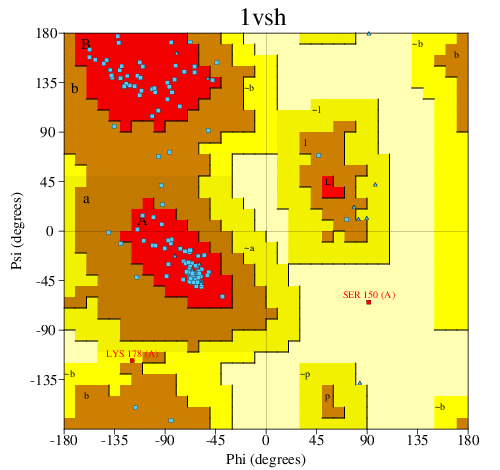
PROCHECK
|
|
|
|
|
|
Headers
|
|
|
|
References
|
|
|
|
|
|

|
|
O92956
(POL_RSVSB) -
Gag-Pol polyprotein from Rous sarcoma virus subgroup B (strain Schmidt-Ruppin)
|
|
|
|
Seq:
Struc:
|
|
|
|
1603 a.a.
146 a.a.*
|
|

|

|
|
|
|
|
|
|
|
|
|
|
|
Key: |
 |
PfamA domain |
|
|
 |
Secondary structure |
|
 |
CATH domain |
|
|
*
PDB and UniProt seqs differ
at 2 residue positions (black
crosses)
|
|
|
|
|
|
|
|
|
|
|
|
|
Enzyme class 2:
|
|
E.C.2.7.7.-
- ?????
|
|
|
|
|
|
|
Enzyme class 3:
|
|
E.C.2.7.7.49
- RNA-directed Dna polymerase.
|
|
|
|
|
|
|
Reaction:
|
|
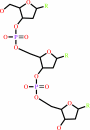
DNA(n) + a 2'-deoxyribonucleoside 5'-triphosphate = DNA(n+1) + diphosphate
|
|
|
|
|
|
 DNA(n)
|
+
|
2'-deoxyribonucleoside 5'-triphosphate
|
=
|
DNA(n+1)
|
+
|
 diphosphate
|
|
|
|
|
|
|
|
|
|
Enzyme class 4:
|
|
E.C.2.7.7.7
- DNA-directed Dna polymerase.
|
|
|
|
|
|
|
Reaction:
|
|
DNA(n) + a 2'-deoxyribonucleoside 5'-triphosphate = DNA(n+1) + diphosphate
|
|
|
|
|
|
DNA(n)
|
+
|
2'-deoxyribonucleoside 5'-triphosphate
|
=
|
DNA(n+1)
|
+
|
diphosphate
|
|
|
|
|
|
|
|
|
|
Enzyme class 5:
|
|
E.C.3.1.-.-
|
|
|
|
|
|
|
Enzyme class 6:
|
|
E.C.3.1.26.4
- ribonuclease H.
|
|
|
|
|
|
|
Reaction:
|
|
Endonucleolytic cleavage to 5'-phosphomonoester.
|
|
|
|
|
|
Enzyme class 7:
|
|
E.C.3.4.23.-
- ?????
|
|
|
|
|
|
|
|
|
|
Note, where more than one E.C. class is given (as above), each may
correspond to a different protein domain or, in the case of polyprotein
precursors, to a different mature protein.
|
|
|
|
Molecule diagrams generated from .mol files obtained from the
KEGG ftp site
|
|
|
|
|
|
|
|
|
|
|
|
|
|
 |
|
|
|
|
|
|
| |
|
|
| |
|
DOI no:
|
J Biol Chem
272:18161-18168
(1997)
|
|
PubMed id:
|
|
|
|
|
|
| |
|
Binding of different divalent cations to the active site of avian sarcoma virus integrase and their effects on enzymatic activity.
|
|
G.Bujacz,
J.Alexandratos,
A.Wlodawer,
G.Merkel,
M.Andrake,
R.A.Katz,
A.M.Skalka.
|
|
|
|
|
| |
ABSTRACT
|
|
|
|
| |
|
|
Retroviral integrases (INs) contain two known metal binding domains. The
N-terminal domain includes a zinc finger motif and has been shown to bind Zn2+,
whereas the central catalytic core domain includes a triad of acidic amino acids
that bind Mn2+ or Mg2+, the metal cofactors required for enzymatic activity. The
integration reaction occurs in two distinct steps; the first is a specific
endonucleolytic cleavage step called "processing," and the second is a
polynucleotide transfer or "joining" step. Our previous results showed
that the metal preference for in vitro activity of avian sarcoma virus IN is
Mn2+ > Mg2+ and that a single cation of either metal is coordinated by two of
the three critical active site residues (Asp-64 and Asp-121) in crystals of the
isolated catalytic domain. Here, we report that Ca2+, Zn2+, and Cd2+ can also
bind in the active site of the catalytic domain. Furthermore, two zinc and
cadmium cations are bound at the active site, with all three residues of the
active site triad (Asp-64, Asp-121, and Glu-157) contributing to their
coordination. These results are consistent with a two-metal mechanism for
catalysis by retroviral integrases. We also show that Zn2+ can serve as a
cofactor for the endonucleolytic reactions catalyzed by either the full-length
protein, a derivative lacking the N-terminal domain, or the isolated catalytic
domain of avian sarcoma virus IN. However, polynucleotidyl transferase
activities are severely impaired or undetectable in the presence of Zn2+. Thus,
although the processing and joining steps of integrase employ a similar
mechanism and the same active site triad, they can be clearly distinguished by
their metal preferences.
|
|
|
|
|
|
| |
Selected figure(s)
|
|
|
|
| |
|
|

|
|

|
|
Figure 2.
Fig. 2. A stereo view of the active site of ASV IN in the
presence of divalent cations. Shown are the superimposed
coordinates of the side chains of Asp-64 (D64), Asp-121 (D121),
and Glu-157^ (E157) as well as the divalent cations. The
complexes presented^ here are with Mn2+ (yellow), Zn2+ (green),
Cd^2+ (red), and Ca^2+ (blue).
|
|
Figure 6.
Fig. 6. The environment of Mg2+ and Zn2+ divalent cations in
the active site of polynucleotidyltransferases. The residues
forming the D,D(35)E motif in the active site of ASV IN (green)
are compared^ with the equivalent sites of HIV-1 RNase H (blue)
as well as of^ the exonuclease domain of the Klenow fragment of
DNA I polymerase^ (pink). One of the water molecules present in
site I of ASV IN is found in a position occupied by carboxylate
oxygens (O) in the other two structures. D, Asp-; E, Glu-.
|
|
|
|
|
|
| |
The above figures are
reprinted
by permission from the ASBMB:
J Biol Chem
(1997,
272,
18161-18168)
copyright 1997.
|
|
| |
Figures were
selected
by the author.
|
|
|
|
|
|
|
|
|
|
|
|
|
|
|
|
 |
 |
 |
|
Literature references that cite this PDB file's key reference
|
|
|
| |
PubMed id
|
|
Reference
|
|
|
|
|
|
A.L.Perryman,
S.Forli,
G.M.Morris,
C.Burt,
Y.Cheng,
M.J.Palmer,
K.Whitby,
J.A.McCammon,
C.Phillips,
and
A.J.Olson
(2010).
A dynamic model of HIV integrase inhibition and drug resistance.
|
| |
J Mol Biol,
397,
600-615.
|
|
|
|
|
|
|
S.Hare,
S.S.Gupta,
E.Valkov,
A.Engelman,
and
P.Cherepanov
(2010).
Retroviral intasome assembly and inhibition of DNA strand transfer.
|
| |
Nature,
464,
232-236.
|
|
|
PDB codes:
|
|
|
|
|
|
|
|
C.Marchand,
K.Maddali,
M.Métifiot,
and
Y.Pommier
(2009).
HIV-1 IN inhibitors: 2010 update and perspectives.
|
| |
Curr Top Med Chem,
9,
1016-1037.
|
|
|
|
|
|
|
M.Jaskolski,
J.N.Alexandratos,
G.Bujacz,
and
A.Wlodawer
(2009).
Piecing together the structure of retroviral integrase, an important target in AIDS therapy.
|
| |
FEBS J,
276,
2926-2946.
|
|
|
|
|
|
|
M.L.Barreca,
N.Iraci,
L.De Luca,
and
A.Chimirri
(2009).
Induced-fit docking approach provides insight into the binding mode and mechanism of action of HIV-1 integrase inhibitors.
|
| |
ChemMedChem,
4,
1446-1456.
|
|
|
|
|
|
|
S.P.Moore,
and
D.J.Garfinkel
(2009).
Functional analysis of N-terminal residues of ty1 integrase.
|
| |
J Virol,
83,
9502-9511.
|
|
|
|
|
|
|
S.V.Lipchock,
and
S.A.Strobel
(2008).
A relaxed active site after exon ligation by the group I intron.
|
| |
Proc Natl Acad Sci U S A,
105,
5699-5704.
|
|
|
PDB codes:
|
|
|
|
|
|
|
|
A.Savarino
(2007).
In-Silico docking of HIV-1 integrase inhibitors reveals a novel drug type acting on an enzyme/DNA reaction intermediate.
|
| |
Retrovirology,
4,
21.
|
|
|
|
|
|
|
G.Ren,
K.Gao,
F.D.Bushman,
and
M.Yeager
(2007).
Single-particle image reconstruction of a tetramer of HIV integrase bound to DNA.
|
| |
J Mol Biol,
366,
286-294.
|
|
|
|
|
|
|
J.M.Richardson,
A.Dawson,
N.O'Hagan,
P.Taylor,
D.J.Finnegan,
and
M.D.Walkinshaw
(2006).
Mechanism of Mos1 transposition: insights from structural analysis.
|
| |
EMBO J,
25,
1324-1334.
|
|
|
PDB code:
|
|
|
|
|
|
|
|
J.Ramcharan,
D.M.Colleluori,
G.Merkel,
M.D.Andrake,
and
A.M.Skalka
(2006).
Mode of inhibition of HIV-1 Integrase by a C-terminal domain-specific monoclonal antibody.
|
| |
Retrovirology,
3,
34.
|
|
|
|
|
|
|
S.Kehlenbeck,
U.Betz,
A.Birkmann,
B.Fast,
A.H.Göller,
K.Henninger,
T.Lowinger,
D.Marrero,
A.Paessens,
D.Paulsen,
V.Pevzner,
R.Schohe-Loop,
H.Tsujishita,
R.Welker,
J.Kreuter,
H.Rübsamen-Waigmann,
and
F.Dittmer
(2006).
Dihydroxythiophenes are novel potent inhibitors of human immunodeficiency virus integrase with a diketo acid-like pharmacophore.
|
| |
J Virol,
80,
6883-6894.
|
|
|
|
|
|
|
T.L.Diamond,
and
F.D.Bushman
(2006).
Role of metal ions in catalysis by HIV integrase analyzed using a quantitative PCR disintegration assay.
|
| |
Nucleic Acids Res,
34,
6116-6125.
|
|
|
|
|
|
|
F.V.Rivas,
N.H.Tolia,
J.J.Song,
J.P.Aragon,
J.Liu,
G.J.Hannon,
and
L.Joshua-Tor
(2005).
Purified Argonaute2 and an siRNA form recombinant human RISC.
|
| |
Nat Struct Mol Biol,
12,
340-349.
|
|
|
PDB codes:
|
|
|
|
|
|
|
|
J.Didierjean,
C.Isel,
F.Querré,
J.F.Mouscadet,
A.M.Aubertin,
J.Y.Valnot,
S.R.Piettre,
and
R.Marquet
(2005).
Inhibition of human immunodeficiency virus type 1 reverse transcriptase, RNase H, and integrase activities by hydroxytropolones.
|
| |
Antimicrob Agents Chemother,
49,
4884-4894.
|
|
|
|
|
|
|
J.Snásel,
Z.Krejcík,
V.Jencová,
I.Rosenberg,
T.Ruml,
J.Alexandratos,
A.Gustchina,
and
I.Pichová
(2005).
Integrase of Mason-Pfizer monkey virus.
|
| |
FEBS J,
272,
203-216.
|
|
|
|
|
|
|
Y.Pommier,
A.A.Johnson,
and
C.Marchand
(2005).
Integrase inhibitors to treat HIV/AIDS.
|
| |
Nat Rev Drug Discov,
4,
236-248.
|
|
|
|
|
|
|
K.Gao,
S.Wong,
and
F.Bushman
(2004).
Metal binding by the D,DX35E motif of human immunodeficiency virus type 1 integrase: selective rescue of Cys substitutions by Mn2+ in vitro.
|
| |
J Virol,
78,
6715-6722.
|
|
|
|
|
|
|
R.G.Karki,
Y.Tang,
T.R.Burke,
and
M.C.Nicklaus
(2004).
Model of full-length HIV-1 integrase complexed with viral DNA as template for anti-HIV drug design.
|
| |
J Comput Aided Mol Des,
18,
739-760.
|
|
|
|
|
|
|
A.L.Harper,
M.Sudol,
and
M.Katzman
(2003).
An amino acid in the central catalytic domain of three retroviral integrases that affects target site selection in nonviral DNA.
|
| |
J Virol,
77,
3838-3845.
|
|
|
|
|
|
|
M.J.Curcio,
and
K.M.Derbyshire
(2003).
The outs and ins of transposition: from mu to kangaroo.
|
| |
Nat Rev Mol Cell Biol,
4,
865-877.
|
|
|
|
|
|
|
M.L.Barreca,
K.W.Lee,
A.Chimirri,
and
J.M.Briggs
(2003).
Molecular dynamics studies of the wild-type and double mutant HIV-1 integrase complexed with the 5CITEP inhibitor: mechanism for inhibition and drug resistance.
|
| |
Biophys J,
84,
1450-1463.
|
|
|
|
|
|
|
J.A.Grobler,
K.Stillmock,
B.Hu,
M.Witmer,
P.Felock,
A.S.Espeseth,
A.Wolfe,
M.Egbertson,
M.Bourgeois,
J.Melamed,
J.S.Wai,
S.Young,
J.Vacca,
and
D.J.Hazuda
(2002).
Diketo acid inhibitor mechanism and HIV-1 integrase: implications for metal binding in the active site of phosphotransferase enzymes.
|
| |
Proc Natl Acad Sci U S A,
99,
6661-6666.
|
|
|
|
|
|
|
S.Lovell,
I.Y.Goryshin,
W.R.Reznikoff,
and
I.Rayment
(2002).
Two-metal active site binding of a Tn5 transposase synaptic complex.
|
| |
Nat Struct Biol,
9,
278-281.
|
|
|
PDB codes:
|
|
|
|
|
|
|
|
A.L.Harper,
L.M.Skinner,
M.Sudol,
and
M.Katzman
(2001).
Use of patient-derived human immunodeficiency virus type 1 integrases to identify a protein residue that affects target site selection.
|
| |
J Virol,
75,
7756-7762.
|
|
|
|
|
|
|
A.Pingoud,
and
A.Jeltsch
(2001).
Structure and function of type II restriction endonucleases.
|
| |
Nucleic Acids Res,
29,
3705-3727.
|
|
|
|
|
|
|
A.B.Hickman,
Y.Li,
S.V.Mathew,
E.W.May,
N.L.Craig,
and
F.Dyda
(2000).
Unexpected structural diversity in DNA recombination: the restriction endonuclease connection.
|
| |
Mol Cell,
5,
1025-1034.
|
|
|
PDB code:
|
|
|
|
|
|
|
|
J.Yi,
and
A.M.Skalka
(2000).
Mapping epitopes of monoclonal antibodies against HIV-1 integrase with limited proteolysis and matrix-assisted laser desorption ionization time-of-flight mass spectrometry.
|
| |
Biopolymers,
55,
308-318.
|
|
|
|
|
|
|
R.D.Lins,
T.P.Straatsma,
and
J.M.Briggs
(2000).
Similarities in the HIV-1 and ASV integrase active sites upon metal cofactor binding.
|
| |
Biopolymers,
53,
308-315.
|
|
|
|
|
|
|
J.Yi,
E.Asante-Appiah,
and
A.M.Skalka
(1999).
Divalent cations stimulate preferential recognition of a viral DNA end by HIV-1 integrase.
|
| |
Biochemistry,
38,
8458-8468.
|
|
|
|
|
|
|
L.Haren,
B.Ton-Hoang,
and
M.Chandler
(1999).
Integrating DNA: transposases and retroviral integrases.
|
| |
Annu Rev Microbiol,
53,
245-281.
|
|
|
|
|
|
|
J.Lubkowski,
F.Yang,
J.Alexandratos,
A.Wlodawer,
H.Zhao,
T.R.Burke,
N.Neamati,
Y.Pommier,
G.Merkel,
and
A.M.Skalka
(1998).
Structure of the catalytic domain of avian sarcoma virus integrase with a bound HIV-1 integrase-targeted inhibitor.
|
| |
Proc Natl Acad Sci U S A,
95,
4831-4836.
|
|
|
PDB codes:
|
|
|
|
|
|
|
|
S.Y.Namgoong,
and
R.M.Harshey
(1998).
The same two monomers within a MuA tetramer provide the DDE domains for the strand cleavage and strand transfer steps of transposition.
|
| |
EMBO J,
17,
3775-3785.
|
|
|
|
|
|
|
Y.Goldgur,
F.Dyda,
A.B.Hickman,
T.M.Jenkins,
R.Craigie,
and
D.R.Davies
(1998).
Three new structures of the core domain of HIV-1 integrase: an active site that binds magnesium.
|
| |
Proc Natl Acad Sci U S A,
95,
9150-9154.
|
|
|
PDB codes:
|
|
|
|
|
|
|
The most recent references are shown first.
Citation data come partly from CiteXplore and partly
from an automated harvesting procedure. Note that this is likely to be
only a partial list as not all journals are covered by
either method. However, we are continually building up the citation data
so more and more references will be included with time.
Where a reference describes a PDB structure, the PDB
codes are
shown on the right.
|
|


 Links
Links


