|
PDBsum entry 1vpe

|
|
|
|
|
 |
Contents |
 |
|
|
|
|
|
|
|
|
|
|
|
|
|
|
* Residue conservation analysis
|
|
|
|
|
|
|
|
|
|
|
Enzyme class 2:
|
|
E.C.2.7.2.3
- phosphoglycerate kinase.
|
|
|
|
|
|
|
Pathway:
|
|
Calvin Cycle (carbon fixation stages)
|
|
|
|
|
|
Reaction:
|
|
(2R)-3-phosphoglycerate + ATP = (2R)-3-phospho-glyceroyl phosphate + ADP
|
|
|
|
|
|
(2R)-3-phosphoglycerate
|
+
|
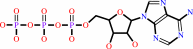 ATP
ATP
|
=
|
(2R)-3-phospho-glyceroyl phosphate
|
+
|
ADP
Bound ligand (Het Group name = )
matches with 81.25% similarity
|
|
|
|
|
|
|
|
|
|
Enzyme class 3:
|
|
E.C.5.3.1.1
- triose-phosphate isomerase.
|
|
|
|
|
|
|
Reaction:
|
|
D-glyceraldehyde 3-phosphate = dihydroxyacetone phosphate
|
|
|
|
|
|
D-glyceraldehyde 3-phosphate
Bound ligand (Het Group name = )
matches with 90.91% similarity
|
=
|
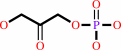 dihydroxyacetone phosphate
|
|
|
|
|
|
|
|
|
|
|
|
|
Note, where more than one E.C. class is given (as above), each may
correspond to a different protein domain or, in the case of polyprotein
precursors, to a different mature protein.
|
|
|
|
Molecule diagrams generated from .mol files obtained from the
KEGG ftp site
|
|
|
|
|
|
|
|
|
|
|
|
|
|
 |
|
|
|
|
|
|
| |
|
|
| |
|
DOI no:
|
Structure
5:1475-1483
(1997)
|
|
PubMed id:
|
|
|
|
|
|
| |
|
Closed structure of phosphoglycerate kinase from Thermotoga maritima reveals the catalytic mechanism and determinants of thermal stability.
|
|
G.Auerbach,
R.Huber,
M.Grättinger,
K.Zaiss,
H.Schurig,
R.Jaenicke,
U.Jacob.
|
|
|
|
|
| |
ABSTRACT
|
|
|
|
| |
|
|
BACKGROUND: Phosphoglycerate kinase (PGK) is essential in most living cells both
for ATP generation in the glycolytic pathway of aerobes and for fermentation in
anaerobes. In addition, in many plants the enzyme is involved in carbon
fixation. Like other kinases, PGK folds into two distinct domains, which undergo
a large hinge-bending motion upon catalysis. The monomeric 45 kDa enzyme
catalyzes the transfer of the C1-phosphoryl group from 1, 3-bisphosphoglycerate
to ADP to form 1,3-bisphosphoglycerate to ADP to form 3-phosphoglycerate and
ATP. For decades, the conformation of the enzyme during catalysis has been
enigmatic. The crystal structure of PGK from the hyperthermophilic organism
Thermotoga maritima (TmPGK) represents the first structure of an extremely
thermostable PGK. It adds to a series of four known crystal structures of PGKs
from mesophilic via moderately thermophilic to a hyperthermophilic organism,
allowing a detailed analysis of possible structural determinants of
thermostability. RESULTS: The crystal structure of TmPGK was determined to 2.0 A
resolution, as a ternary complex with the product 3-phosphoglycerate and the
product analogue AMP-PNP (adenylyl-imido diphosphate). The complex crystallizes
in a closed conformation with a drastically reduced inter-domain angle and a
distance between the two bound ligands of 4.4 A, presumably representing the
active conformation of the enzyme. The structure provides new details of the
catalytic mechanism. An inter-domain salt bridge between residues Arg62 and
Asp200 forms a strap to hold the two domains in the closed state. We identify
Lys197 as a residue involved in stabilization of the transition state phosphoryl
group, and so term it the 'phosphoryl gripper'. CONCLUSIONS: The hinge-bending
motion of the two domains upon closure of the structure, as seen in the
Trypanosoma PGK structure, is confirmed. This closed conformation obviously
occurs after binding of both substrates and is locked by the Arg62-Asp200 salt
bridge. Re-orientations in the conserved active-site loop region around Thr374
also bring both domains into direct contact in the core region of the former
inter-domain cleft, to form the complete catalytic site. Comparison of extremely
thermostable TmPGK with less thermostable homologues reveals that its increased
rigidity is achieved by a raised number of intramolecular interactions, such as
an increased number of ion pairs and additional stabilization of alpha helix and
loop regions. The covalent fusion with triosephosphate isomerase might represent
an additional stabilization strategy.
|
|
|
|
|
|
| |
Selected figure(s)
|
|
|
|
| |
|
|

|
|
Figure 3.
Figure 3. Stereo view of the superposition of the closed
structure of TmPGK (black) with the open structure of BsPGK
(red). The central water of the TmPGK structure is shown in
blue. A large motion of residue Thr374 (Thr371; BsPGK) towards
Arg36 causes a subsequent reorientation of the C-terminal
residues Gly375-Gly377 (not labelled). The closed conformation
is locked by an inter-domain salt bridge between Arg62 and
Asp200 (green). The difference between the inter-domain angles
in TmPGK and BsPGK, a[TM] and a[BS], respectively, is 21°.
|
|
|
|
|
|
| |
The above figure is
reprinted
by permission from Cell Press:
Structure
(1997,
5,
1475-1483)
copyright 1997.
|
|
| |
Figure was
selected
by an automated process.
|
|
|
|
|
|
|
|
|
|
|
|
|
|
|
|
 |
 |
 |
|
Literature references that cite this PDB file's key reference
|
|
|
| |
PubMed id
|
|
Reference
|
|
|
|
|
|
R.Encalada,
A.Rojo-Domínguez,
J.S.Rodríguez-Zavala,
J.P.Pardo,
H.Quezada,
R.Moreno-Sánchez,
and
E.Saavedra
(2009).
Molecular basis of the unusual catalytic preference for GDP/GTP in Entamoeba histolytica 3-phosphoglycerate kinase.
|
| |
FEBS J,
276,
2037-2047.
|
|
|
|
|
|
|
Z.Palmai,
L.Chaloin,
C.Lionne,
J.Fidy,
D.Perahia,
and
E.Balog
(2009).
Substrate binding modifies the hinge bending characteristics of human 3-phosphoglycerate kinase: a molecular dynamics study.
|
| |
Proteins,
77,
319-329.
|
|
|
|
|
|
|
C.Gondeau,
L.Chaloin,
P.Lallemand,
B.Roy,
C.Périgaud,
T.Barman,
A.Varga,
M.Vas,
C.Lionne,
and
S.T.Arold
(2008).
Molecular basis for the lack of enantioselectivity of human 3-phosphoglycerate kinase.
|
| |
Nucleic Acids Res,
36,
3620-3629.
|
|
|
PDB codes:
|
|
|
|
|
|
|
|
G.M.Sawyer,
A.F.Monzingo,
E.C.Poteet,
D.A.O'Brien,
and
J.D.Robertus
(2008).
X-ray analysis of phosphoglycerate kinase 2, a sperm-specific isoform from Mus musculus.
|
| |
Proteins,
71,
1134-1144.
|
|
|
PDB codes:
|
|
|
|
|
|
|
|
E.Balog,
M.Laberge,
and
J.Fidy
(2007).
The influence of interdomain interactions on the intradomain motions in yeast phosphoglycerate kinase: a molecular dynamics study.
|
| |
Biophys J,
92,
1709-1716.
|
|
|
|
|
|
|
L.Miallau,
W.N.Hunter,
S.M.McSweeney,
and
G.A.Leonard
(2007).
Structures of Staphylococcus aureus D-tagatose-6-phosphate kinase implicate domain motions in specificity and mechanism.
|
| |
J Biol Chem,
282,
19948-19957.
|
|
|
PDB codes:
|
|
|
|
|
|
|
|
Y.O.You,
and
W.A.van der Donk
(2007).
Mechanistic investigations of the dehydration reaction of lacticin 481 synthetase using site-directed mutagenesis.
|
| |
Biochemistry,
46,
5991-6000.
|
|
|
|
|
|
|
A.Varga,
B.Flachner,
E.Gráczer,
S.Osváth,
A.N.Szilágyi,
and
M.Vas
(2005).
Correlation between conformational stability of the ternary enzyme-substrate complex and domain closure of 3-phosphoglycerate kinase.
|
| |
FEBS J,
272,
1867-1885.
|
|
|
|
|
|
|
C.Ingram-Smith,
A.Gorrell,
S.H.Lawrence,
P.Iyer,
K.Smith,
and
J.G.Ferry
(2005).
Characterization of the acetate binding pocket in the Methanosarcina thermophila acetate kinase.
|
| |
J Bacteriol,
187,
2386-2394.
|
|
|
|
|
|
|
C.Strub,
C.Alies,
A.Lougarre,
C.Ladurantie,
J.Czaplicki,
and
D.Fournier
(2004).
Mutation of exposed hydrophobic amino acids to arginine to increase protein stability.
|
| |
BMC Biochem,
5,
9.
|
|
|
|
|
|
|
N.Fernandez-Fuentes,
A.Hermoso,
J.Espadaler,
E.Querol,
F.X.Aviles,
and
B.Oliva
(2004).
Classification of common functional loops of kinase super-families.
|
| |
Proteins,
56,
539-555.
|
|
|
|
|
|
|
Z.Kovári,
and
M.Vas
(2004).
Protein conformer selection by sequence-dependent packing contacts in crystals of 3-phosphoglycerate kinase.
|
| |
Proteins,
55,
198-209.
|
|
|
|
|
|
|
D.L.Jakeman,
A.J.Ivory,
G.M.Blackburn,
and
M.P.Williamson
(2003).
Orientation of 1,3-bisphosphoglycerate analogs bound to phosphoglycerate kinase.
|
| |
J Biol Chem,
278,
10957-10962.
|
|
|
|
|
|
|
P.Jordan,
L.A.Snyder,
and
N.J.Saunders
(2003).
Diversity in coding tandem repeats in related Neisseria spp.
|
| |
BMC Microbiol,
3,
23.
|
|
|
|
|
|
|
P.Tougard,
T.Bizebard,
M.Ritco-Vonsovici,
P.Minard,
and
M.Desmadril
(2002).
Structure of a circularly permuted phosphoglycerate kinase.
|
| |
Acta Crystallogr D Biol Crystallogr,
58,
2018-2023.
|
|
|
PDB code:
|
|
|
|
|
|
|
|
S.Ramón-Maiques,
A.Marina,
F.Gil-Ortiz,
I.Fita,
and
V.Rubio
(2002).
Structure of acetylglutamate kinase, a key enzyme for arginine biosynthesis and a prototype for the amino acid kinase enzyme family, during catalysis.
|
| |
Structure,
10,
329-342.
|
|
|
PDB codes:
|
|
|
|
|
|
|
|
A.N.Szilágyi,
N.V.Kotova,
G.V.Semisotnov,
and
M.Vas
(2001).
Incomplete refolding of a fragment of the N-terminal domain of pig muscle 3-phosphoglycerate kinase that lacks a subdomain. Comparison with refolding of the complementary C-terminal fragment.
|
| |
Eur J Biochem,
268,
1851-1860.
|
|
|
|
|
|
|
C.Vieille,
and
G.J.Zeikus
(2001).
Hyperthermophilic enzymes: sources, uses, and molecular mechanisms for thermostability.
|
| |
Microbiol Mol Biol Rev,
65,
1.
|
|
|
|
|
|
|
D.Mandelman,
M.Bentahir,
G.Feller,
C.Gerday,
and
R.Haser
(2001).
Crystallization and preliminary X-ray analysis of a bacterial psychrophilic enzyme, phosphoglycerate kinase.
|
| |
Acta Crystallogr D Biol Crystallogr,
57,
1666-1668.
|
|
|
|
|
|
|
A.Szilágyi,
and
P.Závodszky
(2000).
Structural differences between mesophilic, moderately thermophilic and extremely thermophilic protein subunits: results of a comprehensive survey.
|
| |
Structure,
8,
493-504.
|
|
|
|
|
|
|
H.Erlandsen,
E.E.Abola,
and
R.C.Stevens
(2000).
Combining structural genomics and enzymology: completing the picture in metabolic pathways and enzyme active sites.
|
| |
Curr Opin Struct Biol,
10,
719-730.
|
|
|
|
|
|
|
M.Bentahir,
G.Feller,
M.Aittaleb,
J.Lamotte-Brasseur,
T.Himri,
J.P.Chessa,
and
C.Gerday
(2000).
Structural, kinetic, and calorimetric characterization of the cold-active phosphoglycerate kinase from the antarctic Pseudomonas sp. TACII18.
|
| |
J Biol Chem,
275,
11147-11153.
|
|
|
|
|
|
|
M.C.Wahl,
R.Huber,
S.Marinkoviç,
E.Weyher-Stingl,
and
S.Ehlert
(2000).
Structural investigations of the highly flexible recombinant ribosomal protein L12 from Thermotoga maritima.
|
| |
Biol Chem,
381,
221-229.
|
|
|
|
|
|
|
K.Zaiss,
and
R.Jaenicke
(1999).
Thermodynamic study of phosphoglycerate kinase from Thermotoga maritima and its isolated domains: reversible thermal unfolding monitored by differential scanning calorimetry and circular dichroism spectroscopy.
|
| |
Biochemistry,
38,
4633-4639.
|
|
|
|
|
|
|
S.Kumar,
B.Ma,
C.J.Tsai,
H.Wolfson,
and
R.Nussinov
(1999).
Folding funnels and conformational transitions via hinge-bending motions.
|
| |
Cell Biochem Biophys,
31,
141-164.
|
|
|
|
|
|
|
W.Grabarse,
M.Vaupel,
J.A.Vorholt,
S.Shima,
R.K.Thauer,
A.Wittershagen,
G.Bourenkov,
H.D.Bartunik,
and
U.Ermler
(1999).
The crystal structure of methenyltetrahydromethanopterin cyclohydrolase from the hyperthermophilic archaeon Methanopyrus kandleri.
|
| |
Structure,
7,
1257-1268.
|
|
|
PDB code:
|
|
|
|
|
|
|
|
A.Matte,
L.W.Tari,
and
L.T.Delbaere
(1998).
How do kinases transfer phosphoryl groups?
|
| |
Structure,
6,
413-419.
|
|
|
|
|
|
|
A.N.Szilágyi,
and
M.Vas
(1998).
Anion activation of 3-phosphoglycerate kinase requires domain closure.
|
| |
Biochemistry,
37,
8551-8563.
|
|
|
|
|
|
|
B.E.Bernstein,
and
W.G.Hol
(1998).
Crystal structures of substrates and products bound to the phosphoglycerate kinase active site reveal the catalytic mechanism.
|
| |
Biochemistry,
37,
4429-4436.
|
|
|
|
|
|
|
K.Gruber,
G.Klintschar,
M.Hayn,
A.Schlacher,
W.Steiner,
and
C.Kratky
(1998).
Thermophilic xylanase from Thermomyces lanuginosus: high-resolution X-ray structure and modeling studies.
|
| |
Biochemistry,
37,
13475-13485.
|
|
|
PDB code:
|
|
|
|
|
|
|
|
M.W.Bauer,
and
R.M.Kelly
(1998).
The family 1 beta-glucosidases from Pyrococcus furiosus and Agrobacterium faecalis share a common catalytic mechanism.
|
| |
Biochemistry,
37,
17170-17178.
|
|
|
|
|
|
|
R.Jaenicke,
and
G.Böhm
(1998).
The stability of proteins in extreme environments.
|
| |
Curr Opin Struct Biol,
8,
738-748.
|
|
|
|
|
|
The most recent references are shown first.
Citation data come partly from CiteXplore and partly
from an automated harvesting procedure. Note that this is likely to be
only a partial list as not all journals are covered by
either method. However, we are continually building up the citation data
so more and more references will be included with time.
Where a reference describes a PDB structure, the PDB
codes are
shown on the right.
|
|


 Links
Links