 |
PDBsum entry 1vjc

|
|
|
|
|
 |
Contents |
 |
|
|
|
|
|
|
|
|
|
|
|
|
|
|
* Residue conservation analysis
|
|
|
|
|
|
PDB id:
|
|
|
|
| Name: |
|
Transferase
|
|
|
Title:
|
|
Structure of pig muscle pgk complexed with mgatp
|
|
Structure:
|
|
Phosphoglycerate kinase. Chain: a. Ec: 2.7.2.3
|
|
Source:
|
|
Sus scrofa. Pig. Organism_taxid: 9823. Tissue: muscle
|
|
Resolution:
|
|
|
2.10Å
|
R-factor:
|
0.173
|
R-free:
|
0.233
|
|
|
Authors:
|
|
B.Flachner,Z.Kovari,A.Varga,Z.Gugolya,F.Vonderviszt,G.Naray-Szabo, M.Vas
|
Key ref:

|
|
B.Flachner
et al.
(2004).
Role of phosphate chain mobility of MgATP in completing the 3-phosphoglycerate kinase catalytic site: binding, kinetic, and crystallographic studies with ATP and MgATP.
Biochemistry,
43,
3436-3449.
PubMed id:
DOI:
|
|
|
Date:
|
|
|
03-Feb-04
|
Release date:
|
30-Mar-04
|
|
|
|
|
|
|
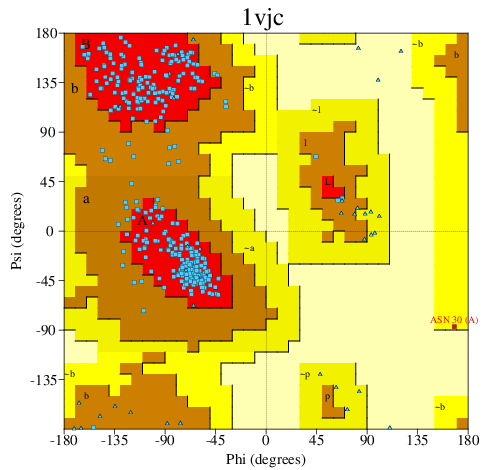
PROCHECK
|
|
|
|
|
|
Headers
|
|
|
|
References
|
|
|
|
|
|

|
|
Q7SIB7
(PGK1_PIG) -
Phosphoglycerate kinase 1 from Sus scrofa
|
|
|
|
Seq:
Struc:
|
|
|
|
417 a.a.
416 a.a.*
|
|

|

|

|
|
|
|
|
|
|
|
|
|
|
Key: |
 |
PfamA domain |
|
|
 |
Secondary structure |
|
 |
CATH domain |
|
|
*
PDB and UniProt seqs differ
at 2 residue positions (black
crosses)
|
|
|
|
|
|
|
|
|
|
|
|
|
Enzyme class:
|
|
E.C.2.7.2.3
- phosphoglycerate kinase.
|
|
|
|
|
|
|
Pathway:
|
|
Calvin Cycle (carbon fixation stages)
|
|
|
|
|
|
Reaction:
|
|
(2R)-3-phosphoglycerate + ATP = (2R)-3-phospho-glyceroyl phosphate + ADP
|
|
|
|
|
|
(2R)-3-phosphoglycerate
|
+
|
ATP
Bound ligand (Het Group name = )
corresponds exactly
|
=
|
(2R)-3-phospho-glyceroyl phosphate
|
+
|
 ADP
ADP
|
|
|
|
|
|
|
|
|
|
|
|
|
Molecule diagrams generated from .mol files obtained from the
KEGG ftp site
|
|
|
|
|
|
|
|
|
|
|
|
|
|
 |
|
|
|
|
|
|
| |
|
|
| |
|
DOI no:
|
Biochemistry
43:3436-3449
(2004)
|
|
PubMed id:
|
|
|
|
|
|
| |
|
Role of phosphate chain mobility of MgATP in completing the 3-phosphoglycerate kinase catalytic site: binding, kinetic, and crystallographic studies with ATP and MgATP.
|
|
B.Flachner,
Z.Kovári,
A.Varga,
Z.Gugolya,
F.Vonderviszt,
G.Náray-Szabó,
M.Vas.
|
|
|
|
|
| |
ABSTRACT
|
|
|
|
| |
|
|
The complexes of pig muscle 3-phosphoglycerate kinase with the substrate MgATP
and with the nonsubstrate Mg(2+)-free ATP have been characterized by binding,
kinetic, and crystallographic studies. Comparative experiments with ADP and
MgADP have also been carried out. In contrast to the less specific and largely
ionic binding of Mg(2+)-free ATP and ADP, specific occupation of the adenosine
binding pocket by MgATP and MgADP has been revealed by displacement experiments
with adenosine and anions, as well as supported by isothermal calorimetric
titrations. The Mg(2+)-free nucleotides similarly stabilize the overall protein
structure and restrict the conformational flexibility around the reactive thiol
groups of helix 13, as observed by differential scanning microcalorimetry and
thiol reactivity studies, respectively. The metal complexes, however, behave
differently. MgADP, but not MgATP, further increases the conformational
stability with respect to its Mg(2+)-free form, which indicates their different
modes of binding to the enzyme. Crystal structures of the binary complexes of
the enzyme with MgATP and with ATP (2.1 and 1.9 A resolution, respectively) have
shown that the orientation and interaction of phosphates of MgATP largely differ
not only from those of ATP but also from the previously determined ones of
either MgADP [Davies, G. J., Gamblin, S. J., Littlechild, J. A., Dauter, Z.,
Wilson, K. S., and Watson, H. C. (1994) Acta Crystallogr. D50, 202-209] or the
metal complexes of AMP-PNP [May, A., Vas, M., Harlos, K., and Blake, C. C. F.
(1996) Proteins 24, 292-303; Auerbach, G., Huber, R., Grattinger, M., Zaiss, K.,
Schurig, H., Jaenicke, R., and Jacob, U. (1997) Structure 5, 1475-1483] and are
more similar to the interactions formed with MgAMP-PCP [Kovári, Z., Flachner,
B., Náray-Szabó, G., and Vas, M. (2002) Biochemistry 41, 8796-8806]. Mg(2+) is
liganded to both beta- and gamma-phosphates of ATP, while beta-phosphate is
linked to the conserved Asp218, i.e., to the N-terminus of helix 8, through a
water molecule; the known interactions of either MgADP or the metal complexes of
AMP-PNP with the N-terminus of helix 13 and with Asn336 of beta-strand J are
absent in the case of MgATP. Fluctuation of MgATP phosphates between two
alternative sites has been proposed to facilitate the correct positioning of the
mobile side chain of Lys215, and the catalytically competent active site is
thereby completed.
|
|
|
|
|
|
|
|
|
|
|
|
|
|
|
|
|
|
 |
 |
 |
|
Literature references that cite this PDB file's key reference
|
|
|
| |
PubMed id
|
|
Reference
|
|
|
|
|
|
A.R.Mattoo,
A.Arora,
S.Maiti,
and
Y.Singh
(2008).
Identification, characterization and activation mechanism of a tyrosine kinase of Bacillus anthracis.
|
| |
FEBS J,
275,
6237-6247.
|
|
|
|
|
|
|
A.R.Mattoo,
M.Saif Zaman,
G.P.Dubey,
A.Arora,
A.Narayan,
N.Jailkhani,
K.Rathore,
S.Maiti,
and
Y.Singh
(2008).
Spo0B of Bacillus anthracis - a protein with pleiotropic functions.
|
| |
FEBS J,
275,
739-752.
|
|
|
|
|
|
|
C.Gondeau,
L.Chaloin,
P.Lallemand,
B.Roy,
C.Périgaud,
T.Barman,
A.Varga,
M.Vas,
C.Lionne,
and
S.T.Arold
(2008).
Molecular basis for the lack of enantioselectivity of human 3-phosphoglycerate kinase.
|
| |
Nucleic Acids Res,
36,
3620-3629.
|
|
|
PDB codes:
|
|
|
|
|
|
|
|
G.M.Sawyer,
A.F.Monzingo,
E.C.Poteet,
D.A.O'Brien,
and
J.D.Robertus
(2008).
X-ray analysis of phosphoglycerate kinase 2, a sperm-specific isoform from Mus musculus.
|
| |
Proteins,
71,
1134-1144.
|
|
|
PDB codes:
|
|
|
|
|
|
|
|
E.Beutler
(2007).
PGK deficiency.
|
| |
Br J Haematol,
136,
3.
|
|
|
|
|
|
|
A.Ababou,
and
J.E.Ladbury
(2006).
Survey of the year 2004: literature on applications of isothermal titration calorimetry.
|
| |
J Mol Recognit,
19,
79-89.
|
|
|
|
|
|
|
J.M.Flanagan,
M.Rhodes,
M.Wilson,
and
E.Beutler
(2006).
The identification of a recurrent phosphoglycerate kinase mutation associated with chronic haemolytic anaemia and neurological dysfunction in a family from USA.
|
| |
Br J Haematol,
134,
233-237.
|
|
|
|
|
|
|
A.L.Buchachenko,
D.A.Kouznetsov,
M.A.Orlova,
and
A.A.Markarian
(2005).
Magnetic isotope effect of magnesium in phosphoglycerate kinase phosphorylation.
|
| |
Proc Natl Acad Sci U S A,
102,
10793-10796.
|
|
|
|
|
|
|
A.Varga,
B.Flachner,
E.Gráczer,
S.Osváth,
A.N.Szilágyi,
and
M.Vas
(2005).
Correlation between conformational stability of the ternary enzyme-substrate complex and domain closure of 3-phosphoglycerate kinase.
|
| |
FEBS J,
272,
1867-1885.
|
|
|
|
|
|
|
H.Sigel,
and
R.Griesser
(2005).
Nucleoside 5'-triphosphates: self-association, acid-base, and metal ion-binding properties in solution.
|
| |
Chem Soc Rev,
34,
875-900.
|
|
|
|
|
|
|
O.Barabás,
V.Pongrácz,
J.Kovári,
M.Wilmanns,
and
B.G.Vértessy
(2004).
Structural insights into the catalytic mechanism of phosphate ester hydrolysis by dUTPase.
|
| |
J Biol Chem,
279,
42907-42915.
|
|
|
PDB codes:
|
|
|
|
|
|
|
The most recent references are shown first.
Citation data come partly from CiteXplore and partly
from an automated harvesting procedure. Note that this is likely to be
only a partial list as not all journals are covered by
either method. However, we are continually building up the citation data
so more and more references will be included with time.
Where a reference describes a PDB structure, the PDB
codes are
shown on the right.
|
|


 Links
Links


