|
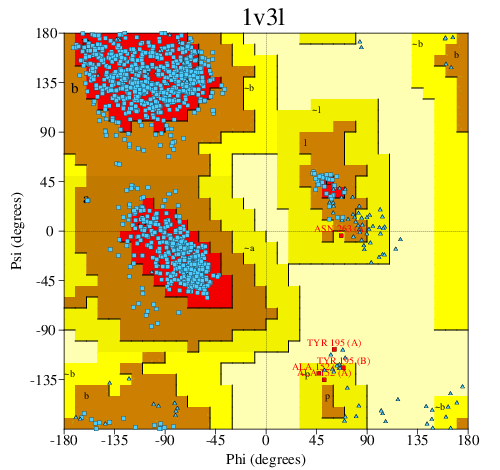
PDBsum entry 1v3l

|
|
|
|
|
 |
Contents |
 |
|
|
|
|
|
|
|
|
|
|
|
|
|
|
* Residue conservation analysis
|
|
|
|
|
|
|
|
|
|
|
Enzyme class:
|
|
E.C.2.4.1.19
- cyclomaltodextrin glucanotransferase.
|
|
|
|
|
|
|
Reaction:
|
|
Degrades starch to cyclodextrins by formation of a 1,4-alpha-D- glucosidic bond.
|
|
|
|
|
|
|
|
|
|
|
|
|
|
|
|
|
|
 |
|
|
|
|
|
|
| |
|
DOI no:
|
Protein Sci
13:457-465
(2004)
|
|
PubMed id:
|
|
|
|
|
|
| |
|
Role of Phe283 in enzymatic reaction of cyclodextrin glycosyltransferase from alkalophilic Bacillus sp.1011: Substrate binding and arrangement of the catalytic site.
|
|
R.Kanai,
K.Haga,
T.Akiba,
K.Yamane,
K.Harata.
|
|
|
|
|
| |
ABSTRACT
|
|
|
|
| |
|
|
Cyclodextrin glycosyltransferase (CGTase) belonging to the alpha-amylase family
mainly catalyzes transglycosylation and produces cyclodextrins from starch and
related alpha-1,4-glucans. The catalytic site of CGTase specifically conserves
four aromatic residues, Phe183, Tyr195, Phe259, and Phe283, which are not found
in alpha-amylase. To elucidate the structural role of Phe283, we determined the
crystal structures of native and acarbose-complexed mutant CGTases in which
Phe283 was replaced with leucine (F283L) or tyrosine (F283Y). The temperature
factors of the region 259-269 in native F283L increased >10 A(2) compared with
the wild type. The complex formation with acarbose not only increased the
temperature factors (>10 A(2)) but also changed the structure of the region
257-267. This region is stabilized by interactions of Phe283 with Phe259 and
Leu260 and plays an important role in the cyclodextrin binding. The conformation
of the side-chains of Glu257, Phe259, His327, and Asp328 in the catalytic site
was altered by the mutation of Phe283 with leucine, and this indicates that
Phe283 partly arranges the structure of the catalytic site through contacts with
Glu257 and Phe259. The replacement of Phe283 with tyrosine decreased the
enzymatic activity in the basic pH range. The hydroxyl group of Tyr283 forms
hydrogen bonds with the carboxyl group of Glu257, and the pK(a) of Glu257 in
F283Y may be lower than that in the wild type.
|
|
|
|
|
|
| |
Selected figure(s)
|
|
|
|
| |
|
|

|
|

|
|
Figure 1.
Figure 1. Absolute starch degrading activity. pH Profiles
for F283L (Nakamura et al. 1994 [solid circles]), F283Y mutant
(solid squares), and wild-type CGTase (solid diamonds).
|
|
Figure 4.
Figure 4. Comparison of structures and temperature factors.
(A) Difference of isotropic temperature factors for equivalent C
 atoms between
F283L and wild-type CGTase. (B) Difference of isotropic
temperature factors for equivalent C atoms between
F283L_ACA and F283L. (C) Positional difference for equivalent C
atoms in domain
A (residues 1-138 and 204-406) between F283L_ACA and F283L. atoms between
F283L and wild-type CGTase. (B) Difference of isotropic
temperature factors for equivalent C atoms between
F283L_ACA and F283L. (C) Positional difference for equivalent C
atoms in domain
A (residues 1-138 and 204-406) between F283L_ACA and F283L.
|
|
|
|
|
|
| |
The above figures are
reprinted
by permission from the Protein Society:
Protein Sci
(2004,
13,
457-465)
copyright 2004.
|
|
| |
Figures were
selected
by the author.
|
|
|
|
|
|
|
|
|
|
|
|
|
|
|
|
 |
 |
 |
|
Literature references that cite this PDB file's key reference
|
|
|
| |
PubMed id
|
|
Reference
|
|
|
|
|
|
G.Hai Tran,
T.Desmet,
M.R.De Groeve,
and
W.Soetaert
(2011).
Probing the active site of cellodextrin phosphorylase from Clostridium stercorarium: Kinetic characterization, ligand docking, and site-directed mutagenesis.
|
| |
Biotechnol Prog,
27,
326-332.
|
|
|
|
|
|
|
H.Bach,
and
D.L.Gutnick
(2006).
Novel polysaccharide-protein-based amphipathic formulations.
|
| |
Appl Microbiol Biotechnol,
71,
34-38.
|
|
|
|
|
|
The most recent references are shown first.
Citation data come partly from CiteXplore and partly
from an automated harvesting procedure. Note that this is likely to be
only a partial list as not all journals are covered by
either method. However, we are continually building up the citation data
so more and more references will be included with time.
|
|


 Links
Links