 |
PDBsum entry 1pl2

|
|
|
|
|
 |
Contents |
 |
|
|
|
|
|
|
|
|
|
|
|
|
|
|
* Residue conservation analysis
|
|
|
|
|
|
PDB id:
|
|
|
|
| Name: |
|
Transferase
|
|
|
Title:
|
|
Crystal structure of human glutathione transferase (gst) a1-1 t68e mutant in complex with decarboxy-glutathione
|
|
Structure:
|
|
Glutathione s-transferase a1. Chain: a, b. Synonym: gth1, ha subunit 1, gst-epsilon, gsta1-1, gst class-alpha. Engineered: yes. Mutation: yes
|
|
Source:
|
|
Homo sapiens. Human. Organism_taxid: 9606. Expressed in: escherichia coli. Expression_system_taxid: 562
|
|
Biol. unit:
|
|
Dimer (from
)
|
|
Resolution:
|
|
|
1.80Å
|
R-factor:
|
0.165
|
R-free:
|
0.200
|
|
|
Authors:
|
|
E.Grahn,E.Jakobsson,A.Gustafsson,L.Grehn,B.Olin,M.Wahlberg,D.Madsen, G.J.Kleywegt,B.Mannervik
|
Key ref:

|
|
E.Grahn
et al.
(2006).
New crystal structures of human glutathione transferase A1-1 shed light on glutathione binding and the conformation of the C-terminal helix.
Acta Crystallogr D Biol Crystallogr,
62,
197-207.
PubMed id:
DOI:

|
|
|
Date:
|
|
|
06-Jun-03
|
Release date:
|
22-Jun-04
|
|
|
|
|
|
|
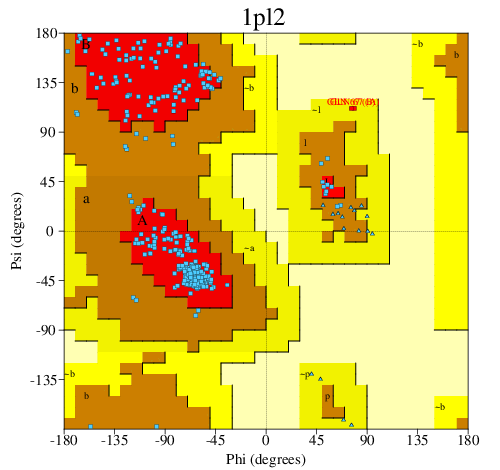
PROCHECK
|
|
|
|
|
|
Headers
|
|
|
|
References
|
|
|
|
|
|

|
|
P08263
(GSTA1_HUMAN) -
Glutathione S-transferase A1 from Homo sapiens
|
|
|
|
Seq:
Struc:
|
|
|
|
222 a.a.
221 a.a.*
|
|

|

|
|
|
|
|
|
|
|
|
|
|
|
Key: |
|
 |
Secondary structure |
|
 |
CATH domain |
|
|
*
PDB and UniProt seqs differ
at 2 residue positions (black
crosses)
|
|
|
|
|
|
|
|
|
|
|
|
|
Enzyme class 2:
|
|
E.C.1.11.1.-
- ?????
|
|
|
|
|
|
|
Enzyme class 3:
|
|
E.C.2.5.1.18
- glutathione transferase.
|
|
|
|
|
|
|
Reaction:
|
|
RX + glutathione = an S-substituted glutathione + a halide anion + H+
|
|
|
|
|
|
 RX
RX
|
+
|
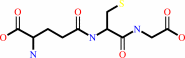 glutathione
|
=
|
S-substituted glutathione
|
+
|
halide anion
|
+
|
H(+)
|
|
|
|
|
|
|
|
|
|
Enzyme class 4:
|
|
E.C.5.3.3.-
- ?????
|
|
|
|
|
|
|
|
|
|
Note, where more than one E.C. class is given (as above), each may
correspond to a different protein domain or, in the case of polyprotein
precursors, to a different mature protein.
|
|
|
|
Molecule diagrams generated from .mol files obtained from the
KEGG ftp site
|
|
|
|
|
|
|
|
|
|
|
|
|
|
 |
|
|
|
|
|
|
| |
|
|
| |
|
DOI no:
|
Acta Crystallogr D Biol Crystallogr
62:197-207
(2006)
|
|
PubMed id:
|
|
|
|
|
|
| |
|
New crystal structures of human glutathione transferase A1-1 shed light on glutathione binding and the conformation of the C-terminal helix.
|
|
E.Grahn,
M.Novotny,
E.Jakobsson,
A.Gustafsson,
L.Grehn,
B.Olin,
D.Madsen,
M.Wahlberg,
B.Mannervik,
G.J.Kleywegt.
|
|
|
|
|
| |
ABSTRACT
|
|
|
|
| |
|
|
Human glutathione transferase A1-1 is a well studied enzyme, but despite a
wealth of structural and biochemical data a number of aspects of its catalytic
function are still poorly understood. Here, five new crystal structures of this
enzyme are described that provide several insights. Firstly, the structure of a
complex of the wild-type human enzyme with glutathione was determined for the
first time at 2.0 angstroms resolution. This reveals that glutathione binds in
the G site in a very similar fashion as the glutathione portion of substrate
analogues in other structures and also that glutathione binding alone is
sufficient to stabilize the C-terminal helix of the protein. Secondly, we have
studied the complex with a decarboxylated glutathione conjugate that is known to
dramatically decrease the activity of the enzyme. The T68E mutant of human
glutathione transferase A1-1 recovers some of the activity that is lost with the
decarboxylated glutathione, but our structures of this mutant show that none of
the earlier explanations of this phenomenon are likely to be correct. Thirdly,
and serendipitously, the apo structures also reveal the conformation of the
crucial C-terminal region that is disordered in all previous apo structures. The
C-terminal region can adopt an ordered helix-like structure even in the apo
state, but shows a strong tendency to unwind. Different conformations of the
C-terminal regions were observed in the apo states of the two monomers, which
suggests that cooperativity could play a role in the activity of the enzyme.
|
|
|
|
|
|
| |
Selected figure(s)
|
|
|
|
| |
|
|

|
|

|
|
Figure 2.
Figure 2
Crystal structure of human GST A1-1 with only glutathione bound. (a) The homodimer shown
in a ribbon representation. The view is along the twofold axis that relates the two
subunits. (b) The A subunit with secondary-structure elements labelled. Figs. 2, 3 and 4
were created using Swiss-PDB Viewer 3.7 (Guex & Peitsch, 1997 [Guex, N. & Peitsch, M.
C. (1997). Electrophoresis, 18, 2714-2723.]) and POV-Ray 3.6 for
Windows (http://www.povray.org/ ).
|
|
Figure 5.
Figure 5
Superposition of the C-terminal regions of various GST A1-1 structures. (a) Eight
different GST A1-1 structures (16 monomers; PDB codes 1guh , 1gse and 1gsf
, as well as the five structures reported here) were superimposed (using the C^
 atoms of residues 2-209). Four structures with a glutathione conjugate bound
are shown in red, the two apo structures in yellow, the structure with only glutathione
bound in blue and the structure with ethacrynic acid bound in green. (b) Superposition of
the C-terminal regions of the two apo structures presented here. A monomers are shown in
red and B monomers in yellow. Figs. 5 and 6 were created with PyMOL
(http://www.pymol.org/ ). atoms of residues 2-209). Four structures with a glutathione conjugate bound
are shown in red, the two apo structures in yellow, the structure with only glutathione
bound in blue and the structure with ethacrynic acid bound in green. (b) Superposition of
the C-terminal regions of the two apo structures presented here. A monomers are shown in
red and B monomers in yellow. Figs. 5 and 6 were created with PyMOL
(http://www.pymol.org/ ).
|
|
|
|
|
|
| |
The above figures are
reprinted
by permission from the IUCr:
Acta Crystallogr D Biol Crystallogr
(2006,
62,
197-207)
copyright 2006.
|
|
| |
Figures were
selected
by an automated process.
|
|
|
|
|
|
|
|
|
|
|
|
|
|
|
|
 |
 |
 |
|
Literature references that cite this PDB file's key reference
|
|
|
| |
PubMed id
|
|
Reference
|
|
|
|
|
|
L.M.Balogh,
and
W.M.Atkins
(2011).
Interactions of glutathione transferases with 4-hydroxynonenal.
|
| |
Drug Metab Rev,
43,
165-178.
|
|
|
|
|
|
|
L.M.Balogh,
I.Le Trong,
K.A.Kripps,
L.M.Shireman,
R.E.Stenkamp,
W.Zhang,
B.Mannervik,
and
W.M.Atkins
(2010).
Substrate specificity combined with stereopromiscuity in glutathione transferase A4-4-dependent metabolism of 4-hydroxynonenal.
|
| |
Biochemistry,
49,
1541-1548.
|
|
|
PDB codes:
|
|
|
|
|
|
|
|
L.M.Balogh,
I.Le Trong,
K.A.Kripps,
K.Tars,
R.E.Stenkamp,
B.Mannervik,
and
W.M.Atkins
(2009).
Structural analysis of a glutathione transferase A1-1 mutant tailored for high catalytic efficiency with toxic alkenals.
|
| |
Biochemistry,
48,
7698-7704.
|
|
|
PDB codes:
|
|
|
|
|
|
|
|
D.F.Dourado,
P.A.Fernandes,
B.Mannervik,
and
M.J.Ramos
(2008).
Glutathione transferase: new model for glutathione activation.
|
| |
Chemistry,
14,
9591-9598.
|
|
|
|
|
|
The most recent references are shown first.
Citation data come partly from CiteXplore and partly
from an automated harvesting procedure. Note that this is likely to be
only a partial list as not all journals are covered by
either method. However, we are continually building up the citation data
so more and more references will be included with time.
Where a reference describes a PDB structure, the PDB
codes are
shown on the right.
|
|


 Links
Links


