
|
|
|
|
|
 |
Contents |
 |
|
|
|
|
|
|
|
|
|
|
|


 (+ 2 more)
223 a.a.
(+ 2 more)
223 a.a.
|
|
|
|
|
|
|
|
|
|
|


 222 a.a.
|
|
|
|
|
|
|
|
|
|
|
|
|
* Residue conservation analysis
|
|
|
|
|
|
PDB id:
|
|
|
|
| Name: |
|
Structural protein
|
|
|
Title:
|
|
Structure of type iv collagen nc1 domains
|
|
Structure:
|
|
Type iv collagen noncollagenous domain- alpha1. Chain: a, b, d, e, g, h, j, k. Fragment: nc1 domain (residues 1-229). Type iv collagen noncollagenous domain- alpha2. Chain: c, f, i, l. Fragment: nc1 domain (residues 1-227)
|
|
Source:
|
|
Bos taurus. Cattle. Organism_taxid: 9913. Other_details: bovine eye lens capsule. Other_details: bovine eye lens capsule
|
|
Biol. unit:
|
|
 Hexamer (from
)
Hexamer (from
)
|
|
Resolution:
|
|
|
2.00Å
|
R-factor:
|
0.169
|
R-free:
|
0.197
|
|
|
Authors:
|
|
M.Sundaramoorthy,M.Meiyappan,P.Todd,B.G.Hudson
|
Key ref:

|
|
M.Sundaramoorthy
et al.
(2002).
Crystal structure of NC1 domains. Structural basis for type IV collagen assembly in basement membranes.
J Biol Chem,
277,
31142-31153.
PubMed id:
DOI:

|
|
|
Date:
|
|
|
27-Jun-02
|
Release date:
|
07-Jan-03
|
|
|
|
|
|
|
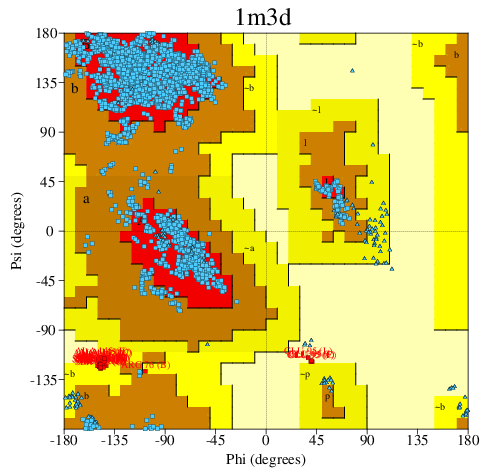
PROCHECK
|
|
|
|
|
|
Headers
|
|
|
|
References
|
|
|
|
|
|
|
|
|
|
|
|
|
|
|
|
 |
|
|
|
|
|
|
| |
|
DOI no:
|
J Biol Chem
277:31142-31153
(2002)
|
|
PubMed id:
|
|
|
|
|
|
| |
|
Crystal structure of NC1 domains. Structural basis for type IV collagen assembly in basement membranes.
|
|
M.Sundaramoorthy,
M.Meiyappan,
P.Todd,
B.G.Hudson.
|
|
|
|
|
| |
ABSTRACT
|
|
|
|
| |
|
|
Type IV collagen, which is present in all metazoan, exists as a family of six
homologous alpha(IV) chains, alpha1-alpha6, in mammals. The six chains assemble
into three different triple helical protomers and self-associate as three
distinct networks. The network underlies all epithelia as a component of
basement membranes, which play important roles in cell adhesion, growth,
differentiation, tissue repair and molecular ultrafiltration. The specificity of
both protomer and network assembly is governed by amino acid sequences of the
C-terminal noncollagenous (NC1) domain of each chain. In this study, the
structural basis for protomer and network assembly was investigated by
determining the crystal structure of the ubiquitous [(alpha1)(2).alpha2](2) NC1
hexamer of bovine lens capsule basement membrane at 2.0 A resolution. The NC1
monomer folds into a novel tertiary structure. The (alpha1)(2).alpha2 trimer is
organized through the unique three-dimensional domain swapping interactions. The
differences in the primary sequences of the hypervariable region manifest in
different secondary structures, which determine the chain specificity at the
monomer-monomer interfaces. The trimer-trimer interface is stabilized by the
extensive hydrophobic and hydrophilic interactions without a need for disulfide
cross-linking.
|
|
|
|
|
|
| |
Selected figure(s)
|
|
|
|
| |
|
|

|
|

|
|
Figure 3.
Fig. 3. Stereo view of a section of 2Fo  F[c] map
(contoured at 1 F[c] map
(contoured at 1  ), where
differences between the human and bovine sequences occur ( ), where
differences between the human and bovine sequences occur (  2: D96E and
E97D) (refer also to Fig. 2 legend). 2: D96E and
E97D) (refer also to Fig. 2 legend).
|
|
Figure 8.
Fig. 8. Comparison of the essential hydrogen bonding
interactions in the interface at the "core" (A) and the "outer"
(B) and major-minor junctions (C) for 1- 1 and 1- 2 dimers at
the trimer-trimer interface (see text for details).
|
|
|
|
|
|
| |
The above figures are
reprinted
by permission from the ASBMB:
J Biol Chem
(2002,
277,
31142-31153)
copyright 2002.
|
|
| |
Figures were
selected
by an automated process.
|
|
|
|
|
|
|
|
|
|
|
|
|
|
|
|
 |
 |
 |
|
Literature references that cite this PDB file's key reference
|
|
|
| |
PubMed id
|
|
Reference
|
|
|
|
|
|
J.A.Wirz,
S.P.Boudko,
T.F.Lerch,
M.S.Chapman,
and
H.P.Bächinger
(2011).
Crystal structure of the human collagen XV trimerization domain: a potent trimerizing unit common to multiplexin collagens.
|
| |
Matrix Biol,
30,
9.
|
|
|
PDB code:
|
|
|
|
|
|
|
|
R.Vanacore,
V.Pedchenko,
G.Bhave,
and
B.G.Hudson
(2011).
Sulphilimine cross-links in Goodpasture's disease.
|
| |
Clin Exp Immunol,
164,
4-6.
|
|
|
|
|
|
|
V.Pedchenko,
R.Vanacore,
and
B.Hudson
(2011).
Goodpasture's disease: molecular architecture of the autoantigen provides clues to etiology and pathogenesis.
|
| |
Curr Opin Nephrol Hypertens,
20,
290-296.
|
|
|
|
|
|
|
M.A.Wouters,
S.W.Fan,
and
N.L.Haworth
(2010).
Disulfides as redox switches: from molecular mechanisms to functional significance.
|
| |
Antioxid Redox Signal,
12,
53-91.
|
|
|
|
|
|
|
T.A.Powell,
R.Amini,
A.Oltean,
V.A.Barnett,
K.D.Dorfman,
Y.Segal,
and
V.H.Barocas
(2010).
Elasticity of the porcine lens capsule as measured by osmotic swelling.
|
| |
J Biomech Eng,
132,
091008.
|
|
|
|
|
|
|
Z.Yu,
O.Mirochnitchenko,
C.Xu,
A.Yoshizumi,
B.Brodsky,
and
M.Inouye
(2010).
Noncollagenous region of the streptococcal collagen-like protein is a trimerization domain that supports refolding of adjacent homologous and heterologous collagenous domains.
|
| |
Protein Sci,
19,
775-785.
|
|
|
|
|
|
|
R.Vanacore,
A.J.Ham,
M.Voehler,
C.R.Sanders,
T.P.Conrads,
T.D.Veenstra,
K.B.Sharpless,
P.E.Dawson,
and
B.G.Hudson
(2009).
A sulfilimine bond identified in collagen IV.
|
| |
Science,
325,
1230-1234.
|
|
|
|
|
|
|
S.P.Boudko,
T.Sasaki,
J.Engel,
T.F.Lerch,
J.Nix,
M.S.Chapman,
and
H.P.Bächinger
(2009).
Crystal structure of human collagen XVIII trimerization domain: A novel collagen trimerization Fold.
|
| |
J Mol Biol,
392,
787-802.
|
|
|
PDB codes:
|
|
|
|
|
|
|
|
J.Khoshnoodi,
V.Pedchenko,
and
B.G.Hudson
(2008).
Mammalian collagen IV.
|
| |
Microsc Res Tech,
71,
357-370.
|
|
|
|
|
|
|
J.S.Kang,
S.Colon,
T.Hellmark,
Y.Sado,
B.G.Hudson,
and
D.B.Borza
(2008).
Identification of noncollagenous sites encoding specific interactions and quaternary assembly of alpha 3 alpha 4 alpha 5(IV) collagen: implications for Alport gene therapy.
|
| |
J Biol Chem,
283,
35070-35077.
|
|
|
|
|
|
|
R.M.Vanacore,
A.J.Ham,
J.P.Cartailler,
M.Sundaramoorthy,
P.Todd,
V.Pedchenko,
Y.Sado,
D.B.Borza,
and
B.G.Hudson
(2008).
A role for collagen IV cross-links in conferring immune privilege to the Goodpasture autoantigen: structural basis for the crypticity of B cell epitopes.
|
| |
J Biol Chem,
283,
22737-22748.
|
|
|
|
|
|
|
Y.J.Chen,
and
M.Inouye
(2008).
The intramolecular chaperone-mediated protein folding.
|
| |
Curr Opin Struct Biol,
18,
765-770.
|
|
|
|
|
|
|
G.Coleman,
T.A.Gardiner,
A.Boutaud,
and
A.W.Stitt
(2007).
Recombinant alpha2(IV)NC1 domain of type IV collagen is an effective regulator of retinal capillary endothelial cell proliferation and inhibits pre-retinal neovascularisation.
|
| |
Graefes Arch Clin Exp Ophthalmol,
245,
581-587.
|
|
|
|
|
|
|
J.Favor,
C.J.Gloeckner,
D.Janik,
M.Klempt,
A.Neuhäuser-Klaus,
W.Pretsch,
W.Schmahl,
and
L.Quintanilla-Fend
(2007).
Type IV procollagen missense mutations associated with defects of the eye, vascular stability, the brain, kidney function and embryonic or postnatal viability in the mouse, Mus musculus: an extension of the Col4a1 allelic series and the identification of the first two Col4a2 mutant alleles.
|
| |
Genetics,
175,
725-736.
|
|
|
|
|
|
|
P.A.Campochiaro
(2007).
Molecular targets for retinal vascular diseases.
|
| |
J Cell Physiol,
210,
575-581.
|
|
|
|
|
|
|
B.Brown,
K.Lindberg,
J.Reing,
D.B.Stolz,
and
S.F.Badylak
(2006).
The basement membrane component of biologic scaffolds derived from extracellular matrix.
|
| |
Tissue Eng,
12,
519-526.
|
|
|
|
|
|
|
C.Petibois,
G.Gouspillou,
K.Wehbe,
J.P.Delage,
and
G.Déléris
(2006).
Analysis of type I and IV collagens by FT-IR spectroscopy and imaging for a molecular investigation of skeletal muscle connective tissue.
|
| |
Anal Bioanal Chem,
386,
1961-1966.
|
|
|
|
|
|
|
J.J.Calvete,
F.Revert,
M.Blanco,
J.Cervera,
C.Tárrega,
L.Sanz,
F.Revert-Ros,
F.Granero,
E.Pérez-Payá,
B.G.Hudson,
and
J.Saus
(2006).
Conformational diversity of the Goodpasture antigen, the noncollagenous-1 domain of the alpha3 chain of collagen IV.
|
| |
Proteomics,
6,
S237-S244.
|
|
|
|
|
|
|
R.Lima E Silva,
S.Kachi,
H.Akiyama,
J.Shen,
S.Aslam,
Y.Yuan Gong,
N.H.Khu,
M.C.Hatara,
A.Boutaud,
R.Peterson,
and
P.A.Campochiaro
(2006).
Recombinant non-collagenous domain of alpha2(IV) collagen causes involution of choroidal neovascularization by inducing apoptosis.
|
| |
J Cell Physiol,
208,
161-166.
|
|
|
|
|
|
|
T.J.Molloy,
C.E.de Bock,
Y.Wang,
and
G.A.Murrell
(2006).
Gene expression changes in SNAP-stimulated and iNOS-transfected tenocytes--expression of extracellular matrix genes and its implications for tendon-healing.
|
| |
J Orthop Res,
24,
1869-1882.
|
|
|
|
|
|
|
J.M.Roth,
A.Akalu,
A.Zelmanovich,
D.Policarpio,
B.Ng,
S.MacDonald,
S.Formenti,
L.Liebes,
and
P.C.Brooks
(2005).
Recombinant alpha2(IV)NC1 domain inhibits tumor cell-extracellular matrix interactions, induces cellular senescence, and inhibits tumor growth in vivo.
|
| |
Am J Pathol,
166,
901-911.
|
|
|
|
|
|
|
M.E.Than,
G.P.Bourenkov,
S.Henrich,
K.Mann,
and
W.Bode
(2005).
The NC1 dimer of human placental basement membrane collagen IV: does a covalent crosslink exist?
|
| |
Biol Chem,
386,
759-766.
|
|
|
|
|
|
|
B.Tazón Vega,
C.Badenas,
E.Ars,
X.Lens,
M.Milà,
A.Darnell,
and
R.Torra
(2003).
Autosomal recessive Alport's syndrome and benign familial hematuria are collagen type IV diseases.
|
| |
Am J Kidney Dis,
42,
952-959.
|
|
|
|
|
|
|
J.Stetefeld,
S.Frank,
M.Jenny,
T.Schulthess,
R.A.Kammerer,
S.Boudko,
R.Landwehr,
K.Okuyama,
and
J.Engel
(2003).
Collagen stabilization at atomic level: crystal structure of designed (GlyProPro)10foldon.
|
| |
Structure,
11,
339-346.
|
|
|
PDB code:
|
|
|
|
|
|
|
|
R.Kalluri
(2003).
Basement membranes: structure, assembly and role in tumour angiogenesis.
|
| |
Nat Rev Cancer,
3,
422-433.
|
|
|
|
|
|
|
N.Ortega,
and
Z.Werb
(2002).
New functional roles for non-collagenous domains of basement membrane collagens.
|
| |
J Cell Sci,
115,
4201-4214.
|
|
|
|
|
|
The most recent references are shown first.
Citation data come partly from CiteXplore and partly
from an automated harvesting procedure. Note that this is likely to be
only a partial list as not all journals are covered by
either method. However, we are continually building up the citation data
so more and more references will be included with time.
Where a reference describes a PDB structure, the PDB
code is
shown on the right.
|
 |


 Links
Links


