 |
PDBsum entry 1kv2

|
|
|
|
|
 |
Contents |
 |
|
|
|
|
|
|
|
|
|
|
* Residue conservation analysis
|
|
|
|
|
|
PDB id:
|
|
|
|
| Name: |
|
Transferase
|
|
|
Title:
|
|
Human p38 map kinase in complex with birb 796
|
|
Structure:
|
|
P38 map kinase. Chain: a. Synonym: mitogen-activated protein kinase p38, mitogen-activated protein kinase 14. Engineered: yes
|
|
Source:
|
|
Homo sapiens. Human. Organism_taxid: 9606. Expressed in: escherichia coli. Expression_system_taxid: 562
|
|
Resolution:
|
|
|
2.80Å
|
R-factor:
|
0.228
|
R-free:
|
0.318
|
|
|
Authors:
|
|
C.Pargellis,L.Tong,L.Churchill,P.F.Cirillo,T.Gilmore,A.G.Graham, P.M.Grob,E.R.Hickey,N.Moss,S.Pav,J.Regan
|
Key ref:

|
|
C.Pargellis
et al.
(2002).
Inhibition of p38 MAP kinase by utilizing a novel allosteric binding site.
Nat Struct Biol,
9,
268-272.
PubMed id:
DOI:

|
|
|
Date:
|
|
|
23-Jan-02
|
Release date:
|
27-Mar-02
|
|
|
|
|
|
|
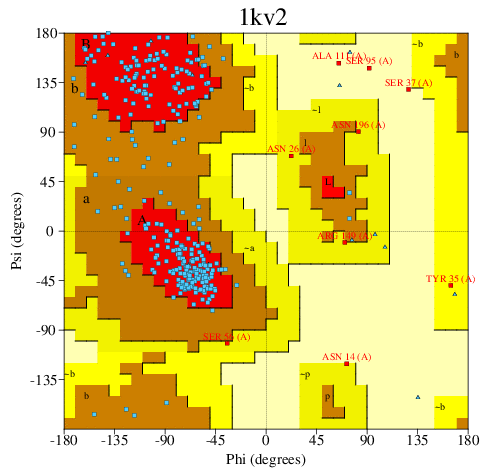
PROCHECK
|
|
|
|
|
|
Headers
|
|
|
|
References
|
|
|
|
|
|

|
|
Q16539
(MK14_HUMAN) -
Mitogen-activated protein kinase 14 from Homo sapiens
|
|
|
|
Seq:
Struc:
|
|
|
|
360 a.a.
325 a.a.
|
|

|

|

|
|
|
|
|
|
|
|
|
|
|
Key: |
 |
PfamA domain |
|
|
 |
Secondary structure |
|
 |
CATH domain |
|
|
|
|
|
|
|
|
|
|
|
|
|
Enzyme class:
|
|
E.C.2.7.11.24
- mitogen-activated protein kinase.
|
|
|
|
|
|
|
Reaction:
|
|
|
1.
|
L-seryl-[protein] + ATP = O-phospho-L-seryl-[protein] + ADP + H+
|
|
2.
|
L-threonyl-[protein] + ATP = O-phospho-L-threonyl-[protein] + ADP + H+
|
|
|
|
|
|
|
L-seryl-[protein]
|
+
|
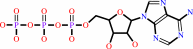 ATP
ATP
|
=
|
O-phospho-L-seryl-[protein]
|
+
|
 ADP
ADP
|
+
|
H(+)
|
|
|
|
|
|
|
L-threonyl-[protein]
|
+
|
ATP
|
=
|
O-phospho-L-threonyl-[protein]
|
+
|
ADP
|
+
|
H(+)
|
|
|
|
|
|
|
|
|
|
|
|
|
Molecule diagrams generated from .mol files obtained from the
KEGG ftp site
|
|
|
|
|
|
|
|
|
|
|
|
|
|
 |
|
|
|
|
|
|
| |
|
|
| |
|
DOI no:
|
Nat Struct Biol
9:268-272
(2002)
|
|
PubMed id:
|
|
|
|
|
|
| |
|
Inhibition of p38 MAP kinase by utilizing a novel allosteric binding site.
|
|
C.Pargellis,
L.Tong,
L.Churchill,
P.F.Cirillo,
T.Gilmore,
A.G.Graham,
P.M.Grob,
E.R.Hickey,
N.Moss,
S.Pav,
J.Regan.
|
|
|
|
|
| |
ABSTRACT
|
|
|
|
| |
|
|
The p38 MAP kinase plays a crucial role in regulating the production of
proinflammatory cytokines, such as tumor necrosis factor and interleukin-1.
Blocking this kinase may offer an effective therapy for treating many
inflammatory diseases. Here we report a new allosteric binding site for a diaryl
urea class of highly potent and selective inhibitors against human p38 MAP
kinase. The formation of this binding site requires a large conformational
change not observed previously for any of the protein Ser/Thr kinases. This
change is in the highly conserved Asp-Phe-Gly motif within the active site of
the kinase. Solution studies demonstrate that this class of compounds has slow
binding kinetics, consistent with the requirement for conformational change.
Improving interactions in this allosteric pocket, as well as establishing
binding interactions in the ATP pocket, enhanced the affinity of the inhibitors
by 12,000-fold. One of the most potent compounds in this series, BIRB 796, has
picomolar affinity for the kinase and low nanomolar inhibitory activity in cell
culture.
|
|
|
|
|
|
| |
Selected figure(s)
|
|
|
|
| |
|
|

|
|

|
|
Figure 2.
Figure 2. A new allosteric binding pocket for compound 1 in
human p38 MAP kinase. a, Schematic drawing of the structure
of p38 MAP kinase in complex with compound 1. The inhibitor is
shown as a stick model, with carbon atoms in green. The expected
location of the ATP molecule^8 (purple for carbon atoms) is
shown for reference. b, Final 2F[o] - F[c] electron density map
for compound 1, contoured at 1  level.
Panel (a) is produced with RIBBONS27 and panel (b) with SETOR28. level.
Panel (a) is produced with RIBBONS27 and panel (b) with SETOR28.
|
|
Figure 3.
Figure 3. A conformational change in the kinase is required for
the binding of diaryl urea inhibitors. a, Stereo view showing
the conformational change for the DFG motif. The DFG-in
conformation is shown with the carbon atoms in light blue, and
the DFG-out conformation is in gray. Also shown is the overlay
of the binding modes of compound 1 (green), the 3'-iodo analog
of SB 203580 (cyan)8 and ATP (purple). b, Molecular surface of
the p38 MAP kinase in the active site region in complex with
compound 1. For clarity, residues in the DFG motif are shown as
a stick model. The ATP molecule is shown for reference. c,
Stereo view showing the binding pocket (gray for carbon atoms)
for BIRB 796 (green). Also shown is compound 1 and the
conformation of Glu 71 (cyan) in that complex. Produced with
GRASP29.
|
|
|
|
|
|
| |
The above figures are
reprinted
by permission from Macmillan Publishers Ltd:
Nat Struct Biol
(2002,
9,
268-272)
copyright 2002.
|
|
| |
Figures were
selected
by an automated process.
|
|
|
|
|
|
|
|
|
|
|
|
|
|
|
|
 |
 |
 |
|
Literature references that cite this PDB file's key reference
|
|
|
| |
PubMed id
|
|
Reference
|
|
|
|
|
|
A.Sukhwal,
M.Bhattacharyya,
and
S.Vishveshwara
(2011).
Network approach for capturing ligand-induced subtle global changes in protein structures.
|
| |
Acta Crystallogr D Biol Crystallogr,
67,
429-439.
|
|
|
|
|
|
|
N.Handa,
T.Takagi,
S.Saijo,
S.Kishishita,
D.Takaya,
M.Toyama,
T.Terada,
M.Shirouzu,
A.Suzuki,
S.Lee,
T.Yamauchi,
M.Okada-Iwabu,
M.Iwabu,
T.Kadowaki,
Y.Minokoshi,
and
S.Yokoyama
(2011).
Structural basis for compound C inhibition of the human AMP-activated protein kinase α2 subunit kinase domain.
|
| |
Acta Crystallogr D Biol Crystallogr,
67,
480-487.
|
|
|
PDB codes:
|
|
|
|
|
|
|
|
A.Bai,
and
Z.Peng
(2010).
Biological therapies of inflammatory bowel disease.
|
| |
Immunotherapy,
2,
727-742.
|
|
|
|
|
|
|
A.Cuadrado,
and
A.R.Nebreda
(2010).
Mechanisms and functions of p38 MAPK signalling.
|
| |
Biochem J,
429,
403-417.
|
|
|
|
|
|
|
A.Fujino,
K.Fukushima,
N.Namiki,
T.Kosugi,
and
M.Takimoto-Kamimura
(2010).
Structural analysis of an MK2-inhibitor complex: insight into the regulation of the secondary structure of the Gly-rich loop by TEI-I01800.
|
| |
Acta Crystallogr D Biol Crystallogr,
66,
80-87.
|
|
|
PDB code:
|
|
|
|
|
|
|
|
B.S.Hendriks,
K.M.Seidl,
and
J.R.Chabot
(2010).
Two additive mechanisms impair the differentiation of 'substrate-selective' p38 inhibitors from classical p38 inhibitors in vitro.
|
| |
BMC Syst Biol,
4,
23.
|
|
|
|
|
|
|
C.A.Dodson,
M.Kosmopoulou,
M.W.Richards,
B.Atrash,
V.Bavetsias,
J.Blagg,
and
R.Bayliss
(2010).
Crystal structure of an Aurora-A mutant that mimics Aurora-B bound to MLN8054: insights into selectivity and drug design.
|
| |
Biochem J,
427,
19-28.
|
|
|
PDB codes:
|
|
|
|
|
|
|
|
D.Falck,
J.S.de Vlieger,
W.M.Niessen,
J.Kool,
M.Honing,
M.Giera,
and
H.Irth
(2010).
Development of an online p38α mitogen-activated protein kinase binding assay and integration of LC-HR-MS.
|
| |
Anal Bioanal Chem,
398,
1771-1780.
|
|
|
|
|
|
|
D.Huang,
T.Zhou,
K.Lafleur,
C.Nevado,
and
A.Caflisch
(2010).
Kinase selectivity potential for inhibitors targeting the ATP binding site: a network analysis.
|
| |
Bioinformatics,
26,
198-204.
|
|
|
|
|
|
|
E.A.Murphy,
D.J.Shields,
K.Stoletov,
E.Dneprovskaia,
M.McElroy,
J.I.Greenberg,
J.Lindquist,
L.M.Acevedo,
S.Anand,
B.K.Majeti,
I.Tsigelny,
A.Saldanha,
B.Walsh,
R.M.Hoffman,
M.Bouvet,
R.L.Klemke,
P.K.Vogt,
L.Arnold,
W.Wrasidlo,
and
D.A.Cheresh
(2010).
Disruption of angiogenesis and tumor growth with an orally active drug that stabilizes the inactive state of PDGFRbeta/B-RAF.
|
| |
Proc Natl Acad Sci U S A,
107,
4299-4304.
|
|
|
|
|
|
|
L.M.Wodicka,
P.Ciceri,
M.I.Davis,
J.P.Hunt,
M.Floyd,
S.Salerno,
X.H.Hua,
J.M.Ford,
R.C.Armstrong,
P.P.Zarrinkar,
and
D.K.Treiber
(2010).
Activation state-dependent binding of small molecule kinase inhibitors: structural insights from biochemistry.
|
| |
Chem Biol,
17,
1241-1249.
|
|
|
|
|
|
|
M.J.Rudolph,
G.A.Amodeo,
and
L.Tong
(2010).
An inhibited conformation for the protein kinase domain of the Saccharomyces cerevisiae AMPK homolog Snf1.
|
| |
Acta Crystallogr Sect F Struct Biol Cryst Commun,
66,
999.
|
|
|
PDB code:
|
|
|
|
|
|
|
|
N.Dzamko,
M.Deak,
F.Hentati,
A.D.Reith,
A.R.Prescott,
D.R.Alessi,
and
R.J.Nichols
(2010).
Inhibition of LRRK2 kinase activity leads to dephosphorylation of Ser(910)/Ser(935), disruption of 14-3-3 binding and altered cytoplasmic localization.
|
| |
Biochem J,
430,
405-413.
|
|
|
|
|
|
|
N.Huang,
and
M.P.Jacobson
(2010).
Binding-site assessment by virtual fragment screening.
|
| |
PLoS One,
5,
e10109.
|
|
|
|
|
|
|
P.Ranjitkar,
A.M.Brock,
and
D.J.Maly
(2010).
Affinity reagents that target a specific inactive form of protein kinases.
|
| |
Chem Biol,
17,
195-206.
|
|
|
|
|
|
|
T.H.Page,
A.Brown,
E.M.Timms,
B.M.Foxwell,
and
K.P.Ray
(2010).
Inhibitors of p38 suppress cytokine production in rheumatoid arthritis synovial membranes: does variable inhibition of interleukin-6 production limit effectiveness in vivo?
|
| |
Arthritis Rheum,
62,
3221-3231.
|
|
|
|
|
|
|
W.I.Wu,
W.C.Voegtli,
H.L.Sturgis,
F.P.Dizon,
G.P.Vigers,
and
B.J.Brandhuber
(2010).
Crystal structure of human AKT1 with an allosteric inhibitor reveals a new mode of kinase inhibition.
|
| |
PLoS One,
5,
e12913.
|
|
|
PDB code:
|
|
|
|
|
|
|
|
C.D.Wood,
T.M.Thornton,
G.Sabio,
R.A.Davis,
and
M.Rincon
(2009).
Nuclear localization of p38 MAPK in response to DNA damage.
|
| |
Int J Biol Sci,
5,
428-437.
|
|
|
|
|
|
|
C.García-Echeverría
(2009).
Protein and lipid kinase inhibitors as targeted anticancer agents of the Ras/Raf/MEK and PI3K/PKB pathways.
|
| |
Purinergic Signal,
5,
117-125.
|
|
|
|
|
|
|
G.T.Lountos,
J.E.Tropea,
D.Zhang,
A.G.Jobson,
Y.Pommier,
R.H.Shoemaker,
and
D.S.Waugh
(2009).
Crystal structure of checkpoint kinase 2 in complex with NSC 109555, a potent and selective inhibitor.
|
| |
Protein Sci,
18,
92.
|
|
|
PDB code:
|
|
|
|
|
|
|
|
J.Fastrez
(2009).
Engineering allosteric regulation into biological catalysts.
|
| |
Chembiochem,
10,
2824-2835.
|
|
|
|
|
|
|
J.R.Simard,
S.Klüter,
C.Grütter,
M.Getlik,
M.Rabiller,
H.B.Rode,
and
D.Rauh
(2009).
A new screening assay for allosteric inhibitors of cSrc.
|
| |
Nat Chem Biol,
5,
394-396.
|
|
|
PDB codes:
|
|
|
|
|
|
|
|
K.Abbas,
J.Breton,
C.R.Picot,
V.Quesniaux,
C.Bouton,
and
J.C.Drapier
(2009).
Signaling events leading to peroxiredoxin 5 up-regulation in immunostimulated macrophages.
|
| |
Free Radic Biol Med,
47,
794-802.
|
|
|
|
|
|
|
K.Burkhard,
S.Smith,
R.Deshmukh,
A.D.MacKerell,
and
P.Shapiro
(2009).
Development of extracellular signal-regulated kinase inhibitors.
|
| |
Curr Top Med Chem,
9,
678-689.
|
|
|
|
|
|
|
K.O.Wrzeszczynski,
and
B.Rost
(2009).
Cell cycle kinases predicted from conserved biophysical properties.
|
| |
Proteins,
74,
655-668.
|
|
|
|
|
|
|
L.N.Johnson
(2009).
Protein kinase inhibitors: contributions from structure to clinical compounds.
|
| |
Q Rev Biophys,
42,
1.
|
|
|
|
|
|
|
M.K.Tarrant,
and
P.A.Cole
(2009).
The chemical biology of protein phosphorylation.
|
| |
Annu Rev Biochem,
78,
797-825.
|
|
|
|
|
|
|
R.Li,
A.Pourpak,
and
S.W.Morris
(2009).
Inhibition of the insulin-like growth factor-1 receptor (IGF1R) tyrosine kinase as a novel cancer therapy approach.
|
| |
J Med Chem,
52,
4981-5004.
|
|
|
|
|
|
|
R.S.Armen,
J.Chen,
and
C.L.Brooks
(2009).
An Evaluation of Explicit Receptor Flexibility in Molecular Docking Using Molecular Dynamics and Torsion Angle Molecular Dynamics.
|
| |
J Chem Theory Comput,
5,
2909-2923.
|
|
|
|
|
|
|
S.Han,
A.Mistry,
J.S.Chang,
D.Cunningham,
M.Griffor,
P.C.Bonnette,
H.Wang,
B.A.Chrunyk,
G.E.Aspnes,
D.P.Walker,
A.D.Brosius,
and
L.Buckbinder
(2009).
Structural Characterization of Proline-rich Tyrosine Kinase 2 (PYK2) Reveals a Unique (DFG-out) Conformation and Enables Inhibitor Design.
|
| |
J Biol Chem,
284,
13193-13201.
|
|
|
PDB codes:
|
|
|
|
|
|
|
|
S.Sen,
and
A.B.West
(2009).
The therapeutic potential of LRRK2 and alpha-synuclein in Parkinson's disease.
|
| |
Antioxid Redox Signal,
11,
2167-2187.
|
|
|
|
|
|
|
A.C.Dar,
M.S.Lopez,
and
K.M.Shokat
(2008).
Small molecule recognition of c-Src via the Imatinib-binding conformation.
|
| |
Chem Biol,
15,
1015-1022.
|
|
|
PDB codes:
|
|
|
|
|
|
|
|
B.D.Marsden,
and
S.Knapp
(2008).
Doing more than just the structure-structural genomics in kinase drug discovery.
|
| |
Curr Opin Chem Biol,
12,
40-45.
|
|
|
|
|
|
|
B.Gorelik,
and
A.Goldblum
(2008).
High quality binding modes in docking ligands to proteins.
|
| |
Proteins,
71,
1373-1386.
|
|
|
|
|
|
|
D.Leroy,
and
C.Doerig
(2008).
Drugging the Plasmodium kinome: the benefits of academia-industry synergy.
|
| |
Trends Pharmacol Sci,
29,
241-249.
|
|
|
|
|
|
|
D.Lietha,
and
M.J.Eck
(2008).
Crystal structures of the FAK kinase in complex with TAE226 and related bis-anilino pyrimidine inhibitors reveal a helical DFG conformation.
|
| |
PLoS ONE,
3,
e3800.
|
|
|
PDB codes:
|
|
|
|
|
|
|
|
D.M.Goldstein,
N.S.Gray,
and
P.P.Zarrinkar
(2008).
High-throughput kinase profiling as a platform for drug discovery.
|
| |
Nat Rev Drug Discov,
7,
391-397.
|
|
|
|
|
|
|
I.Reulecke,
G.Lange,
J.Albrecht,
R.Klein,
and
M.Rarey
(2008).
Towards an integrated description of hydrogen bonding and dehydration: decreasing false positives in virtual screening with the HYDE scoring function.
|
| |
ChemMedChem,
3,
885-897.
|
|
|
|
|
|
|
J.S.Sack,
K.F.Kish,
M.Pokross,
D.Xie,
G.J.Duke,
J.A.Tredup,
S.E.Kiefer,
and
J.A.Newitt
(2008).
Structural basis for the high-affinity binding of pyrrolotriazine inhibitors of p38 MAP kinase.
|
| |
Acta Crystallogr D Biol Crystallogr,
64,
705-710.
|
|
|
|
|
|
|
J.Subramanian,
S.Sharma,
and
C.B-Rao
(2008).
Modeling and selection of flexible proteins for structure-based drug design: backbone and side chain movements in p38 MAPK.
|
| |
ChemMedChem,
3,
336-344.
|
|
|
|
|
|
|
J.Zou,
Y.D.Wang,
F.X.Ma,
M.L.Xiang,
B.Shi,
Y.Q.Wei,
and
S.Y.Yang
(2008).
Detailed conformational dynamics of juxtamembrane region and activation loop in c-Kit kinase activation process.
|
| |
Proteins,
72,
323-332.
|
|
|
|
|
|
|
N.Vajpai,
A.Strauss,
G.Fendrich,
S.W.Cowan-Jacob,
P.W.Manley,
S.Grzesiek,
and
W.Jahnke
(2008).
Solution conformations and dynamics of ABL kinase-inhibitor complexes determined by NMR substantiate the different binding modes of imatinib/nilotinib and dasatinib.
|
| |
J Biol Chem,
283,
18292-18302.
|
|
|
|
|
|
|
S.J.Cho,
and
Y.Sun
(2008).
Visual exploration of structure-activity relationship using maximum common framework.
|
| |
J Comput Aided Mol Des,
22,
571-578.
|
|
|
|
|
|
|
S.Rao,
P.C.Sanschagrin,
J.R.Greenwood,
M.P.Repasky,
W.Sherman,
and
R.Farid
(2008).
Improving database enrichment through ensemble docking.
|
| |
J Comput Aided Mol Des,
22,
621-627.
|
|
|
|
|
|
|
T.A.Binkowski,
and
A.Joachimiak
(2008).
Protein functional surfaces: global shape matching and local spatial alignments of ligand binding sites.
|
| |
BMC Struct Biol,
8,
45.
|
|
|
|
|
|
|
A.White,
C.A.Pargellis,
J.M.Studts,
B.G.Werneburg,
and
B.T.Farmer
(2007).
Molecular basis of MAPK-activated protein kinase 2:p38 assembly.
|
| |
Proc Natl Acad Sci U S A,
104,
6353-6358.
|
|
|
PDB code:
|
|
|
|
|
|
|
|
D.J.Diller,
and
D.W.Hobbs
(2007).
Understanding hERG inhibition with QSAR models based on a one-dimensional molecular representation.
|
| |
J Comput Aided Mol Des,
21,
379-393.
|
|
|
|
|
|
|
D.Kuhn,
N.Weskamp,
E.Hüllermeier,
and
G.Klebe
(2007).
Functional Classification of Protein Kinase Binding Sites Using Cavbase.
|
| |
ChemMedChem,
2,
1432-1447.
|
|
|
|
|
|
|
G.M.Verkhivker
(2007).
In silico profiling of tyrosine kinases binding specificity and drug resistance using Monte Carlo simulations with the ensembles of protein kinase crystal structures.
|
| |
Biopolymers,
85,
333-348.
|
|
|
|
|
|
|
G.M.Verkhivker
(2007).
Computational proteomics of biomolecular interactions in the sequence and structure space of the tyrosine kinome: deciphering the molecular basis of the kinase inhibitors selectivity.
|
| |
Proteins,
66,
912-929.
|
|
|
|
|
|
|
H.Yasui,
T.Hideshima,
H.Ikeda,
J.Jin,
E.M.Ocio,
T.Kiziltepe,
Y.Okawa,
S.Vallet,
K.Podar,
K.Ishitsuka,
P.G.Richardson,
C.Pargellis,
N.Moss,
N.Raje,
and
K.C.Anderson
(2007).
BIRB 796 enhances cytotoxicity triggered by bortezomib, heat shock protein (Hsp) 90 inhibitor, and dexamethasone via inhibition of p38 mitogen-activated protein kinase/Hsp27 pathway in multiple myeloma cell lines and inhibits paracrine tumour growth.
|
| |
Br J Haematol,
136,
414-423.
|
|
|
|
|
|
|
I.Plaza-Menacho,
L.Mologni,
E.Sala,
C.Gambacorti-Passerini,
A.I.Magee,
T.P.Links,
R.M.Hofstra,
D.Barford,
and
C.M.Isacke
(2007).
Sorafenib functions to potently suppress RET tyrosine kinase activity by direct enzymatic inhibition and promoting RET lysosomal degradation independent of proteasomal targeting.
|
| |
J Biol Chem,
282,
29230-29240.
|
|
|
|
|
|
|
J.E.Clark,
N.Sarafraz,
and
M.S.Marber
(2007).
Potential of p38-MAPK inhibitors in the treatment of ischaemic heart disease.
|
| |
Pharmacol Ther,
116,
192-206.
|
|
|
|
|
|
|
L.T.May,
K.Leach,
P.M.Sexton,
and
A.Christopoulos
(2007).
Allosteric modulation of G protein-coupled receptors.
|
| |
Annu Rev Pharmacol Toxicol,
47,
1.
|
|
|
|
|
|
|
R.G.Kulkarni,
P.Srivani,
G.Achaiah,
and
G.N.Sastry
(2007).
Strategies to design pyrazolyl urea derivatives for p38 kinase inhibition: a molecular modeling study.
|
| |
J Comput Aided Mol Des,
21,
155-166.
|
|
|
|
|
|
|
S.Margutti,
and
S.A.Laufer
(2007).
Are MAP Kinases Drug Targets? Yes, but Difficult Ones.
|
| |
ChemMedChem,
2,
1116-1140.
|
|
|
|
|
|
|
S.W.Cowan-Jacob,
G.Fendrich,
A.Floersheimer,
P.Furet,
J.Liebetanz,
G.Rummel,
P.Rheinberger,
M.Centeleghe,
D.Fabbro,
and
P.W.Manley
(2007).
Structural biology contributions to the discovery of drugs to treat chronic myelogenous leukaemia.
|
| |
Acta Crystallogr D Biol Crystallogr,
63,
80-93.
|
|
|
PDB codes:
|
|
|
|
|
|
|
|
T.Persson,
C.W.Yde,
J.E.Rasmussen,
T.L.Rasmussen,
B.Guerra,
O.G.Issinger,
and
J.Nielsen
(2007).
Pyrazole carboxamides and carboxylic acids as protein kinase inhibitors in aberrant eukaryotic signal transduction: induction of growth arrest in MCF-7 cancer cells.
|
| |
Org Biomol Chem,
5,
3963-3970.
|
|
|
|
|
|
|
A.P.Kornev,
N.M.Haste,
S.S.Taylor,
and
L.F.Eyck
(2006).
Surface comparison of active and inactive protein kinases identifies a conserved activation mechanism.
|
| |
Proc Natl Acad Sci U S A,
103,
17783-17788.
|
|
|
|
|
|
|
D.R.Groebe
(2006).
Screening for positive allosteric modulators of biological targets.
|
| |
Drug Discov Today,
11,
632-639.
|
|
|
|
|
|
|
D.W.Heinz,
M.S.Weiss,
and
K.U.Wendt
(2006).
Biomacromolecular interactions, assemblies and machines: a structural view.
|
| |
Chembiochem,
7,
203-208.
|
|
|
|
|
|
|
G.J.Zaman,
M.M.van der Lee,
J.J.Kok,
R.L.Nelissen,
and
E.E.Loomans
(2006).
Enzyme fragment complementation binding assay for p38alpha mitogen-activated protein kinase to study the binding kinetics of enzyme inhibitors.
|
| |
Assay Drug Dev Technol,
4,
411-420.
|
|
|
|
|
|
|
G.Wagner,
and
S.Laufer
(2006).
Small molecular anti-cytokine agents.
|
| |
Med Res Rev,
26,
1.
|
|
|
|
|
|
|
J.S.Melnick,
J.Janes,
S.Kim,
J.Y.Chang,
D.G.Sipes,
D.Gunderson,
L.Jarnes,
J.T.Matzen,
M.E.Garcia,
T.L.Hood,
R.Beigi,
G.Xia,
R.A.Harig,
H.Asatryan,
S.F.Yan,
Y.Zhou,
X.J.Gu,
A.Saadat,
V.Zhou,
F.J.King,
C.M.Shaw,
A.I.Su,
R.Downs,
N.S.Gray,
P.G.Schultz,
M.Warmuth,
and
J.S.Caldwell
(2006).
An efficient rapid system for profiling the cellular activities of molecular libraries.
|
| |
Proc Natl Acad Sci U S A,
103,
3153-3158.
|
|
|
|
|
|
|
M.C.Bagley,
T.Davis,
M.C.Dix,
C.S.Widdowson,
and
D.Kipling
(2006).
Microwave-assisted synthesis of N-pyrazole ureas and the p38alpha inhibitor BIRB 796 for study into accelerated cell ageing.
|
| |
Org Biomol Chem,
4,
4158-4164.
|
|
|
|
|
|
|
M.Vogtherr,
K.Saxena,
S.Hoelder,
S.Grimme,
M.Betz,
U.Schieborr,
B.Pescatore,
M.Robin,
L.Delarbre,
T.Langer,
K.U.Wendt,
and
H.Schwalbe
(2006).
NMR characterization of kinase p38 dynamics in free and ligand-bound forms.
|
| |
Angew Chem Int Ed Engl,
45,
993-997.
|
|
|
PDB code:
|
|
|
|
|
|
|
|
N.M.Levinson,
O.Kuchment,
K.Shen,
M.A.Young,
M.Koldobskiy,
M.Karplus,
P.A.Cole,
and
J.Kuriyan
(2006).
A Src-like inactive conformation in the abl tyrosine kinase domain.
|
| |
PLoS Biol,
4,
e144.
|
|
|
PDB codes:
|
|
|
|
|
|
|
|
R.Jauch,
M.K.Cho,
S.Jäkel,
C.Netter,
K.Schreiter,
B.Aicher,
M.Zweckstetter,
H.Jäckle,
and
M.C.Wahl
(2006).
Mitogen-activated protein kinases interacting kinases are autoinhibited by a reprogrammed activation segment.
|
| |
EMBO J,
25,
4020-4032.
|
|
|
PDB codes:
|
|
|
|
|
|
|
|
S.Ross,
T.Chen,
V.Yu,
Y.Tudor,
D.Zhang,
L.Liu,
N.Tamayo,
C.Dominguez,
and
D.Powers
(2006).
High-content screening analysis of the p38 pathway: profiling of structurally related p38alpha kinase inhibitors using cell-based assays.
|
| |
Assay Drug Dev Technol,
4,
397-409.
|
|
|
|
|
|
|
S.Schreiber,
B.Feagan,
G.D'Haens,
J.F.Colombel,
K.Geboes,
M.Yurcov,
V.Isakov,
O.Golovenko,
C.N.Bernstein,
D.Ludwig,
T.Winter,
U.Meier,
C.Yong,
and
J.Steffgen
(2006).
Oral p38 mitogen-activated protein kinase inhibition with BIRB 796 for active Crohn's disease: a randomized, double-blind, placebo-controlled trial.
|
| |
Clin Gastroenterol Hepatol,
4,
325-334.
|
|
|
|
|
|
|
Y.Liu,
and
N.S.Gray
(2006).
Rational design of inhibitors that bind to inactive kinase conformations.
|
| |
Nat Chem Biol,
2,
358-364.
|
|
|
|
|
|
|
A.E.Szafranska,
and
K.N.Dalby
(2005).
Kinetic mechanism for p38 MAP kinase alpha. A partial rapid-equilibrium random-order ternary-complex mechanism for the phosphorylation of a protein substrate.
|
| |
FEBS J,
272,
4631-4645.
|
|
|
|
|
|
|
B.M.Klebl,
and
G.Müller
(2005).
Second-generation kinase inhibitors.
|
| |
Expert Opin Ther Targets,
9,
975-993.
|
|
|
|
|
|
|
H.Briem,
and
J.Günther
(2005).
Classifying "kinase inhibitor-likeness" by using machine-learning methods.
|
| |
Chembiochem,
6,
558-566.
|
|
|
|
|
|
|
M.A.Fabian,
W.H.Biggs,
D.K.Treiber,
C.E.Atteridge,
M.D.Azimioara,
M.G.Benedetti,
T.A.Carter,
P.Ciceri,
P.T.Edeen,
M.Floyd,
J.M.Ford,
M.Galvin,
J.L.Gerlach,
R.M.Grotzfeld,
S.Herrgard,
D.E.Insko,
M.A.Insko,
A.G.Lai,
J.M.Lélias,
S.A.Mehta,
Z.V.Milanov,
A.M.Velasco,
L.M.Wodicka,
H.K.Patel,
P.P.Zarrinkar,
and
D.J.Lockhart
(2005).
A small molecule-kinase interaction map for clinical kinase inhibitors.
|
| |
Nat Biotechnol,
23,
329-336.
|
|
|
|
|
|
|
M.Vieth,
J.J.Sutherland,
D.H.Robertson,
and
R.M.Campbell
(2005).
Kinomics: characterizing the therapeutically validated kinase space.
|
| |
Drug Discov Today,
10,
839-846.
|
|
|
|
|
|
|
R.Jauch,
S.Jäkel,
C.Netter,
K.Schreiter,
B.Aicher,
H.Jäckle,
and
M.C.Wahl
(2005).
Crystal structures of the Mnk2 kinase domain reveal an inhibitory conformation and a zinc binding site.
|
| |
Structure,
13,
1559-1568.
|
|
|
PDB codes:
|
|
|
|
|
|
|
|
R.Murali,
X.Cheng,
A.Berezov,
X.Du,
A.Schön,
E.Freire,
X.Xu,
Y.H.Chen,
and
M.I.Greene
(2005).
Disabling TNF receptor signaling by induced conformational perturbation of tryptophan-107.
|
| |
Proc Natl Acad Sci U S A,
102,
10970-10975.
|
|
|
|
|
|
|
T.A.Carter,
L.M.Wodicka,
N.P.Shah,
A.M.Velasco,
M.A.Fabian,
D.K.Treiber,
Z.V.Milanov,
C.E.Atteridge,
W.H.Biggs,
P.T.Edeen,
M.Floyd,
J.M.Ford,
R.M.Grotzfeld,
S.Herrgard,
D.E.Insko,
S.A.Mehta,
H.K.Patel,
W.Pao,
C.L.Sawyers,
H.Varmus,
P.P.Zarrinkar,
and
D.J.Lockhart
(2005).
Inhibition of drug-resistant mutants of ABL, KIT, and EGF receptor kinases.
|
| |
Proc Natl Acad Sci U S A,
102,
11011-11016.
|
|
|
|
|
|
|
W.Jahnke,
M.J.Blommers,
C.Fernández,
C.Zwingelstein,
and
R.Amstutz
(2005).
Strategies for the NMR-based identification and optimization of allosteric protein kinase inhibitors.
|
| |
Chembiochem,
6,
1607-1610.
|
|
|
|
|
|
|
Y.Kuma,
G.Sabio,
J.Bain,
N.Shpiro,
R.Márquez,
and
A.Cuenda
(2005).
BIRB796 inhibits all p38 MAPK isoforms in vitro and in vivo.
|
| |
J Biol Chem,
280,
19472-19479.
|
|
|
|
|
|
|
Z.A.Knight,
and
K.M.Shokat
(2005).
Features of selective kinase inhibitors.
|
| |
Chem Biol,
12,
621-637.
|
|
|
|
|
|
|
C.Wiesmann,
K.J.Barr,
J.Kung,
J.Zhu,
D.A.Erlanson,
W.Shen,
B.J.Fahr,
M.Zhong,
L.Taylor,
M.Randal,
R.S.McDowell,
and
S.K.Hansen
(2004).
Allosteric inhibition of protein tyrosine phosphatase 1B.
|
| |
Nat Struct Mol Biol,
11,
730-737.
|
|
|
PDB codes:
|
|
|
|
|
|
|
|
D.A.Erlanson,
J.A.Wells,
and
A.C.Braisted
(2004).
Tethering: fragment-based drug discovery.
|
| |
Annu Rev Biophys Biomol Struct,
33,
199-223.
|
|
|
|
|
|
|
D.L.Almholt,
F.Loechel,
S.J.Nielsen,
C.Krog-Jensen,
R.Terry,
S.P.Bjørn,
H.C.Pedersen,
M.Praestegaard,
S.Møller,
M.Heide,
L.Pagliaro,
A.J.Mason,
S.Butcher,
and
S.W.Dahl
(2004).
Nuclear export inhibitors and kinase inhibitors identified using a MAPK-activated protein kinase 2 redistribution screen.
|
| |
Assay Drug Dev Technol,
2,
7.
|
|
|
|
|
|
|
H.Zhang,
B.Tweel,
J.Li,
and
L.Tong
(2004).
Crystal structure of the carboxyltransferase domain of acetyl-coenzyme A carboxylase in complex with CP-640186.
|
| |
Structure,
12,
1683-1691.
|
|
|
PDB code:
|
|
|
|
|
|
|
|
J.F.Ohren,
H.Chen,
A.Pavlovsky,
C.Whitehead,
E.Zhang,
P.Kuffa,
C.Yan,
P.McConnell,
C.Spessard,
C.Banotai,
W.T.Mueller,
A.Delaney,
C.Omer,
J.Sebolt-Leopold,
D.T.Dudley,
I.K.Leung,
C.Flamme,
J.Warmus,
M.Kaufman,
S.Barrett,
H.Tecle,
and
C.A.Hasemann
(2004).
Structures of human MAP kinase kinase 1 (MEK1) and MEK2 describe novel noncompetitive kinase inhibition.
|
| |
Nat Struct Mol Biol,
11,
1192-1197.
|
|
|
PDB codes:
|
|
|
|
|
|
|
|
K.Gunasekaran,
B.Ma,
and
R.Nussinov
(2004).
Is allostery an intrinsic property of all dynamic proteins?
|
| |
Proteins,
57,
433-443.
|
|
|
|
|
|
|
M.E.Noble,
J.A.Endicott,
and
L.N.Johnson
(2004).
Protein kinase inhibitors: insights into drug design from structure.
|
| |
Science,
303,
1800-1805.
|
|
|
|
|
|
|
N.Gresh,
and
G.B.Shi
(2004).
Conformation-dependent intermolecular interaction energies of the triphosphate anion with divalent metal cations. Application to the ATP-binding site of a binuclear bacterial enzyme. A parallel quantum chemical and polarizable molecular mechanics investigation.
|
| |
J Comput Chem,
25,
160-168.
|
|
|
|
|
|
|
P.T.Wan,
M.J.Garnett,
S.M.Roe,
S.Lee,
D.Niculescu-Duvaz,
V.M.Good,
C.M.Jones,
C.J.Marshall,
C.J.Springer,
D.Barford,
and
R.Marais
(2004).
Mechanism of activation of the RAF-ERK signaling pathway by oncogenic mutations of B-RAF.
|
| |
Cell,
116,
855-867.
|
|
|
PDB codes:
|
|
|
|
|
|
|
|
S.Atwell,
J.M.Adams,
J.Badger,
M.D.Buchanan,
I.K.Feil,
K.J.Froning,
X.Gao,
J.Hendle,
K.Keegan,
B.C.Leon,
H.J.Müller-Dieckmann,
V.L.Nienaber,
B.W.Noland,
K.Post,
K.R.Rajashankar,
A.Ramos,
M.Russell,
S.K.Burley,
and
S.G.Buchanan
(2004).
A novel mode of Gleevec binding is revealed by the structure of spleen tyrosine kinase.
|
| |
J Biol Chem,
279,
55827-55832.
|
|
|
PDB codes:
|
|
|
|
|
|
|
|
W.J.Sandborn,
and
W.A.Faubion
(2004).
Biologics in inflammatory bowel disease: how much progress have we made?
|
| |
Gut,
53,
1366-1373.
|
|
|
|
|
|
|
A.Golebiowski,
S.R.Klopfenstein,
and
D.E.Portlock
(2003).
Lead compounds discovered from libraries: part 2.
|
| |
Curr Opin Chem Biol,
7,
308-325.
|
|
|
|
|
|
|
C.E.Fitzgerald,
S.B.Patel,
J.W.Becker,
P.M.Cameron,
D.Zaller,
V.B.Pikounis,
S.J.O'Keefe,
and
G.Scapin
(2003).
Structural basis for p38alpha MAP kinase quinazolinone and pyridol-pyrimidine inhibitor specificity.
|
| |
Nat Struct Biol,
10,
764-769.
|
|
|
PDB codes:
|
|
|
|
|
|
|
|
G.H.Waetzig,
and
S.Schreiber
(2003).
Review article: mitogen-activated protein kinases in chronic intestinal inflammation - targeting ancient pathways to treat modern diseases.
|
| |
Aliment Pharmacol Ther,
18,
17-32.
|
|
|
|
|
|
|
S.F.Holmes,
and
D.A.Erie
(2003).
Downstream DNA sequence effects on transcription elongation. Allosteric binding of nucleoside triphosphates facilitates translocation via a ratchet motion.
|
| |
J Biol Chem,
278,
35597-35608.
|
|
|
|
|
|
|
Y.Shi,
and
M.Gaestel
(2002).
In the cellular garden of forking paths: how p38 MAPKs signal for downstream assistance.
|
| |
Biol Chem,
383,
1519-1536.
|
|
|
|
|
|
The most recent references are shown first.
Citation data come partly from CiteXplore and partly
from an automated harvesting procedure. Note that this is likely to be
only a partial list as not all journals are covered by
either method. However, we are continually building up the citation data
so more and more references will be included with time.
Where a reference describes a PDB structure, the PDB
codes are
shown on the right.
|
|


 Links
Links


