 |
PDBsum entry 1fc0

|
|
|
|
|
 |
Contents |
 |
|
|
|
|
|
|
|
|
|
|
|
|
* Residue conservation analysis
|
|
|
|
|
|
PDB id:
|
|
|
|
| Name: |
|
Transferase
|
|
|
Title:
|
|
Human liver glycogen phosphorylase complexed with n-acetyl-beta-d- glucopyranosylamine
|
|
Structure:
|
|
Glycogen phosphorylase, liver form. Chain: a, b. Engineered: yes
|
|
Source:
|
|
Homo sapiens. Human. Organism_taxid: 9606. Tissue: liver. Expressed in: spodoptera frugiperda. Expression_system_taxid: 7108. Expression_system_cell_line: sf9.
|
|
Biol. unit:
|
|
Dimer (from
)
|
|
Resolution:
|
|
|
2.40Å
|
R-factor:
|
0.198
|
R-free:
|
0.235
|
|
|
Authors:
|
|
V.L.Rath,M.Ammirati,P.K.Lemotte,K.F.Fennell,M.M.Mansour,D.E.Danley, T.R.Hynes,G.K.Schulte,D.J.Wasilko,J.Pandit
|
|
Key ref:
|
|
V.L.Rath
et al.
(2000).
Activation of human liver glycogen phosphorylase by alteration of the secondary structure and packing of the catalytic core.
Mol Cell,
6,
139-148.
PubMed id:
|
|
|
Date:
|
|
|
17-Jul-00
|
Release date:
|
25-Aug-00
|
|
|
|
|
|
|
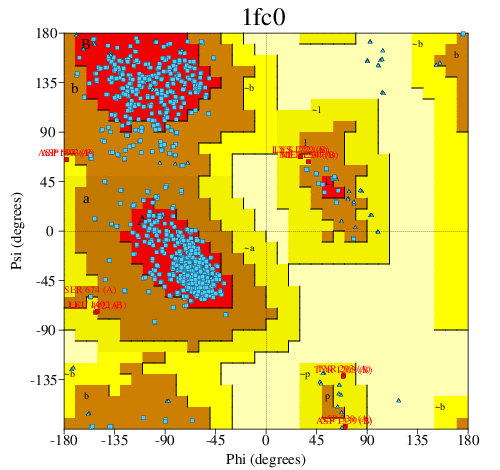
PROCHECK
|
|
|
|
|
|
Headers
|
|
|
|
References
|
|
|
|
|
|

|
|
P06737
(PYGL_HUMAN) -
Glycogen phosphorylase, liver form from Homo sapiens
|
|
|
|
Seq:
Struc:
|
|
|
|
847 a.a.
792 a.a.
|
|

|

|

|
|
|
|
|
|
|
|
|
|
|
Key: |
 |
PfamA domain |
|
|
 |
Secondary structure |
|
 |
CATH domain |
|
|
|
|
|
|
|
|
|
|
|
|
|
Enzyme class:
|
|
E.C.2.4.1.1
- glycogen phosphorylase.
|
|
|
|
|
|
|
Pathway:
|
|
Glycogen
|
|
|
|
|
|
Reaction:
|
|
[(1->4)-alpha-D-glucosyl](n) + phosphate = [(1->4)-alpha-D-glucosyl](n-1) + alpha-D-glucose 1-phosphate
|
|
|
|
|
|
[(1->4)-alpha-D-glucosyl](n)
|
+
|
 phosphate
|
=
|
[(1->4)-alpha-D-glucosyl](n-1)
|
+
|
alpha-D-glucose 1-phosphate
Bound ligand (Het Group name = )
matches with 63.16% similarity
|
|
|
|
|
|
|
|
|
|
|
|
|
Molecule diagrams generated from .mol files obtained from the
KEGG ftp site
|
|
|
|
|
|
|
|
|
|
|
|
|
|
 |
|
|
|
|
|
|
| |
|
|
| |
|
|
Mol Cell
6:139-148
(2000)
|
|
PubMed id:
|
|
|
|
|
|
| |
|
Activation of human liver glycogen phosphorylase by alteration of the secondary structure and packing of the catalytic core.
|
|
V.L.Rath,
M.Ammirati,
P.K.LeMotte,
K.F.Fennell,
M.N.Mansour,
D.E.Danley,
T.R.Hynes,
G.K.Schulte,
D.J.Wasilko,
J.Pandit.
|
|
|
|
|
| |
ABSTRACT
|
|
|
|
| |
|
|
Glycogen phosphorylases catalyze the breakdown of glycogen to
glucose-1-phosphate, which enters glycolysis to fulfill the energetic
requirements of the organism. Maintaining control of blood glucose levels is
critical in minimizing the debilitating effects of diabetes, making liver
glycogen phosphorylase a potential therapeutic target. To support inhibitor
design, we determined the crystal structures of the active and inactive forms of
human liver glycogen phosphorylase a. During activation, forty residues of the
catalytic site undergo order/disorder transitions, changes in secondary
structure, or packing to reorganize the catalytic site for substrate binding and
catalysis. Knowing the inactive and active conformations of the liver enzyme and
how each differs from its counterpart in muscle phosphorylase provides the basis
for designing inhibitors that bind preferentially to the inactive conformation
of the liver isozyme.
|
|
|
|
|
|
|
|
|
|
|
|
|
|
|
|
|
|
 |
 |
 |
|
Literature references that cite this PDB file's key reference
|
|
|
| |
PubMed id
|
|
Reference
|
|
|
|
|
|
A.Pautsch,
N.Stadler,
O.Wissdorf,
E.Langkopf,
W.Moreth,
and
R.Streicher
(2008).
Molecular recognition of the protein phosphatase 1 glycogen targeting subunit by glycogen phosphorylase.
|
| |
J Biol Chem,
283,
8913-8918.
|
|
|
PDB code:
|
|
|
|
|
|
|
|
L.L.Lairson,
B.Henrissat,
G.J.Davies,
and
S.G.Withers
(2008).
Glycosyltransferases: structures, functions, and mechanisms.
|
| |
Annu Rev Biochem,
77,
521-555.
|
|
|
|
|
|
|
C.Tiraidis,
K.M.Alexacou,
S.E.Zographos,
D.D.Leonidas,
T.Gimisis,
and
N.G.Oikonomakos
(2007).
FR258900, a potential anti-hyperglycemic drug, binds at the allosteric site of glycogen phosphorylase.
|
| |
Protein Sci,
16,
1773-1782.
|
|
|
PDB code:
|
|
|
|
|
|
|
|
N.J.Beauchamp,
J.Taybert,
M.P.Champion,
V.Layet,
P.Heinz-Erian,
A.Dalton,
M.S.Tanner,
E.Pronicka,
and
M.J.Sharrard
(2007).
High frequency of missense mutations in glycogen storage disease type VI.
|
| |
J Inherit Metab Dis,
30,
722-734.
|
|
|
|
|
|
|
C.M.Lukacs,
N.G.Oikonomakos,
R.L.Crowther,
L.N.Hong,
R.U.Kammlott,
W.Levin,
S.Li,
C.M.Liu,
D.Lucas-McGady,
S.Pietranico,
and
L.Reik
(2006).
The crystal structure of human muscle glycogen phosphorylase a with bound glucose and AMP: an intermediate conformation with T-state and R-state features.
|
| |
Proteins,
63,
1123-1126.
|
|
|
PDB code:
|
|
|
|
|
|
|
|
S.Freeman,
J.B.Bartlett,
G.Convey,
I.Hardern,
J.L.Teague,
S.J.Loxham,
J.M.Allen,
S.M.Poucher,
and
A.D.Charles
(2006).
Sensitivity of glycogen phosphorylase isoforms to indole site inhibitors is markedly dependent on the activation state of the enzyme.
|
| |
Br J Pharmacol,
149,
775-785.
|
|
|
|
|
|
|
M.Yanase,
H.Takata,
K.Fujii,
T.Takaha,
and
T.Kuriki
(2005).
Cumulative effect of amino acid replacements results in enhanced thermostability of potato type L alpha-glucan phosphorylase.
|
| |
Appl Environ Microbiol,
71,
5433-5439.
|
|
|
|
|
|
|
A.Buschiazzo,
J.E.Ugalde,
M.E.Guerin,
W.Shepard,
R.A.Ugalde,
and
P.M.Alzari
(2004).
Crystal structure of glycogen synthase: homologous enzymes catalyze glycogen synthesis and degradation.
|
| |
EMBO J,
23,
3196-3205.
|
|
|
PDB codes:
|
|
|
|
|
|
|
|
J.Adams,
Z.P.Chen,
B.J.Van Denderen,
C.J.Morton,
M.W.Parker,
L.A.Witters,
D.Stapleton,
and
B.E.Kemp
(2004).
Intrasteric control of AMPK via the gamma1 subunit AMP allosteric regulatory site.
|
| |
Protein Sci,
13,
155-165.
|
|
|
|
|
|
|
D.D.Boehr,
A.R.Farley,
G.D.Wright,
and
J.R.Cox
(2002).
Analysis of the pi-pi stacking interactions between the aminoglycoside antibiotic kinase APH(3')-IIIa and its nucleotide ligands.
|
| |
Chem Biol,
9,
1209-1217.
|
|
|
|
|
|
|
J.L.Buchbinder,
V.L.Rath,
and
R.J.Fletterick
(2001).
Structural relationships among regulated and unregulated phosphorylases.
|
| |
Annu Rev Biophys Biomol Struct,
30,
191-209.
|
|
|
|
|
|
|
J.L.Treadway,
P.Mendys,
and
D.J.Hoover
(2001).
Glycogen phosphorylase inhibitors for treatment of type 2 diabetes mellitus.
|
| |
Expert Opin Investig Drugs,
10,
439-454.
|
|
|
|
|
|
The most recent references are shown first.
Citation data come partly from CiteXplore and partly
from an automated harvesting procedure. Note that this is likely to be
only a partial list as not all journals are covered by
either method. However, we are continually building up the citation data
so more and more references will be included with time.
Where a reference describes a PDB structure, the PDB
code is
shown on the right.
|
|


 Links
Links



