|
PDBsum entry 1f9c

|
|
|
|
|
 |
Contents |
 |
|
|
|
|
|
|
|
|
|
|
|
|
* Residue conservation analysis
|
|
|
|
|
|
|
|
|
|
|
Enzyme class:
|
|
E.C.5.5.1.1
- muconate cycloisomerase.
|
|
|
|
|
|
|
Pathway:
|
|
Benzoate Metabolism
|
|
|
|
|
|
Reaction:
|
|
(S)-muconolactone = cis,cis-muconate + H+
|
|
|
|
|
|
(S)-muconolactone
|
=
|
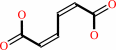 cis,cis-muconate
|
+
|
H(+)
|
|
|
|
|
|
|
|
|
|
Cofactor:
|
|
Mn(2+)
|
|
|
|
|
|
|
|
|
Molecule diagrams generated from .mol files obtained from the
KEGG ftp site
|
|
|
|
|
|
|
|
|
|
|
|
|
|
 |
|
|
|
|
|
|
| |
|
|
| |
|
DOI no:
|
Structure
8:1203-1214
(2000)
|
|
PubMed id:
|
|
|
|
|
|
| |
|
Buried charged surface in proteins.
|
|
T.Kajander,
P.C.Kahn,
S.H.Passila,
D.C.Cohen,
L.Lehtiö,
W.Adolfsen,
J.Warwicker,
U.Schell,
A.Goldman.
|
|
|
|
|
| |
ABSTRACT
|
|
|
|
| |
|
|
BACKGROUND: The traditional picture of charged amino acids in globular proteins
is that they are almost exclusively on the outside exposed to the solvent.
Buried charges, when they do occur, are assumed to play an essential role in
catalysis and ligand binding, or in stabilizing structure as, for instance,
helix caps. RESULTS: By analyzing the amount and distribution of buried charged
surface and charges in proteins over a broad range of protein sizes, we show
that buried charge is much more common than is generally believed. We also show
that the amount of buried charge rises with protein size in a manner which
differs from other types of surfaces, especially aromatic and polar uncharged
surfaces. In large proteins such as hemocyanin, 35% of all charges are greater
than 75% buried. Furthermore, at all sizes few charged groups are fully exposed.
As an experimental test, we show that replacement of the buried D178 of muconate
lactonizing enzyme by N stabilizes the enzyme by 4.2 degrees C without any
change in crystallographic structure. In addition, free energy calculations of
stability support the experimental results. CONCLUSIONS: Nature may use charge
burial to reduce protein stability; not all buried charges are fully stabilized
by a prearranged protein environment. Consistent with this view, thermophilic
proteins often have less buried charge. Modifying the amount of buried charge at
carefully chosen sites may thus provide a general route for changing the
thermophilicity or psychrophilicity of proteins.
|
|
|
|
|
|
| |
Selected figure(s)
|
|
|
|
| |
|
|

|
|
Figure 4.
Figure 4. The Structures of the Regions Containing D178,
H181, and D150 in Wild-Type MLE and the D178N VariantWild type,
(a); Di78N, (b). The path of the backbone is shown as a "worm."
D178, H151, and D150, as well as residues that interact with
them, are in ball and stick. Oxygen is red; nitrogen is blue.
Hydrogen bonds are shown as dotted lines. The figure was
prepared using MOLSCRIPT [65] and Raster3D [66]

|
|
|
|
|
|
| |
The above figure is
reprinted
by permission from Cell Press:
Structure
(2000,
8,
1203-1214)
copyright 2000.
|
|
| |
Figure was
selected
by an automated process.
|
|
|
|
|
|
|
|
|
|
|
|
|
|
|
|
 |
 |
 |
|
Literature references that cite this PDB file's key reference
|
|
|
| |
PubMed id
|
|
Reference
|
|
|
|
|
|
C.N.Pace,
H.Fu,
K.L.Fryar,
J.Landua,
S.R.Trevino,
B.A.Shirley,
M.M.Hendricks,
S.Iimura,
K.Gajiwala,
J.M.Scholtz,
and
G.R.Grimsley
(2011).
Contribution of hydrophobic interactions to protein stability.
|
| |
J Mol Biol,
408,
514-528.
|
|
|
|
|
|
|
G.López,
A.Bañares-Hidalgo,
and
P.Estrada
(2011).
Xylanase II from Trichoderma reesei QM 9414: conformational and catalytic stability to Chaotropes, Trifluoroethanol, and pH changes.
|
| |
J Ind Microbiol Biotechnol,
38,
113-125.
|
|
|
|
|
|
|
N.S.de Groot,
and
S.Ventura
(2010).
Protein aggregation profile of the bacterial cytosol.
|
| |
PLoS One,
5,
e9383.
|
|
|
|
|
|
|
M.Sagermann,
R.R.Chapleau,
E.DeLorimier,
and
M.Lei
(2009).
Using affinity chromatography to engineer and characterize pH-dependent protein switches.
|
| |
Protein Sci,
18,
217-228.
|
|
|
PDB codes:
|
|
|
|
|
|
|
|
D.G.Isom,
B.R.Cannon,
C.A.Castañeda,
A.Robinson,
and
B.García-Moreno
(2008).
High tolerance for ionizable residues in the hydrophobic interior of proteins.
|
| |
Proc Natl Acad Sci U S A,
105,
17784-17788.
|
|
|
|
|
|
|
M.J.Harms,
J.L.Schlessman,
M.S.Chimenti,
G.R.Sue,
A.Damjanović,
and
B.García-Moreno
(2008).
A buried lysine that titrates with a normal pKa: role of conformational flexibility at the protein-water interface as a determinant of pKa values.
|
| |
Protein Sci,
17,
833-845.
|
|
|
PDB code:
|
|
|
|
|
|
|
|
I.Matsui,
and
K.Harata
(2007).
Implication for buried polar contacts and ion pairs in hyperthermostable enzymes.
|
| |
FEBS J,
274,
4012-4022.
|
|
|
|
|
|
|
L.J.Falomir-Lockhart,
L.Laborde,
P.C.Kahn,
J.Storch,
and
B.Córsico
(2006).
Protein-membrane interaction and fatty acid transfer from intestinal fatty acid-binding protein to membranes. Support for a multistep process.
|
| |
J Biol Chem,
281,
13979-13989.
|
|
|
|
|
|
|
M.R.Gunner,
J.Mao,
Y.Song,
and
J.Kim
(2006).
Factors influencing the energetics of electron and proton transfers in proteins. What can be learned from calculations.
|
| |
Biochim Biophys Acta,
1757,
942-968.
|
|
|
|
|
|
|
C.N.Pace,
S.Treviño,
E.Prabhakaran,
and
J.M.Scholtz
(2004).
Protein structure, stability and solubility in water and other solvents.
|
| |
Philos Trans R Soc Lond B Biol Sci,
359,
1225.
|
|
|
|
|
|
|
E.C.Meng,
B.J.Polacco,
and
P.C.Babbitt
(2004).
Superfamily active site templates.
|
| |
Proteins,
55,
962-976.
|
|
|
|
|
|
|
K.B.Murray,
W.R.Taylor,
and
J.M.Thornton
(2004).
Toward the detection and validation of repeats in protein structure.
|
| |
Proteins,
57,
365-380.
|
|
|
|
|
|
|
G.I.Yakovlev,
V.A.Mitkevich,
K.L.Shaw,
S.Trevino,
S.Newsom,
C.N.Pace,
and
A.A.Makarov
(2003).
Contribution of active site residues to the activity and thermal stability of ribonuclease Sa.
|
| |
Protein Sci,
12,
2367-2373.
|
|
|
|
|
|
|
S.Balaji,
S.Aruna,
and
N.Srinivasan
(2003).
Tolerance to the substitution of buried apolar residues by charged residues in the homologous protein structures.
|
| |
Proteins,
53,
783-791.
|
|
|
|
|
|
|
T.Kajander,
L.Lehtiö,
M.Schlömann,
and
A.Goldman
(2003).
The structure of Pseudomonas P51 Cl-muconate lactonizing enzyme: co-evolution of structure and dynamics with the dehalogenation function.
|
| |
Protein Sci,
12,
1855-1864.
|
|
|
PDB code:
|
|
|
|
|
|
|
|
T.V.Chalikian
(2003).
Volumetric properties of proteins.
|
| |
Annu Rev Biophys Biomol Struct,
32,
207-235.
|
|
|
|
|
|
|
T.V.Chalikian
(2003).
Hydrophobic tendencies of polar groups as a major force in molecular recognition.
|
| |
Biopolymers,
70,
492-496.
|
|
|
|
|
|
|
C.W.Levy,
P.A.Buckley,
S.Sedelnikova,
Y.Kato,
Y.Asano,
D.W.Rice,
and
P.J.Baker
(2002).
Insights into enzyme evolution revealed by the structure of methylaspartate ammonia lyase.
|
| |
Structure,
10,
105-113.
|
|
|
PDB codes:
|
|
|
|
|
|
|
|
I.M.Skerrett,
J.Aronowitz,
J.H.Shin,
G.Cymes,
E.Kasperek,
F.L.Cao,
and
B.J.Nicholson
(2002).
Identification of amino acid residues lining the pore of a gap junction channel.
|
| |
J Cell Biol,
159,
349-360.
|
|
|
|
|
|
|
N.Mitra,
V.R.Srinivas,
T.N.Ramya,
N.Ahmad,
G.B.Reddy,
and
A.Surolia
(2002).
Conformational stability of legume lectins reflect their different modes of quaternary association: solvent denaturation studies on concanavalin A and winged bean acidic agglutinin.
|
| |
Biochemistry,
41,
9256-9263.
|
|
|
|
|
|
|
P.Phelan,
A.A.Gorfe,
I.Jelesarov,
D.N.Marti,
J.Warwicker,
and
H.R.Bosshard
(2002).
Salt bridges destabilize a leucine zipper designed for maximized ion pairing between helices.
|
| |
Biochemistry,
41,
2998-3008.
|
|
|
|
|
|
The most recent references are shown first.
Citation data come partly from CiteXplore and partly
from an automated harvesting procedure. Note that this is likely to be
only a partial list as not all journals are covered by
either method. However, we are continually building up the citation data
so more and more references will be included with time.
Where a reference describes a PDB structure, the PDB
codes are
shown on the right.
|
|


 Links
Links