|
|
|
|
|
 |
Contents |
 |
|
|
|
|
|
|
|
|
|
|
|
|
* Residue conservation analysis
|
|
|
|
|
|
|
|
|
|
Enzyme class:
|
|
Chains A, B:
E.C.1.13.11.3
- protocatechuate 3,4-dioxygenase.
|
|
|
|
|
|
|
Pathway:
|
|
Benzoate Metabolism
|
|
|
|
|
|
Reaction:
|
|
3,4-dihydroxybenzoate + O2 = 3-carboxy-cis,cis-muconate + 2 H+
|
|
|
|
|
|
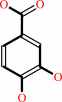 3,4-dihydroxybenzoate
|
+
|
 O2
O2
|
=
|
 3-carboxy-cis,cis-muconate
|
+
|
2
×
H(+)
|
|
|
|
|
|
|
|
|
|
Cofactor:
|
|
Fe cation
|
|
|
|
|
|
|
|
|
Molecule diagrams generated from .mol files obtained from the
KEGG ftp site
|
|
|
|
|
|
|
|
|
|
|
|
|
|
 |
|
|
|
|
|
|
| |
|
|
| |
|
DOI no:
|
Biochemistry
39:7943-7955
(2000)
|
|
PubMed id:
|
|
|
|
|
|
| |
|
Structure of Acinetobacter strain ADP1 protocatechuate 3, 4-dioxygenase at 2.2 A resolution: implications for the mechanism of an intradiol dioxygenase.
|
|
M.W.Vetting,
D.A.D'Argenio,
L.N.Ornston,
D.H.Ohlendorf.
|
|
|
|
|
| |
ABSTRACT
|
|
|
|
| |
|
|
The crystal structures of protocatechuate 3,4-dioxygenase from the soil bacteria
Acinetobacterstrain ADP1 (Ac 3,4-PCD) have been determined in space group I23 at
pH 8.5 and 5.75. In addition, the structures of Ac 3,4-PCD complexed with its
substrate 3, 4-dihydroxybenzoic acid (PCA), the inhibitor 4-nitrocatechol
(4-NC), or cyanide (CN(-)) have been solved using native phases. The overall
tertiary and quaternary structures of Ac 3,4-PCD are similar to those of the
same enzyme from Pseudomonas putida[Ohlendorf et al. (1994) J. Mol. Biol. 244,
586-608]. At pH 8.5, the catalytic non-heme Fe(3+) is coordinated by two axial
ligands, Tyr447(OH) (147beta) and His460(N)(epsilon)(2) (160beta), and three
equatorial ligands, Tyr408(OH) (108beta), His462(N)(epsilon)(2) (162beta), and a
hydroxide ion (d(Fe-OH) = 1.91 A) in a distorted bipyramidal geometry. At pH
5.75, difference maps suggest a sulfate binds to the Fe(3+) in an equatorial
position and the hydroxide is shifted [d(Fe-OH) = 2.3 A] yielding octahedral
geometry for the active site Fe(3+). This change in ligation geometry is
concomitant with a shift in the optical absorbance spectrum of the enzyme from
lambda(max) = 450 nm to lambda(max) = 520 nm. Binding of substrate or 4-NC to
the Fe(3+) is bidentate with the axial ligand Tyr447(OH) (147beta) dissociating.
The structure of the 4-NC complex supports the view that resonance
delocalization of the positive character of the nitrogen prevents substrate
activation. The cyanide complex confirms previous work that protocatechuate
3,4-dioxygenases have three coordination sites available for binding by
exogenous substrates. A significant conformational change extending away from
the active site is seen in all structures when compared to the native enzyme at
pH 8.5. This conformational change is discussed in its relevance to enhancing
catalysis in protocatechuate 3,4-dioxygenases.
|
|
|
|
|
|
|
|
|
|
|
|
|
|
|
|
|
|
 |
 |
 |
|
Literature references that cite this PDB file's key reference
|
|
|
| |
PubMed id
|
|
Reference
|
|
|
|
|
|
A.Gosling,
S.J.Fowler,
M.S.O'Shea,
M.Straffon,
G.Dumsday,
and
M.Zachariou
(2011).
Metabolic production of a novel polymer feedstock, 3-carboxy muconate, from vanillin.
|
| |
Appl Microbiol Biotechnol,
90,
107-116.
|
|
|
|
|
|
|
N.Anitha,
and
M.Palaniandavar
(2011).
Mononuclear iron(III) complexes of 3N ligands in organized assemblies: spectral and redox properties and attainment of regioselective extradiol dioxygenase activity.
|
| |
Dalton Trans,
40,
1888-1901.
|
|
|
|
|
|
|
R.Mayilmurugan,
M.Sankaralingam,
E.Suresh,
and
M.Palaniandavar
(2010).
Novel square pyramidal iron(III) complexes of linear tetradentate bis(phenolate) ligands as structural and reactive models for intradiol-cleaving 3,4-PCD enzymes: Quinone formation vs. intradiol cleavage.
|
| |
Dalton Trans,
39,
9611-9625.
|
|
|
|
|
|
|
J.Deveryshetty,
and
P.S.Phale
(2009).
Biodegradation of phenanthrene by Pseudomonas sp. strain PPD: purification and characterization of 1-hydroxy-2-naphthoic acid dioxygenase.
|
| |
Microbiology,
155,
3083-3091.
|
|
|
|
|
|
|
L.H.Do,
and
S.J.Lippard
(2009).
2-Phenoxypyridyl dinucleating ligands for assembly of diiron(II) complexes: efficient reactivity with O(2) to form (mu-Oxo)diiron(III) units.
|
| |
Inorg Chem,
48,
10708-10719.
|
|
|
|
|
|
|
E.Masai,
Y.Katayama,
and
M.Fukuda
(2007).
Genetic and biochemical investigations on bacterial catabolic pathways for lignin-derived aromatic compounds.
|
| |
Biosci Biotechnol Biochem,
71,
1.
|
|
|
|
|
|
|
M.Y.Pau,
M.I.Davis,
A.M.Orville,
J.D.Lipscomb,
and
E.I.Solomon
(2007).
Spectroscopic and electronic structure study of the enzyme-substrate complex of intradiol dioxygenases: substrate activation by a high-spin ferric non-heme iron site.
|
| |
J Am Chem Soc,
129,
1944-1958.
|
|
|
|
|
|
|
A.P.Citadini,
A.P.Pinto,
A.P.Araújo,
O.R.Nascimento,
and
A.J.Costa-Filho
(2005).
EPR studies of chlorocatechol 1,2-dioxygenase: evidences of iron reduction during catalysis and of the binding of amphipatic molecules.
|
| |
Biophys J,
88,
3502-3508.
|
|
|
|
|
|
|
D.M.Young,
D.Parke,
and
L.N.Ornston
(2005).
Opportunities for genetic investigation afforded by Acinetobacter baylyi, a nutritionally versatile bacterial species that is highly competent for natural transformation.
|
| |
Annu Rev Microbiol,
59,
519-551.
|
|
|
|
|
|
|
M.Ferraroni,
J.Seifert,
V.M.Travkin,
M.Thiel,
S.Kaschabek,
A.Scozzafava,
L.Golovleva,
M.Schlömann,
and
F.Briganti
(2005).
Crystal structure of the hydroxyquinol 1,2-dioxygenase from Nocardioides simplex 3E, a key enzyme involved in polychlorinated aromatics biodegradation.
|
| |
J Biol Chem,
280,
21144-21154.
|
|
|
PDB code:
|
|
|
|
|
|
|
|
M.L.Neidig,
and
E.I.Solomon
(2005).
Structure-function correlations in oxygen activating non-heme iron enzymes.
|
| |
Chem Commun (Camb),
(),
5843-5863.
|
|
|
|
|
|
|
M.T.García,
A.Ventosa,
and
E.Mellado
(2005).
Catabolic versatility of aromatic compound-degrading halophilic bacteria.
|
| |
FEMS Microbiol Ecol,
54,
97.
|
|
|
|
|
|
|
S.Liu,
N.Ogawa,
T.Senda,
A.Hasebe,
and
K.Miyashita
(2005).
Amino acids in positions 48, 52, and 73 differentiate the substrate specificities of the highly homologous chlorocatechol 1,2-dioxygenases CbnA and TcbC.
|
| |
J Bacteriol,
187,
5427-5436.
|
|
|
|
|
|
|
A.Buchan,
E.L.Neidle,
and
M.A.Moran
(2004).
Diverse organization of genes of the beta-ketoadipate pathway in members of the marine Roseobacter lineage.
|
| |
Appl Environ Microbiol,
70,
1658-1668.
|
|
|
|
|
|
|
C.K.Brown,
M.W.Vetting,
C.A.Earhart,
and
D.H.Ohlendorf
(2004).
Biophysical analyses of designed and selected mutants of protocatechuate 3,4-dioxygenase1.
|
| |
Annu Rev Microbiol,
58,
555-585.
|
|
|
PDB codes:
|
|
|
|
|
|
|
|
E.Skrzypczak-Jankun,
O.Y.Borbulevych,
and
J.Jankun
(2004).
Soybean lipoxygenase-3 in complex with 4-nitrocatechol.
|
| |
Acta Crystallogr D Biol Crystallogr,
60,
613-615.
|
|
|
PDB code:
|
|
|
|
|
|
|
|
M.Ferraroni,
I.P.Solyanikova,
M.P.Kolomytseva,
A.Scozzafava,
L.Golovleva,
and
F.Briganti
(2004).
Crystal structure of 4-chlorocatechol 1,2-dioxygenase from the chlorophenol-utilizing gram-positive Rhodococcus opacus 1CP.
|
| |
J Biol Chem,
279,
27646-27655.
|
|
|
PDB code:
|
|
|
|
|
|
|
|
X.Y.Zhu,
J.Lubeck,
and
J.J.Kilbane
(2003).
Characterization of microbial communities in gas industry pipelines.
|
| |
Appl Environ Microbiol,
69,
5354-5363.
|
|
|
|
|
|
|
M.Ferraroni,
M.Y.Ruiz Tarifa,
F.Briganti,
A.Scozzafava,
S.Mangani,
I.P.Solyanikova,
M.P.Kolomytseva,
and
L.Golovleva
(2002).
4-Chlorocatechol 1,2-dioxygenase from the chlorophenol-utilizing Gram-positive Rhodococcus opacus 1CP: crystallization and preliminary crystallographic analysis.
|
| |
Acta Crystallogr D Biol Crystallogr,
58,
1074-1076.
|
|
|
|
|
|
|
M.J.Ryle,
and
R.P.Hausinger
(2002).
Non-heme iron oxygenases.
|
| |
Curr Opin Chem Biol,
6,
193-201.
|
|
|
|
|
|
|
A.Buchan,
E.L.Neidle,
and
M.A.Moran
(2001).
Diversity of the ring-cleaving dioxygenase gene pcaH in a salt marsh bacterial community.
|
| |
Appl Environ Microbiol,
67,
5801-5809.
|
|
|
|
|
|
|
D.A.D'Argenio,
A.Segura,
P.V.Bünz,
and
L.N.Ornston
(2001).
Spontaneous mutations affecting transcriptional regulation by protocatechuate in Acinetobacter.
|
| |
FEMS Microbiol Lett,
201,
15-19.
|
|
|
|
|
|
|
M.Contzen,
S.Bürger,
and
A.Stolz
(2001).
Cloning of the genes for a 4-sulphocatechol-oxidizing protocatechuate 3,4-dioxygenase from Hydrogenophaga intermedia S1 and identification of the amino acid residues responsible for the ability to convert 4-sulphocatechol.
|
| |
Mol Microbiol,
41,
199-205.
|
|
|
|
|
|
|
A.Buchan,
L.S.Collier,
E.L.Neidle,
and
M.A.Moran
(2000).
Key aromatic-ring-cleaving enzyme, protocatechuate 3,4-dioxygenase, in the ecologically important marine Roseobacter lineage.
|
| |
Appl Environ Microbiol,
66,
4662-4672.
|
|
|
|
|
|
|
D.Parke
(2000).
Positive selection for mutations affecting bioconversion of aromatic compounds in Agrobacterium tumefaciens: analysis of spontaneous mutations in the protocatechuate 3,4-dioxygenase gene.
|
| |
J Bacteriol,
182,
6145-6153.
|
|
|
|
|
|
The most recent references are shown first.
Citation data come partly from CiteXplore and partly
from an automated harvesting procedure. Note that this is likely to be
only a partial list as not all journals are covered by
either method. However, we are continually building up the citation data
so more and more references will be included with time.
Where a reference describes a PDB structure, the PDB
code is
shown on the right.
|
 |


 Links
Links