
|
|
|
|
|
 |
Contents |
 |
|
|
|
|
|
|
|
|
|
|
|

 457 a.a.
|
|
|
|
|
|
|
|
|
|
|
 113 a.a.
|
|
|
|
|
|
|
|
|
|
|
 106 a.a.
|
|
|
|
|
|
|
|
|
|
|
* Residue conservation analysis
|
|
|
|
|
|
PDB id:
|
|
|
|
| Name: |
|
Oxidoreductase
|
|
|
Title:
|
|
Adrenodoxin reductase/adrenodoxin complex of mitochondrial p450 systems
|
|
Structure:
|
|
Nadph\:adrenodoxin oxidoreductase. Chain: a, c. Synonym: ar, adrenodoxin reductase, ferredoxin--NADP(+) reductase ferredoxin reductase, adr, adrenodoxin reductase. Engineered: yes. Other_details: covalent crosslink between lys27 of adr and asp39 of adx. Adrenodoxin. Chain: b, d.
|
|
Source:
|
|
Bos taurus. Bovine. Organism_taxid: 9913. Organ: adrenal gland. Tissue: steroidogenic tissues. Cell: mitochondrion. Organelle: mitochondrial matrix. Cellular_location: attached to inner mitochondrial membrane. Expressed in: escherichia coli.
|
|
Resolution:
|
|
|
2.30Å
|
R-factor:
|
0.222
|
R-free:
|
0.268
|
|
|
Authors:
|
|
J.J.Mueller,A.Lapko,G.Bourenkov,K.Ruckpaul,U.Heinemann
|
Key ref:

|
|
J.J.Müller
et al.
(2001).
Adrenodoxin reductase-adrenodoxin complex structure suggests electron transfer path in steroid biosynthesis.
J Biol Chem,
276,
2786-2789.
PubMed id:
DOI:

|
|
|
Date:
|
|
|
15-Aug-00
|
Release date:
|
09-Aug-01
|
|
|
|
|
|
|
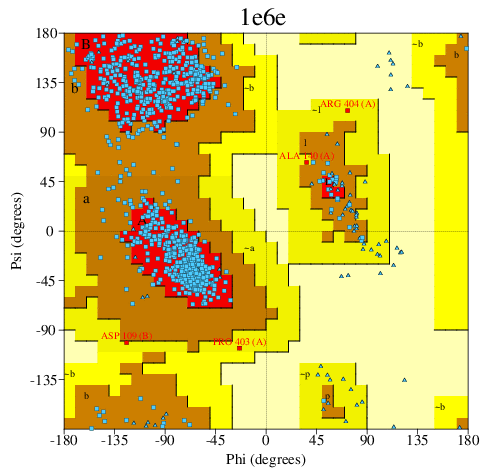
PROCHECK
|
|
|
|
|
|
Headers
|
|
|
|
References
|
|
|
|
|
|

|
|
P08165
(ADRO_BOVIN) -
NADPH:adrenodoxin oxidoreductase, mitochondrial from Bos taurus
|
|
|
|
Seq:
Struc:
|
|
|
|
492 a.a.
457 a.a.
|
|

|

|

|
|
|
|
|
|
|
|
|
|
|
|
|
|
|
|
|
Enzyme class:
|
|
Chains A, C:
E.C.1.18.1.6
- adrenodoxin-NADP(+) reductase.
|
|
|
|
|
|
|
Reaction:
|
|
2 reduced [adrenodoxin] + NADP+ + H+ = 2 oxidized [adrenodoxin] + NADPH
|
|
|
|
|
|
2
×
reduced [adrenodoxin]
|
+
|
 NADP(+)
|
+
|
H(+)
|
=
|
2
×
oxidized [adrenodoxin]
|
+
|
 NADPH
NADPH
|
|
|
|
|
|
|
|
|
|
Cofactor:
|
|
FAD
|
|
|
|
|
|
FAD
Bound ligand (Het Group name =
FAD)
corresponds exactly
|
|
|
|
|
|
|
Molecule diagrams generated from .mol files obtained from the
KEGG ftp site
|
|
|
|
|
|
|
|
|
|
|
|
|
|
 |
|
|
|
|
|
|
| |
|
|
| |
|
DOI no:
|
J Biol Chem
276:2786-2789
(2001)
|
|
PubMed id:
|
|
|
|
|
|
| |
|
Adrenodoxin reductase-adrenodoxin complex structure suggests electron transfer path in steroid biosynthesis.
|
|
J.J.Müller,
A.Lapko,
G.Bourenkov,
K.Ruckpaul,
U.Heinemann.
|
|
|
|
|
| |
ABSTRACT
|
|
|
|
| |
|
|
The steroid hydroxylating system of adrenal cortex mitochondria consists of the
membrane-attached NADPH-dependent adrenodoxin reductase (AR), the soluble
one-electron transport protein adrenodoxin (Adx), and a membrane-integrated
cytochrome P450 of the CYP11 family. In the 2.3-A resolution crystal structure
of the Adx.AR complex, 580 A(2) of partly polar surface are buried. Main
interaction sites are centered around Asp(79), Asp(76), Asp(72), and Asp(39) of
Adx and around Arg(211), Arg(240), Arg(244), and Lys(27) of AR, respectively. In
particular, the region around Asp(39) defines a new protein interaction site for
Adx, similar to those found in plant and bacterial ferredoxins. Additional
contacts involve the electron transfer region between the redox centers of AR
and Adx and C-terminal residues of Adx. The Adx residues Asp(113) to Arg(115)
adopt 3(10)-helical conformation and engage in loose intermolecular contacts
within a deep cleft of AR. Complex formation is accompanied by a slight domain
rearrangement in AR. The [2Fe-2S] cluster of Adx and the isoalloxazine rings of
FAD of AR are 10 A apart suggesting a possible electron transfer route between
these redox centers. The AR.Adx complex represents the first structure of a
biologically relevant complex between a ferredoxin and its reductase.
|
|
|
|
|
|
| |
Selected figure(s)
|
|
|
|
| |
|
|

|
|

|
|
Figure 1.
Fig. 1. Crystal structure of the AR·Adx complex.
AR-Adx contacts occur at the primary and secondary interaction
regions and the region between the [2Fe-2S] cluster of Adx and
the isoalloxazine ring of the FAD of AR. C-terminal residues of
Adx are also in contact with AR. The side chains of some
residues involved in polar AR-Adx interactions are displayed.
For close-ups of the contact sites see Figs. 3 and 4. The brown
triangle marks the position of Adx Lys66 and the green marks AR
Glu4, both residues maintaining another cross-link reported
recently (11, 12). Figure was produced with MOLSCRIPT (17).
|
|
Figure 4.
Fig. 4. Electron transfer region between the [2Fe-2S]
cluster of Adx and the FAD moiety of AR. The hypothetical
electron pathway shown in red was calculated with the program
HARLEM (31). Red dotted lines mark through-space electron jumps.
The AR-Adx interface is stabilized by hydrogen bonds (blue
dotted lines) and van der Waals contacts. Residues are labeled
black for AR and red for Adx. The blue spheres are water
molecules.
|
|
|
|
|
|
| |
The above figures are
reprinted
by permission from the ASBMB:
J Biol Chem
(2001,
276,
2786-2789)
copyright 2001.
|
|
| |
Figures were
selected
by the author.
|
|
|
|
|
|
|
|
|
|
|
|
|
|
|
|
 |
 |
 |
|
Literature references that cite this PDB file's key reference
|
|
|
| |
PubMed id
|
|
Reference
|
|
|
|
|
|
J.J.Müller,
F.Hannemann,
B.Schiffler,
K.M.Ewen,
R.Kappl,
U.Heinemann,
and
R.Bernhardt
(2011).
Structural and thermodynamic characterization of the adrenodoxin-like domain of the electron-transfer protein Etp1 from Schizosaccharomyces pombe.
|
| |
J Inorg Biochem,
105,
957-965.
|
|
|
PDB code:
|
|
|
|
|
|
|
|
S.P.Wu,
M.Bellei,
S.S.Mansy,
G.Battistuzzi,
M.Sola,
and
J.A.Cowan
(2011).
Redox chemistry of the Schizosaccharomyces pombe ferredoxin electron-transfer domain and influence of Cys to Ser substitutions.
|
| |
J Inorg Biochem,
105,
806-811.
|
|
|
|
|
|
|
H.Komori,
D.Seo,
T.Sakurai,
and
Y.Higuchi
(2010).
Crystal structure analysis of Bacillus subtilis ferredoxin-NADP(+) oxidoreductase and the structural basis for its substrate selectivity.
|
| |
Protein Sci,
19,
2279-2290.
|
|
|
PDB codes:
|
|
|
|
|
|
|
|
W.Wei,
Y.Li,
L.Wang,
S.Liu,
X.Yan,
D.Mei,
Y.Li,
Y.Xu,
P.Peng,
and
Q.Hu
(2010).
Development of a novel Sinapis arvensis disomic addition line in Brassica napus containing the restorer gene for Nsa CMS and improved resistance to Sclerotinia sclerotiorum and pod shattering.
|
| |
Theor Appl Genet,
120,
1089-1097.
|
|
|
|
|
|
|
G.P.Christophi,
M.Panos,
C.A.Hudson,
R.L.Christophi,
R.C.Gruber,
A.T.Mersich,
S.D.Blystone,
B.Jubelt,
and
P.T.Massa
(2009).
Macrophages of multiple sclerosis patients display deficient SHP-1 expression and enhanced inflammatory phenotype.
|
| |
Lab Invest,
89,
742-759.
|
|
|
|
|
|
|
A.May,
and
M.Zacharias
(2008).
Energy minimization in low-frequency normal modes to efficiently allow for global flexibility during systematic protein-protein docking.
|
| |
Proteins,
70,
794-809.
|
|
|
|
|
|
|
G.P.Christophi,
C.A.Hudson,
R.C.Gruber,
C.P.Christophi,
C.Mihai,
L.J.Mejico,
B.Jubelt,
and
P.T.Massa
(2008).
SHP-1 deficiency and increased inflammatory gene expression in PBMCs of multiple sclerosis patients.
|
| |
Lab Invest,
88,
243-255.
|
|
|
|
|
|
|
M.Medina,
R.Abagyan,
C.Gómez-Moreno,
and
J.Fernandez-Recio
(2008).
Docking analysis of transient complexes: interaction of ferredoxin-NADP+ reductase with ferredoxin and flavodoxin.
|
| |
Proteins,
72,
848-862.
|
|
|
|
|
|
|
Y.Kanai
(2008).
Alterations of DNA methylation and clinicopathological diversity of human cancers.
|
| |
Pathol Int,
58,
544-558.
|
|
|
|
|
|
|
A.W.Munro,
H.M.Girvan,
and
K.J.McLean
(2007).
Variations on a (t)heme--novel mechanisms, redox partners and catalytic functions in the cytochrome P450 superfamily.
|
| |
Nat Prod Rep,
24,
585-609.
|
|
|
|
|
|
|
M.Senda,
S.Kishigami,
S.Kimura,
and
T.Senda
(2007).
Crystallization and preliminary X-ray analysis of the electron-transfer complex of Rieske-type [2Fe-2S] ferredoxin and NADH-dependent ferredoxin reductase derived from Acidovorax sp. strain KKS102.
|
| |
Acta Crystallogr Sect F Struct Biol Cryst Commun,
63,
520-523.
|
|
|
|
|
|
|
H.Jin,
G.Tan,
D.S.Brar,
M.Tang,
G.Li,
L.Zhu,
and
G.He
(2006).
Molecular and cytogenetic characterization of an Oryza officinalis-O. sativa chromosome 4 addition line and its progenies.
|
| |
Plant Mol Biol,
62,
769-777.
|
|
|
|
|
|
|
J.D.Heaney,
and
S.K.Bronson
(2006).
Artificial chromosome-based transgenes in the study of genome function.
|
| |
Mamm Genome,
17,
791-807.
|
|
|
|
|
|
|
J.L.Chung,
W.Wang,
and
P.E.Bourne
(2006).
Exploiting sequence and structure homologs to identify protein-protein binding sites.
|
| |
Proteins,
62,
630-640.
|
|
|
|
|
|
|
K.J.McLean,
D.Clift,
D.G.Lewis,
M.Sabri,
P.R.Balding,
M.J.Sutcliffe,
D.Leys,
and
A.W.Munro
(2006).
The preponderance of P450s in the Mycobacterium tuberculosis genome.
|
| |
Trends Microbiol,
14,
220-228.
|
|
|
|
|
|
|
Z.Y.Dong,
Y.M.Wang,
Z.J.Zhang,
Y.Shen,
X.Y.Lin,
X.F.Ou,
F.P.Han,
and
B.Liu
(2006).
Extent and pattern of DNA methylation alteration in rice lines derived from introgressive hybridization of rice and Zizania latifolia Griseb.
|
| |
Theor Appl Genet,
113,
196-205.
|
|
|
|
|
|
|
N.V.Strushkevich,
T.N.Azeva,
G.I.Lepesheva,
and
S.A.Usanov
(2005).
Role of positively charged residues lys267, lys270, and arg411 of cytochrome p450scc (CYP11A1) in interaction with adrenodoxin.
|
| |
Biochemistry (Mosc),
70,
664-671.
|
|
|
|
|
|
|
T.L.Azhikina,
and
E.D.Sverdlov
(2005).
Study of tissue-specific CpG methylation of DNA in extended genomic loci.
|
| |
Biochemistry (Mosc),
70,
596-603.
|
|
|
|
|
|
|
W.Doerfler
(2005).
On the biological significance of DNA methylation.
|
| |
Biochemistry (Mosc),
70,
505-524.
|
|
|
|
|
|
|
Y.Ashikawa,
Z.Fujimoto,
H.Noguchi,
H.Habe,
T.Omori,
H.Yamane,
and
H.Nojiri
(2005).
Crystallization and preliminary X-ray diffraction analysis of the electron-transfer complex between the terminal oxygenase component and ferredoxin in the Rieske non-haem iron oxygenase system carbazole 1,9a-dioxygenase.
|
| |
Acta Crystallogr Sect F Struct Biol Cryst Commun,
61,
577-580.
|
|
|
|
|
|
|
F.P.Han,
Z.L.Liu,
M.Tan,
S.Hao,
G.Fedak,
and
B.Liu
(2004).
Mobilized retrotransposon Tos17 of rice by alien DNA introgression transposes into genes and causes structural and methylation alterations of a flanking genomic region.
|
| |
Hereditas,
141,
243-251.
|
|
|
|
|
|
|
M.Prudêncio,
and
M.Ubbink
(2004).
Transient complexes of redox proteins: structural and dynamic details from NMR studies.
|
| |
J Mol Recognit,
17,
524-539.
|
|
|
|
|
|
|
N.Smith,
M.Mayhew,
M.J.Holden,
H.Kelly,
H.Robinson,
A.Heroux,
V.L.Vilker,
and
D.T.Gallagher
(2004).
Structure of C73G putidaredoxin from Pseudomonas putida.
|
| |
Acta Crystallogr D Biol Crystallogr,
60,
816-822.
|
|
|
PDB code:
|
|
|
|
|
|
|
|
P.B.Crowley,
and
M.A.Carrondo
(2004).
The architecture of the binding site in redox protein complexes: implications for fast dissociation.
|
| |
Proteins,
55,
603-612.
|
|
|
|
|
|
|
Y.Sargisova,
F.M.Pierfederici,
A.Scirè,
E.Bertoli,
F.Tanfani,
F.Febbraio,
R.Briante,
Y.Karapetyan,
and
S.Mardanyan
(2004).
Computational, spectroscopic, and resonant mirror biosensor analysis of the interaction of adrenodoxin with native and tryptophan-modified NADPH-adrenodoxin reductase.
|
| |
Proteins,
57,
302-310.
|
|
|
|
|
|
|
M.Faro,
B.Schiffler,
A.Heinz,
I.Nogués,
M.Medina,
R.Bernhardt,
and
C.Gómez-Moreno
(2003).
Insights into the design of a hybrid system between Anabaena ferredoxin-NADP+ reductase and bovine adrenodoxin.
|
| |
Eur J Biochem,
270,
726-735.
|
|
|
|
|
|
|
F.Seeber
(2002).
Eukaryotic genomes contain a [2Fez.sbnd;2S] ferredoxin isoform with a conserved C-terminal sequence motif.
|
| |
Trends Biochem Sci,
27,
545-547.
|
|
|
|
|
|
|
P.D.Richardson,
L.B.Augustin,
B.T.Kren,
and
C.J.Steer
(2002).
Gene repair and transposon-mediated gene therapy.
|
| |
Stem Cells,
20,
105-118.
|
|
|
|
|
|
|
E.C.Müller,
A.Lapko,
A.Otto,
J.J.Müller,
K.Ruckpaul,
and
U.Heinemann
(2001).
Covalently crosslinked complexes of bovine adrenodoxin with adrenodoxin reductase and cytochrome P450scc. Mass spectrometry and Edman degradation of complexes of the steroidogenic hydroxylase system.
|
| |
Eur J Biochem,
268,
1837-1843.
|
|
|
|
|
|
|
G.Cauet,
D.Balbuena,
T.Achstetter,
and
B.Dumas
(2001).
CYP11A1 stimulates the hydroxylase activity of CYP11B1 in mitochondria of recombinant yeast in vivo and in vitro.
|
| |
Eur J Biochem,
268,
4054-4062.
|
|
|
|
|
|
The most recent references are shown first.
Citation data come partly from CiteXplore and partly
from an automated harvesting procedure. Note that this is likely to be
only a partial list as not all journals are covered by
either method. However, we are continually building up the citation data
so more and more references will be included with time.
Where a reference describes a PDB structure, the PDB
code is
shown on the right.
|
 |
|


 Links
Links


