 |
PDBsum entry 1e4d

|
|
|
|
|
|

|

|

|

|
|

|
|

|
|

|
|

|
|

|
|

|
|
|
 |

|

|
|
|
|
|
|
|
|
|
|
|
|
|
|
|
|
|
|
|
|
|
|
|
|
|
|
|
|
|
|
|
|
|
|
|
Beta-lactamase
|
PDB id
|
|
|
|
1e4d
|
|
|
|
|
|
|
|
|
|
|
|
|
|
|

|

|

|
|
|
|
|
|
|
|
 |
Contents |
 |
|
|
|
|
|
|
|
|
|
|
|
|
* Residue conservation analysis
|
|
|
|
|
|
PDB id:
|
|
|
|
| Name: |
|
Beta-lactamase
|
|
|
Title:
|
|
Structure of oxa10 beta-lactamase at ph 8.3
|
|
Structure:
|
|
Beta-lactamase oxa-10. Chain: a, b, c, d. Engineered: yes
|
|
Source:
|
|
Pseudomonas aeruginosa. Organism_taxid: 287. Expressed in: escherichia coli. Expression_system_taxid: 469008.
|
|
Biol. unit:
|
|
 Homo-Dimer (from PDB file)
|
|
Resolution:
|
|
|
1.80Å
|
R-factor:
|
0.198
|
R-free:
|
0.243
|
|
|
Authors:
|
|
L.Maveyraud,D.Golemi,L.P.Kotra,S.Tranier,S.Vakulenko,S.Mobashery, J.P.Samama
|
Key ref:

|
|
L.Maveyraud
et al.
(2000).
Insights into class D beta-lactamases are revealed by the crystal structure of the OXA10 enzyme from Pseudomonas aeruginosa.
Structure,
8,
1289-1298.
PubMed id:
DOI:

|
|
|
Date:
|
|
|
03-Jul-00
|
Release date:
|
12-Jan-01
|
|
|
|
|
|
|
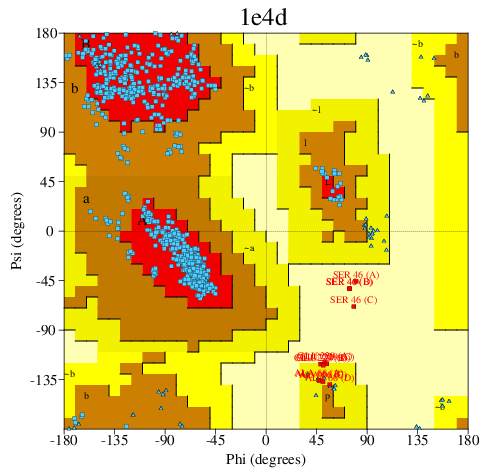
PROCHECK
|
|
|
|
|
|
Headers
|
|
|
|
References
|
|
|
|
|
|

|
|
P14489
(BLO10_PSEAI) -
Beta-lactamase OXA-10 from Pseudomonas aeruginosa
|
|
|
|
Seq:
Struc:
|
|
|
|
266 a.a.
243 a.a.*
|
|

|

|
|
|
|
|
|
|
|
|
|
|
|
Key: |
 |
PfamA domain |
|
|
 |
Secondary structure |
|
 |
CATH domain |
|
|
*
PDB and UniProt seqs differ
at 1 residue position (black
cross)
|
|
|
|
|
|
|
|
|
|
|
|
|
|
|
|
|
 |
|
|
|
|
|
|
| |
|
DOI no:
|
Structure
8:1289-1298
(2000)
|
|
PubMed id:
|
|
|
|
|
|
| |
|
Insights into class D beta-lactamases are revealed by the crystal structure of the OXA10 enzyme from Pseudomonas aeruginosa.
|
|
L.Maveyraud,
D.Golemi,
L.P.Kotra,
S.Tranier,
S.Vakulenko,
S.Mobashery,
J.P.Samama.
|
|
|
|
|
| |
ABSTRACT
|
|
|
|
| |
|
|
BACKGROUND: beta-lactam antibiotic therapies are commonly challenged by the
hydrolytic activities of beta-lactamases in bacteria. These enzymes have been
grouped into four classes: A, B, C, and D. Class B beta-lactamases are zinc
dependent, and enzymes of classes A, C, and D are transiently acylated on a
serine residue in the course of the turnover chemistry. While class A and C
beta-lactamases have been extensively characterized by biochemical and
structural methods, class D enzymes remain the least studied despite their
increasing importance in the clinic. RESULTS: The crystal structure of the OXA10
class D beta-lactamase has been solved to 1.66 A resolution from a gold
derivative and MAD phasing. This structure reveals that beta-lactamases from
classes D and A, despite very poor sequence similarity, share a similar overall
fold. An additional beta strand in OXA10 mediates the association into dimers
characterized by analytical ultracentrifugation. Major differences are found
when comparing the molecular details of the active site of this class D enzyme
to the corresponding regions in class A and C beta-lactamases. In the native
structure of the OXA10 enzyme solved to 1.8 A, Lys-70 is carbamylated.
CONCLUSIONS: Several features were revealed by this study: the dimeric structure
of the OXA10 beta-lactamase, an extension of the substrate binding site which
suggests that class D enzymes may bind other substrates beside beta-lactams, and
carbamylation of the active site Lys-70 residue. The CO2-dependent activity of
the OXA10 enzyme and the kinetic properties of the natural OXA17 mutant protein
suggest possible relationships between carbamylation, inhibition of the enzyme
by anions, and biphasic behavior of the enzyme.
|
|
|
|
|
|
| |
Selected figure(s)
|
|
|
|
| |
|
|

|
|
Figure 6.
Figure 6. Active Sites of Class D and Class A
EnzymesDetailed view of the active site of OXA10 (top) and TEM-1
(bottom) in the same orientation. Main chain atoms are
represented with bold lines, hydrogen bonds with hatched lines,
and water molecules as dots

|
|
|
|
|
|
| |
The above figure is
reprinted
by permission from Cell Press:
Structure
(2000,
8,
1289-1298)
copyright 2000.
|
|
| |
Figure was
selected
by an automated process.
|
|
|
|
|
|
|
|
|
|
|
|
|
|
|
|
 |
 |
 |
|
Literature references that cite this PDB file's key reference
|
|
|
| |
PubMed id
|
|
Reference
|
|
|
|
|
|
G.De Pascale,
and
G.D.Wright
(2010).
Antibiotic resistance by enzyme inactivation: from mechanisms to solutions.
|
| |
Chembiochem,
11,
1325-1334.
|
|
|
|
|
|
|
J.D.Docquier,
M.Benvenuti,
V.Calderone,
F.Giuliani,
D.Kapetis,
F.De Luca,
G.M.Rossolini,
and
S.Mangani
(2010).
Crystal structure of the narrow-spectrum OXA-46 class D beta-lactamase: relationship between active-site lysine carbamylation and inhibition by polycarboxylates.
|
| |
Antimicrob Agents Chemother,
54,
2167-2174.
|
|
|
PDB code:
|
|
|
|
|
|
|
|
L.Vercheval,
C.Bauvois,
A.di Paolo,
F.Borel,
J.L.Ferrer,
E.Sauvage,
A.Matagne,
J.M.Frère,
P.Charlier,
M.Galleni,
and
F.Kerff
(2010).
Three factors that modulate the activity of class D β-lactamases and interfere with the post-translational carboxylation of Lys70.
|
| |
Biochem J,
432,
495-504.
|
|
|
PDB codes:
|
|
|
|
|
|
|
|
S.M.Drawz,
C.R.Bethel,
V.R.Doppalapudi,
A.Sheri,
S.R.Pagadala,
A.M.Hujer,
M.J.Skalweit,
V.E.Anderson,
S.G.Chen,
J.D.Buynak,
and
R.A.Bonomo
(2010).
Penicillin sulfone inhibitors of class D beta-lactamases.
|
| |
Antimicrob Agents Chemother,
54,
1414-1424.
|
|
|
|
|
|
|
S.M.Drawz,
and
R.A.Bonomo
(2010).
Three decades of beta-lactamase inhibitors.
|
| |
Clin Microbiol Rev,
23,
160-201.
|
|
|
|
|
|
|
C.Ramel,
M.Tobler,
M.Meyer,
L.Bigler,
M.O.Ebert,
B.Schellenberg,
and
R.Dudler
(2009).
Biosynthesis of the proteasome inhibitor syringolin A: the ureido group joining two amino acids originates from bicarbonate.
|
| |
BMC Biochem,
10,
26.
|
|
|
|
|
|
|
K.D.Schneider,
C.R.Bethel,
A.M.Distler,
A.M.Hujer,
R.A.Bonomo,
and
D.A.Leonard
(2009).
Mutation of the active site carboxy-lysine (K70) of OXA-1 beta-lactamase results in a deacylation-deficient enzyme.
|
| |
Biochemistry,
48,
6136-6145.
|
|
|
|
|
|
|
C.R.Bethel,
A.M.Distler,
M.W.Ruszczycky,
M.P.Carey,
P.R.Carey,
A.M.Hujer,
M.Taracila,
M.S.Helfand,
J.M.Thomson,
M.Kalp,
V.E.Anderson,
D.A.Leonard,
K.M.Hujer,
T.Abe,
A.M.Venkatesan,
T.S.Mansour,
and
R.A.Bonomo
(2008).
Inhibition of OXA-1 beta-lactamase by penems.
|
| |
Antimicrob Agents Chemother,
52,
3135-3143.
|
|
|
|
|
|
|
Y.Doi,
L.Poirel,
D.L.Paterson,
and
P.Nordmann
(2008).
Characterization of a naturally occurring class D beta-lactamase from Achromobacter xylosoxidans.
|
| |
Antimicrob Agents Chemother,
52,
1952-1956.
|
|
|
|
|
|
|
E.Santillana,
A.Beceiro,
G.Bou,
and
A.Romero
(2007).
Crystal structure of the carbapenemase OXA-24 reveals insights into the mechanism of carbapenem hydrolysis.
|
| |
Proc Natl Acad Sci U S A,
104,
5354-5359.
|
|
|
PDB code:
|
|
|
|
|
|
|
|
C.Héritier,
L.Poirel,
P.E.Fournier,
J.M.Claverie,
D.Raoult,
and
P.Nordmann
(2005).
Characterization of the naturally occurring oxacillinase of Acinetobacter baumannii.
|
| |
Antimicrob Agents Chemother,
49,
4174-4179.
|
|
|
|
|
|
|
C.V.Gallant,
C.Daniels,
J.M.Leung,
A.S.Ghosh,
K.D.Young,
L.P.Kotra,
and
L.L.Burrows
(2005).
Common beta-lactamases inhibit bacterial biofilm formation.
|
| |
Mol Microbiol,
58,
1012-1024.
|
|
|
|
|
|
|
F.Giuliani,
J.D.Docquier,
M.L.Riccio,
L.Pagani,
and
G.M.Rossolini
(2005).
OXA-46, a new class D beta-lactamase of narrow substrate specificity encoded by a blaVIM-1-containing integron from a Pseudomonas aeruginosa clinical isolate.
|
| |
Antimicrob Agents Chemother,
49,
1973-1980.
|
|
|
|
|
|
|
J.Li,
J.B.Cross,
T.Vreven,
S.O.Meroueh,
S.Mobashery,
and
H.B.Schlegel
(2005).
Lysine carboxylation in proteins: OXA-10 beta-lactamase.
|
| |
Proteins,
61,
246-257.
|
|
|
|
|
|
|
S.A.Adediran,
M.Nukaga,
S.Baurin,
J.M.Frère,
and
R.F.Pratt
(2005).
Inhibition of class D beta-lactamases by acyl phosphates and phosphonates.
|
| |
Antimicrob Agents Chemother,
49,
4410-4412.
|
|
|
|
|
|
|
D.Girlich,
T.Naas,
and
P.Nordmann
(2004).
Biochemical characterization of the naturally occurring oxacillinase OXA-50 of Pseudomonas aeruginosa.
|
| |
Antimicrob Agents Chemother,
48,
2043-2048.
|
|
|
|
|
|
|
D.Girlich,
T.Naas,
and
P.Nordmann
(2004).
OXA-60, a chromosomal, inducible, and imipenem-hydrolyzing class D beta-lactamase from Ralstonia pickettii.
|
| |
Antimicrob Agents Chemother,
48,
4217-4225.
|
|
|
|
|
|
|
J.Walther-Rasmussen,
and
N.Høiby
(2004).
Cefotaximases (CTX-M-ases), an expanding family of extended-spectrum beta-lactamases.
|
| |
Can J Microbiol,
50,
137-165.
|
|
|
|
|
|
|
N.H.Georgopapadakou
(2004).
Beta-lactamase inhibitors: evolving compounds for evolving resistance targets.
|
| |
Expert Opin Investig Drugs,
13,
1307-1318.
|
|
|
|
|
|
|
D.Golemi-Kotra,
J.Y.Cha,
S.O.Meroueh,
S.B.Vakulenko,
and
S.Mobashery
(2003).
Resistance to beta-lactam antibiotics and its mediation by the sensor domain of the transmembrane BlaR signaling pathway in Staphylococcus aureus.
|
| |
J Biol Chem,
278,
18419-18425.
|
|
|
|
|
|
|
M.A.Toleman,
K.Rolston,
R.N.Jones,
and
T.R.Walsh
(2003).
Molecular and biochemical characterization of OXA-45, an extended-spectrum class 2d' beta-lactamase in Pseudomonas aeruginosa.
|
| |
Antimicrob Agents Chemother,
47,
2859-2863.
|
|
|
|
|
|
|
M.Oliva,
O.Dideberg,
and
M.J.Field
(2003).
Understanding the acylation mechanisms of active-site serine penicillin-recognizing proteins: a molecular dynamics simulation study.
|
| |
Proteins,
53,
88.
|
|
|
|
|
|
|
S.D.Goldberg,
W.Iannuccilli,
T.Nguyen,
J.Ju,
and
V.W.Cornish
(2003).
Identification of residues critical for catalysis in a class C beta-lactamase by combinatorial scanning mutagenesis.
|
| |
Protein Sci,
12,
1633-1645.
|
|
|
|
|
|
|
T.Sun,
M.Nukaga,
K.Mayama,
E.H.Braswell,
and
J.R.Knox
(2003).
Comparison of beta-lactamases of classes A and D: 1.5-A crystallographic structure of the class D OXA-1 oxacillinase.
|
| |
Protein Sci,
12,
82-91.
|
|
|
PDB code:
|
|
|
|
|
|
|
|
I.Massova,
and
P.A.Kollman
(2002).
pKa, MM, and QM studies of mechanisms of beta-lactamases and penicillin-binding proteins: acylation step.
|
| |
J Comput Chem,
23,
1559-1576.
|
|
|
|
|
|
|
D.Golemi,
L.Maveyraud,
S.Vakulenko,
J.P.Samama,
and
S.Mobashery
(2001).
Critical involvement of a carbamylated lysine in catalytic function of class D beta-lactamases.
|
| |
Proc Natl Acad Sci U S A,
98,
14280-14285.
|
|
|
PDB codes:
|
|
|
|
|
|
|
|
N.Franceschini,
L.Boschi,
S.Pollini,
R.Herman,
M.Perilli,
M.Galleni,
J.M.Frère,
G.Amicosante,
and
G.M.Rossolini
(2001).
Characterization of OXA-29 from Legionella (Fluoribacter) gormanii: molecular class D beta-lactamase with unusual properties.
|
| |
Antimicrob Agents Chemother,
45,
3509-3516.
|
|
|
|
|
|
|
T.Sun,
M.Nukaga,
K.Mayama,
G.V.Crichlow,
A.P.Kuzin,
and
J.R.Knox
(2001).
Crystallization and preliminary X-ray study of OXA-1, a class D beta-lactamase.
|
| |
Acta Crystallogr D Biol Crystallogr,
57,
1912-1914.
|
|
|
|
|
|
The most recent references are shown first.
Citation data come partly from CiteXplore and partly
from an automated harvesting procedure. Note that this is likely to be
only a partial list as not all journals are covered by
either method. However, we are continually building up the citation data
so more and more references will be included with time.
Where a reference describes a PDB structure, the PDB
code is
shown on the right.
|
|


 Links
Links


