 |
PDBsum entry 1dfh

|
|
|
|
|
|

|

|

|

|
|

|
|

|
|

|
|

|
|

|
|

|
|
|
 |

|

|
|
|
|
|
|
|
|
|
|
|
|
|
|
|
|
|
|
|
|
|
|
|
|
|
|
|
|
|
|
|
|
|
|
|
Oxidoreductase
|
PDB id
|
|
|
|
1dfh
|
|
|
|
|
|
|
|
|
|
|
|
|
|
|

|

|

|
|
|
|
|
|
|
|
 |
Contents |
 |
|
|
|
|
|
|
|
|
|
|
* Residue conservation analysis
|
|
|
|
|
|
|
|
|
|
|
Enzyme class:
|
|
E.C.1.3.1.9
- enoyl-[acyl-carrier-protein] reductase (NADH).
|
|
|
|
|
|
|
Reaction:
|
|
a 2,3-saturated acyl-[ACP] + NAD+ = a (2E)-enoyl-[ACP] + NADH + H+
|
|
|
|
|
|
2,3-saturated acyl-[ACP]
|
+
|
NAD(+)
Bound ligand (Het Group name = )
corresponds exactly
|
=
|
(2E)-enoyl-[ACP]
|
+
|
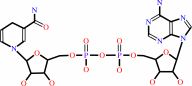 NADH
NADH
|
+
|
H(+)
|
|
|
|
|
|
|
|
|
|
|
|
|
Molecule diagrams generated from .mol files obtained from the
KEGG ftp site
|
|
|
|
|
|
|
|
|
|
|
|
|
|
 |
|
|
|
|
|
|
| |
|
|
| |
|
DOI no:
|
Science
274:2107-2110
(1996)
|
|
PubMed id:
|
|
|
|
|
|
| |
|
A mechanism of drug action revealed by structural studies of enoyl reductase.
|
|
C.Baldock,
J.B.Rafferty,
S.E.Sedelnikova,
P.J.Baker,
A.R.Stuitje,
A.R.Slabas,
T.R.Hawkes,
D.W.Rice.
|
|
|
|
|
| |
ABSTRACT
|
|
|
|
| |
|
|
Enoyl reductase (ENR), an enzyme involved in fatty acid biosynthesis, is the
target for antibacterial diazaborines and the front-line antituberculosis drug
isoniazid. Analysis of the structures of complexes of Escherichia coli ENR with
nicotinamide adenine dinucleotide and either thienodiazaborine or
benzodiazaborine revealed the formation of a covalent bond between the 2'
hydroxyl of the nicotinamide ribose and a boron atom in the drugs to generate a
tight, noncovalently bound bisubstrate analog. This analysis has implications
for the structure-based design of inhibitors of ENR, and similarities to other
oxidoreductases suggest that mimicking this molecular linkage may have generic
applications in other areas of medicinal chemistry.
|
|
|
|
|
|
| |
Selected figure(s)
|
|
|
|
| |
|
|

|
|

|
|
Figure 1.
Fig. 1. The E. coli ENR tetramer is made up of four
subunits, each consisting of a single domain of
approximate dimensions 55 by 45 by 45 Å com-
posed of a parallel b sheet of seven strands (b1 to b7), flanked on one side by helices a1, a2, and a7
and on the other by helices a3 to a5, with a further helix, a6, lying along the top of the b sheet. (A)
Schematic diagram of a single subunit of the ENR-NAD
1
-thienodiazaborine complex. The ribbon trace
of E. coli ENR is shown in red; NAD
1
(blue) and diazaborine (cyan) are shown in an all-atom represen-
tation. The loop that orders on diazaborine binding is highlighted in green. [Produced using MIDAS (25).]
(B and C) Initial Fourier maps of the NAD
1
-thienodiazaborine complex at 2.2 Å resolution (B) and of the
NAD
1
-benzodiazaborine complex at 2.5 Å resolution (C) with the final refined structures superimposed.
The density (contoured at 1.2s and 0.9s, respectively) was calculated with coefficients 2uFobsu 2 uFcalcu
and phases that were calculated from the refined structure from the molecular replacement solution that
had been generated with the model of the E. coli ENR-NAD
1
complex, which contained no information
about the inhibitor. [Produced using BOBSCRIPT (26), a modified version of MOLSCRIPT (27).] (D) The
superposition (based on the nicotinamide and its associated ribose) of the nucleotide-inhibitor complex
of ENR into the active site of the nucleotide-substrate complex of DHFR [PDB entry 7DFR (13)]. The Ca
backbone trace for DHFR is shown in green, with bound NADP and folate colored turquoise and by
atom, respectively; the superimposed NAD
1
and thienodiazaborine of ENR are shown in red and all
atom colors, respectively (red, oxygen; white, carbon; blue, nitrogen; yellow, sulfur; green, boron). The
covalent bond between the 29 hydroxyl of the nicotinamide ribose and the boron of the diazaborine in
ENR is represented by a dotted yellow line. [Produced using MIDAS (25).] When the NAD
1
-thienodi-
azaborine complex is fitted into the active site of DHFR, there are some steric clashes between the
sulfonyl group and the propyl tail of the diazaborine with parts of the enzyme surface. Nonetheless, there
is sufficient space around the 29OH of the nicotinamide ribose to envisage the formation of a linker
between the ribose and a folate analog.
|
|
Figure 2.
Fig. 2. Schematic repre-
sentation of the interac-
tions made by the NAD
1
-
thienodiazaborine com-
plex with the enzyme sur-
face and ordered solvent
molecules. For NAD
1
,
only the nicotinamide ring
and the nicotinamide ri-
bose are shown. Hydro-
gen bonds are represent-
ed by dashed lines, hy-
drophobic contacts are
shown as semicircular
arcs, and Wat 1 and Wat
2 are two ordered solvent
molecules. [Produced
using LIGPLOT (28).]
|
|
|
|
|
|
| |
The above figures are
reprinted
by permission from the AAAs:
Science
(1996,
274,
2107-2110)
copyright 1996.
|
|
|
|
|
|
|
|
|
|
|
|
|
|
 |
 |
 |
|
Literature references that cite this PDB file's key reference
|
|
|
| |
PubMed id
|
|
Reference
|
|
|
|
|
|
A.S.Evitt,
and
R.J.Cox
(2011).
Synthesis and evaluation of conformationally restricted inhibitors of aspartate semialdehyde dehydrogenase.
|
| |
Mol Biosyst,
7,
1564-1575.
|
|
|
|
|
|
|
K.Maity,
T.Banerjee,
N.Prabakaran,
N.Surolia,
A.Surolia,
and
K.Suguna
(2011).
Effect of substrate binding loop mutations on the structure, kinetics, and inhibition of enoyl acyl carrier protein reductase from plasmodium falciparum.
|
| |
IUBMB Life,
63,
30-41.
|
|
|
PDB codes:
|
|
|
|
|
|
|
|
N.Liu,
J.E.Cummings,
K.England,
R.A.Slayden,
and
P.J.Tonge
(2011).
Mechanism and inhibition of the FabI enoyl-ACP reductase from Burkholderia pseudomallei.
|
| |
J Antimicrob Chemother,
66,
564-573.
|
|
|
|
|
|
|
H.Lu,
K.England,
C.am Ende,
J.J.Truglio,
S.Luckner,
B.G.Reddy,
N.L.Marlenee,
S.E.Knudson,
D.L.Knudson,
R.A.Bowen,
C.Kisker,
R.A.Slayden,
and
P.J.Tonge
(2009).
Slow-onset inhibition of the FabI enoyl reductase from francisella tularensis: residence time and in vivo activity.
|
| |
ACS Chem Biol,
4,
221-231.
|
|
|
PDB code:
|
|
|
|
|
|
|
|
R.P.Massengo-Tiassé,
and
J.E.Cronan
(2009).
Diversity in enoyl-acyl carrier protein reductases.
|
| |
Cell Mol Life Sci,
66,
1507-1517.
|
|
|
|
|
|
|
C.W.am Ende,
S.E.Knudson,
N.Liu,
J.Childs,
T.J.Sullivan,
M.Boyne,
H.Xu,
Y.Gegina,
D.L.Knudson,
F.Johnson,
C.A.Peloquin,
R.A.Slayden,
and
P.J.Tonge
(2008).
Synthesis and in vitro antimycobacterial activity of B-ring modified diaryl ether InhA inhibitors.
|
| |
Bioorg Med Chem Lett,
18,
3029-3033.
|
|
|
|
|
|
|
J.Saito,
M.Yamada,
T.Watanabe,
M.Iida,
H.Kitagawa,
S.Takahata,
T.Ozawa,
Y.Takeuchi,
and
F.Ohsawa
(2008).
Crystal structure of enoyl-acyl carrier protein reductase (FabK) from Streptococcus pneumoniae reveals the binding mode of an inhibitor.
|
| |
Protein Sci,
17,
691-699.
|
|
|
PDB codes:
|
|
|
|
|
|
|
|
S.K.Tipparaju,
D.C.Mulhearn,
G.M.Klein,
Y.Chen,
S.Tapadar,
M.H.Bishop,
S.Yang,
J.Chen,
M.Ghassemi,
B.D.Santarsiero,
J.L.Cook,
M.Johlfs,
A.D.Mesecar,
M.E.Johnson,
and
A.P.Kozikowski
(2008).
Design and synthesis of aryl ether inhibitors of the Bacillus anthracis enoyl-ACP reductase.
|
| |
ChemMedChem,
3,
1250-1268.
|
|
|
PDB code:
|
|
|
|
|
|
|
|
D.J.Ferguson,
S.A.Campbell,
F.L.Henriquez,
L.Phan,
E.Mui,
T.A.Richards,
S.P.Muench,
M.Allary,
J.Z.Lu,
S.T.Prigge,
F.Tomley,
M.W.Shirley,
D.W.Rice,
R.McLeod,
and
C.W.Roberts
(2007).
Enzymes of type II fatty acid synthesis and apicoplast differentiation and division in Eimeria tenella.
|
| |
Int J Parasitol,
37,
33-51.
|
|
|
|
|
|
|
H.H.Lee,
J.Moon,
and
S.W.Suh
(2007).
Crystal structure of the Helicobacter pylori enoyl-acyl carrier protein reductase in complex with hydroxydiphenyl ether compounds, triclosan and diclosan.
|
| |
Proteins,
69,
691-694.
|
|
|
PDB codes:
|
|
|
|
|
|
|
|
K.H.Kim,
J.K.Park,
B.H.Ha,
J.H.Moon,
and
E.E.Kim
(2007).
Crystallization and preliminary X-ray crystallographic analysis of enoyl-ACP reductase III (FabL) from Bacillus subtilis.
|
| |
Acta Crystallogr Sect F Struct Biol Cryst Commun,
63,
246-248.
|
|
|
|
|
|
|
S.P.Muench,
S.T.Prigge,
R.McLeod,
J.B.Rafferty,
M.J.Kirisits,
C.W.Roberts,
E.J.Mui,
and
D.W.Rice
(2007).
Studies of Toxoplasma gondii and Plasmodium falciparum enoyl acyl carrier protein reductase and implications for the development of antiparasitic agents.
|
| |
Acta Crystallogr D Biol Crystallogr,
63,
328-338.
|
|
|
PDB codes:
|
|
|
|
|
|
|
|
T.Bogdanovich,
C.Clark,
K.Kosowska-Shick,
B.Dewasse,
P.McGhee,
and
P.C.Appelbaum
(2007).
Antistaphylococcal activity of CG400549, a new experimental FabI inhibitor, compared with that of other agents.
|
| |
Antimicrob Agents Chemother,
51,
4191-4195.
|
|
|
|
|
|
|
S.W.White,
J.Zheng,
Y.M.Zhang,
and
Rock
(2005).
The structural biology of type II fatty acid biosynthesis.
|
| |
Annu Rev Biochem,
74,
791-831.
|
|
|
|
|
|
|
R.J.Heath,
and
C.O.Rock
(2004).
Fatty acid biosynthesis as a target for novel antibacterials.
|
| |
Curr Opin Investig Drugs,
5,
146-153.
|
|
|
|
|
|
|
S.P.Muench,
J.B.Rafferty,
R.McLeod,
D.W.Rice,
and
S.T.Prigge
(2003).
Expression, purification and crystallization of the Plasmodium falciparum enoyl reductase.
|
| |
Acta Crystallogr D Biol Crystallogr,
59,
1246-1248.
|
|
|
|
|
|
|
S.Smith,
A.Witkowski,
and
A.K.Joshi
(2003).
Structural and functional organization of the animal fatty acid synthase.
|
| |
Prog Lipid Res,
42,
289-317.
|
|
|
|
|
|
|
W.L.Duax,
V.Pletnev,
A.Addlagatta,
J.Bruenn,
and
C.M.Weeks
(2003).
Rational proteomics I. Fingerprint identification and cofactor specificity in the short-chain oxidoreductase (SCOR) enzyme family.
|
| |
Proteins,
53,
931-943.
|
|
|
|
|
|
|
D.J.Payne,
W.H.Miller,
V.Berry,
J.Brosky,
W.J.Burgess,
E.Chen,
W.E.DeWolf Jr,
A.P.Fosberry,
R.Greenwood,
M.S.Head,
D.A.Heerding,
C.A.Janson,
D.D.Jaworski,
P.M.Keller,
P.J.Manley,
T.D.Moore,
K.A.Newlander,
S.Pearson,
B.J.Polizzi,
X.Qiu,
S.F.Rittenhouse,
C.Slater-Radosti,
K.L.Salyers,
M.A.Seefeld,
M.G.Smyth,
D.T.Takata,
I.N.Uzinskas,
K.Vaidya,
N.G.Wallis,
S.B.Winram,
C.C.Yuan,
and
W.F.Huffman
(2002).
Discovery of a novel and potent class of FabI-directed antibacterial agents.
|
| |
Antimicrob Agents Chemother,
46,
3118-3124.
|
|
|
|
|
|
|
H.H.Lee,
J.Yun,
J.Moon,
B.W.Han,
B.I.Lee,
J.Y.Lee,
and
S.W.Suh
(2002).
Crystallization and preliminary X-ray crystallographic analysis of enoyl-acyl carrier protein reductase from Helicobacter pylori.
|
| |
Acta Crystallogr D Biol Crystallogr,
58,
1071-1073.
|
|
|
|
|
|
|
X.He,
and
K.A.Reynolds
(2002).
Purification, characterization, and identification of novel inhibitors of the beta-ketoacyl-acyl carrier protein synthase III (FabH) from Staphylococcus aureus.
|
| |
Antimicrob Agents Chemother,
46,
1310-1318.
|
|
|
|
|
|
|
D.J.Payne,
P.V.Warren,
D.J.Holmes,
Y.Ji,
and
J.T.Lonsdale
(2001).
Bacterial fatty-acid biosynthesis: a genomics-driven target for antibacterial drug discovery.
|
| |
Drug Discov Today,
6,
537-544.
|
|
|
|
|
|
|
J.W.Campbell,
and
J.E.Cronan
(2001).
Bacterial fatty acid biosynthesis: targets for antibacterial drug discovery.
|
| |
Annu Rev Microbiol,
55,
305-332.
|
|
|
|
|
|
|
M.P.Groziak
(2001).
Boron therapeutics on the horizon.
|
| |
Am J Ther,
8,
321-328.
|
|
|
|
|
|
|
R.J.Heath,
S.W.White,
and
C.O.Rock
(2001).
Lipid biosynthesis as a target for antibacterial agents.
|
| |
Prog Lipid Res,
40,
467-497.
|
|
|
|
|
|
|
K.L.Fillgrove,
and
V.E.Anderson
(2000).
Orientation of coenzyme A substrates, nicotinamide and active site functional groups in (Di)enoyl-coenzyme A reductases.
|
| |
Biochemistry,
39,
7001-7011.
|
|
|
|
|
|
|
M.Fisher,
J.T.Kroon,
W.Martindale,
A.R.Stuitje,
A.R.Slabas,
and
J.B.Rafferty
(2000).
The X-ray structure of Brassica napus beta-keto acyl carrier protein reductase and its implications for substrate binding and catalysis.
|
| |
Structure,
8,
339-347.
|
|
|
PDB code:
|
|
|
|
|
|
|
|
G.J.de Boer,
G.J.Pielage,
H.J.Nijkamp,
A.R.Slabas,
J.B.Rafferty,
C.Baldock,
D.W.Rice,
and
A.R.Stuitje
(1999).
Molecular genetic analysis of enoyl-acyl carrier protein reductase inhibition by diazaborine.
|
| |
Mol Microbiol,
31,
443-450.
|
|
|
|
|
|
|
L.M.McMurry,
P.F.McDermott,
and
S.B.Levy
(1999).
Genetic evidence that InhA of Mycobacterium smegmatis is a target for triclosan.
|
| |
Antimicrob Agents Chemother,
43,
711-713.
|
|
|
|
|
|
|
T.T.Hoang,
and
H.P.Schweizer
(1999).
Characterization of Pseudomonas aeruginosa enoyl-acyl carrier protein reductase (FabI): a target for the antimicrobial triclosan and its role in acylated homoserine lactone synthesis.
|
| |
J Bacteriol,
181,
5489-5497.
|
|
|
|
|
|
|
X.Qiu,
C.A.Janson,
R.I.Court,
M.G.Smyth,
D.J.Payne,
and
S.S.Abdel-Meguid
(1999).
Molecular basis for triclosan activity involves a flipping loop in the active site.
|
| |
Protein Sci,
8,
2529-2532.
|
|
|
PDB code:
|
|
|
|
|
|
|
|
B.J.Rawlings
(1998).
Biosynthesis of fatty acids and related metabolites.
|
| |
Nat Prod Rep,
15,
275-308.
|
|
|
|
|
|
|
M.C.Davis,
S.G.Franzblau,
and
A.R.Martin
(1998).
Syntheses and evaluation of benzodiazaborine compounds against M. tuberculosis H37Rv in vitro.
|
| |
Bioorg Med Chem Lett,
8,
843-846.
|
|
|
|
|
|
|
C.A.Townsend
(1997).
Structural studies of natural product biosynthetic proteins.
|
| |
Chem Biol,
4,
721-730.
|
|
|
|
|
|
The most recent references are shown first.
Citation data come partly from CiteXplore and partly
from an automated harvesting procedure. Note that this is likely to be
only a partial list as not all journals are covered by
either method. However, we are continually building up the citation data
so more and more references will be included with time.
Where a reference describes a PDB structure, the PDB
codes are
shown on the right.
|
|


 Links
Links


