 |
PDBsum entry 1bl9

|
|
|
|
|
|

|

|

|

|
|

|
|

|
|

|
|

|
|

|
|

|
|
|
 |

|

|
|
|
|
|
|
|
|
|
|
|
|
|
|
|
|
|
|
|
|
|
|
|
|
|
|
|
|
|
|
|
|
|
|
|
Oxidoreductase
|
PDB id
|
|
|
|
1bl9
|
|
|
|
|
|
|
|
|
|
|
|
|
|
|

|

|

|
|
|
|
|
|
|
|
 |
Contents |
 |
|
|
|
|
|
|
|
|
|
|
|
|
* Residue conservation analysis
|
|
|
|
|
|
|
|
|
|
|
Enzyme class 2:
|
|
E.C.1.7.2.1
- nitrite reductase (NO-forming).
|
|
|
|
|
|
|
Reaction:
|
|
nitric oxide + Fe(III)-[cytochrome c] + H2O = Fe(II)-[cytochrome c] + nitrite + 2 H+
|
|
|
|
|
|
 nitric oxide
|
+
|
Fe(III)-[cytochrome c]
|
+
|
H2O
Bound ligand (Het Group name = )
matches with 63.64% similarity
|
=
|
Fe(II)-[cytochrome c]
|
+
|
 nitrite
|
+
|
2
×
H(+)
|
|
|
|
|
|
|
|
|
|
Cofactor:
|
|
Cu cation or Fe cation; FAD
|
|
|
|
|
|
Cu cation
|
or
|
Fe cation
|
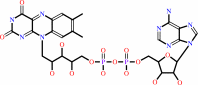 FAD
FAD
|
|
|
|
Enzyme class 3:
|
|
E.C.1.7.99.1
- hydroxylamine reductase.
|
|
|
|
|
|
|
Reaction:
|
|
A + NH4+ + H2O = hydroxylamine + AH2 + H+
|
|
|
|
|
|
|
+
|
NH4(+)
|
+
|
H2O
|
=
|
 hydroxylamine
|
+
|
AH2
|
+
|
2
×
H(+)
|
|
|
|
|
|
|
|
|
|
Cofactor:
|
|
Flavoprotein
|
|
|
|
|
|
 Iron-sulfur
|
|
|
|
|
|
|
|
Note, where more than one E.C. class is given (as above), each may
correspond to a different protein domain or, in the case of polyprotein
precursors, to a different mature protein.
|
|
|
|
Molecule diagrams generated from .mol files obtained from the
KEGG ftp site
|
|
|
|
|
|
|
|
|
|
|
|
|
|
 |
|
|
|
|
|
|
| |
|
|
| |
|
DOI no:
|
Biochemistry
37:13987-13996
(1998)
|
|
PubMed id:
|
|
|
|
|
|
| |
|
Conformational changes occurring upon reduction and NO binding in nitrite reductase from Pseudomonas aeruginosa.
|
|
D.Nurizzo,
F.Cutruzzolà,
M.Arese,
D.Bourgeois,
M.Brunori,
C.Cambillau,
M.Tegoni.
|
|
|
|
|
| |
ABSTRACT
|
|
|
|
| |
|
|
Nitrite reductase (NiR) from Pseudomonas aeruginosa (EC 1.9.3.2) (NiR-Pa) is a
soluble enzyme catalyzing the reduction of nitrite (NO2-) to nitric oxide (NO).
The enzyme is a 120 kDa homodimer, in which each monomer carries one c and one
d1 heme. The oxidized and reduced forms of NiR from Paracoccus denitrificans
GB17 (previously called Thiosphaera pantotropha) (NiR-Pd) have been described
[Fülop, V., et al. (1995) Cell 81, 369-377; Williams, P. A., et al. (1997)
Nature 389, 406-412], and we recently reported on the structure of oxidized
NiR-Pa at 2.15 A [Nurizzo, D., et al. (1997) Structure 5, 1157-1171]. Although
the domains carrying the d1 heme are almost identical in both NiR-Pa and NiR-Pd
oxidized and reduced structures, the c heme domains show a different pattern of
c heme coordination, depending on the species and the redox state. The sixth d1
heme ligand in oxidized NiR-Pd was found to be Tyr25, whereas in NiR-Pa, the
homologuous Tyr10 does not interact directly with Fe3+, but via a hydroxide ion.
Furthermore, upon reduction, the axial ligand of the c heme of NiR-Pd changes
from His17 to Met108. Finally, in the oxidized NiR-Pa structure, the N-terminal
stretch of residues (1-29) of one monomer interacts with the other monomer
(domain swapping), which does not occur in NiR-Pd. Here the structure of reduced
NiR-Pa is described both in the unbound form and with the physiological product,
NO, bound at the d1 heme active site. Although both structures are similar to
that of reduced NiR-Pd, significant differences with respect to oxidized NiR-Pd
were observed in two regions: (i) a loop in the c heme domain (residues 56-62)
is shifted 6 A away and (ii) the hydroxide ion, which is the sixth coordination
ligand of the heme, is removed upon reduction and NO binding and the Tyr10 side
chain rotates away from the position adopted in the oxidized form. The
conformational changes observed in NiR-Pa as the result of reduction are less
extensive than those occurring in NiR-Pd. Starting with oxidized structures that
differ in many respects, the two enzymes converge, yielding reduced
conformations which are very similar to each other, which indicates that the
conformational changes involved in catalysis are considerably diverse.
|
|
|
|
|
|
|
|
|
|
|
|
|
|
|
|
|
|
 |
 |
 |
|
Literature references that cite this PDB file's key reference
|
|
|
| |
PubMed id
|
|
Reference
|
|
|
|
|
|
S.Rinaldo,
G.Giardina,
N.Castiglione,
V.Stelitano,
and
F.Cutruzzolà
(2011).
The catalytic mechanism of Pseudomonas aeruginosa cd1 nitrite reductase.
|
| |
Biochem Soc Trans,
39,
195-200.
|
|
|
|
|
|
|
M.Radoul,
M.Sundararajan,
A.Potapov,
C.Riplinger,
F.Neese,
and
D.Goldfarb
(2010).
Revisiting the nitrosyl complex of myoglobin by high-field pulse EPR spectroscopy and quantum mechanical calculations.
|
| |
Phys Chem Chem Phys,
12,
7276-7289.
|
|
|
|
|
|
|
F.Cutruzzolà,
S.Rinaldo,
N.Castiglione,
G.Giardina,
I.Pecht,
and
M.Brunori
(2009).
Nitrite reduction: a ubiquitous function from a pre-aerobic past.
|
| |
Bioessays,
31,
885-891.
|
|
|
|
|
|
|
K.Conrath,
A.S.Pereira,
C.E.Martins,
C.G.Timóteo,
P.Tavares,
S.Spinelli,
J.Kinne,
C.Flaudrops,
C.Cambillau,
S.Muyldermans,
I.Moura,
J.J.Moura,
M.Tegoni,
and
A.Desmyter
(2009).
Camelid nanobodies raised against an integral membrane enzyme, nitric oxide reductase.
|
| |
Protein Sci,
18,
619-628.
|
|
|
|
|
|
|
O.Farver,
M.Brunori,
F.Cutruzzolà,
S.Rinaldo,
S.Wherland,
and
I.Pecht
(2009).
Intramolecular electron transfer in Pseudomonas aeruginosa cd(1) nitrite reductase: thermodynamics and kinetics.
|
| |
Biophys J,
96,
2849-2856.
|
|
|
|
|
|
|
C.Xu,
and
G.S.Thomas
(2008).
Ambidentate H-bonding by heme-bound NO: structural and spectral effects of -O versus -N H-bonding.
|
| |
J Biol Inorg Chem,
13,
613-621.
|
|
|
|
|
|
|
J.H.van Wonderen,
C.Knight,
V.S.Oganesyan,
S.J.George,
W.G.Zumft,
and
M.R.Cheesman
(2007).
Activation of the cytochrome cd1 nitrite reductase from Paracoccus pantotrophus. Reaction of oxidized enzyme with substrate drives a ligand switch at heme c.
|
| |
J Biol Chem,
282,
28207-28215.
|
|
|
|
|
|
|
A.Karlsson,
J.V.Parales,
R.E.Parales,
D.T.Gibson,
H.Eklund,
and
S.Ramaswamy
(2005).
NO binding to naphthalene dioxygenase.
|
| |
J Biol Inorg Chem,
10,
483-489.
|
|
|
PDB codes:
|
|
|
|
|
|
|
|
D.M.Copeland,
A.H.West,
and
G.B.Richter-Addo
(2003).
Crystal structures of ferrous horse heart myoglobin complexed with nitric oxide and nitrosoethane.
|
| |
Proteins,
53,
182-192.
|
|
|
PDB codes:
|
|
|
|
|
|
|
|
O.Farver,
P.M.Kroneck,
W.G.Zumft,
and
I.Pecht
(2003).
Allosteric control of internal electron transfer in cytochrome cd1 nitrite reductase.
|
| |
Proc Natl Acad Sci U S A,
100,
7622-7625.
|
|
|
|
|
|
|
F.Cutruzzola,
K.Brown,
E.K.Wilson,
A.Bellelli,
M.Arese,
M.Tegoni,
C.Cambillau,
and
M.Brunori
(2001).
The nitrite reductase from Pseudomonas aeruginosa: essential role of two active-site histidines in the catalytic and structural properties.
|
| |
Proc Natl Acad Sci U S A,
98,
2232-2237.
|
|
|
|
|
|
|
F.Rousseau,
J.W.Schymkowitz,
H.R.Wilkinson,
and
L.S.Itzhaki
(2001).
Three-dimensional domain swapping in p13suc1 occurs in the unfolded state and is controlled by conserved proline residues.
|
| |
Proc Natl Acad Sci U S A,
98,
5596-5601.
|
|
|
|
|
|
|
I.Moura,
and
J.J.Moura
(2001).
Structural aspects of denitrifying enzymes.
|
| |
Curr Opin Chem Biol,
5,
168-175.
|
|
|
|
|
|
|
K.Kobayashi,
A.Koppenhöfer,
S.J.Ferguson,
N.J.Watmough,
and
S.Tagawa
(2001).
Intramolecular electron transfer from c heme to d1 heme in bacterial cytochrome cd1 nitrite reductase occurs over the same distances at very different rates depending on the source of the enzyme.
|
| |
Biochemistry,
40,
8542-8547.
|
|
|
|
|
|
|
D.M.Lawson,
C.E.Stevenson,
C.R.Andrew,
and
R.R.Eady
(2000).
Unprecedented proximal binding of nitric oxide to heme: implications for guanylate cyclase.
|
| |
EMBO J,
19,
5661-5671.
|
|
|
PDB codes:
|
|
|
|
|
|
|
|
G.Ranghino,
E.Scorza,
T.Sjögren,
P.A.Williams,
M.Ricci,
and
J.Hajdu
(2000).
Quantum mechanical interpretation of nitrite reduction by cytochrome cd1 nitrite reductase from Paracoccus pantotrophus.
|
| |
Biochemistry,
39,
10958-10966.
|
|
|
|
|
|
|
D.J.Richardson,
and
N.J.Watmough
(1999).
Inorganic nitrogen metabolism in bacteria.
|
| |
Curr Opin Chem Biol,
3,
207-219.
|
|
|
|
|
|
|
D.Nurizzo,
F.Cutruzzolà,
M.Arese,
D.Bourgeois,
M.Brunori,
C.Cambillau,
and
M.Tegoni
(1999).
Does the reduction of c heme trigger the conformational change of crystalline nitrite reductase?
|
| |
J Biol Chem,
274,
14997-15004.
|
|
|
PDB codes:
|
|
|
|
|
|
|
|
F.Cutruzzolà
(1999).
Bacterial nitric oxide synthesis.
|
| |
Biochim Biophys Acta,
1411,
231-249.
|
|
|
|
|
|
The most recent references are shown first.
Citation data come partly from CiteXplore and partly
from an automated harvesting procedure. Note that this is likely to be
only a partial list as not all journals are covered by
either method. However, we are continually building up the citation data
so more and more references will be included with time.
Where a reference describes a PDB structure, the PDB
codes are
shown on the right.
|
|


 Links
Links


