 |
PDBsum entry 1z5m

|
|
|
|
|
 |
Contents |
 |
|
|
|
|
|
|
|
|
|
|
|
|
|
|
* Residue conservation analysis
|
|
|
|
|
|
|
|
|
|
|
Enzyme class:
|
|
E.C.2.7.11.1
- non-specific serine/threonine protein kinase.
|
|
|
|
|
|
|
Reaction:
|
|
|
1.
|
L-seryl-[protein] + ATP = O-phospho-L-seryl-[protein] + ADP + H+
|
|
2.
|
L-threonyl-[protein] + ATP = O-phospho-L-threonyl-[protein] + ADP + H+
|
|
|
|
|
|
|
L-seryl-[protein]
|
+
|
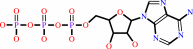 ATP
ATP
|
=
|
O-phospho-L-seryl-[protein]
|
+
|
 ADP
ADP
|
+
|
H(+)
|
|
|
|
|
|
|
L-threonyl-[protein]
|
+
|
ATP
|
=
|
O-phospho-L-threonyl-[protein]
|
+
|
ADP
|
+
|
H(+)
|
|
|
|
|
|
|
|
|
|
|
|
|
Molecule diagrams generated from .mol files obtained from the
KEGG ftp site
|
|
|
|
|
|
|
|
|
|
|
|
|
|
 |
|
|
|
|
|
|
| |
|
|
| |
|
DOI no:
|
J Biol Chem
280:19867-19874
(2005)
|
|
PubMed id:
|
|
|
|
|
|
| |
|
Novel small molecule inhibitors of 3-phosphoinositide-dependent kinase-1.
|
|
R.I.Feldman,
J.M.Wu,
M.A.Polokoff,
M.J.Kochanny,
H.Dinter,
D.Zhu,
S.L.Biroc,
B.Alicke,
J.Bryant,
S.Yuan,
B.O.Buckman,
D.Lentz,
M.Ferrer,
M.Whitlow,
M.Adler,
S.Finster,
Z.Chang,
D.O.Arnaiz.
|
|
|
|
|
| |
ABSTRACT
|
|
|
|
| |
|
|
The phosphoinositide 3-kinase/3-phosphoinositide-dependent kinase 1 (PDK1)/Akt
signaling pathway plays a key role in cancer cell growth, survival, and tumor
angiogenesis and represents a promising target for anticancer drugs. Here, we
describe three potent PDK1 inhibitors, BX-795, BX-912, and BX-320 (IC(50) =
11-30 nm) and their initial biological characterization. The inhibitors blocked
PDK1/Akt signaling in tumor cells and inhibited the anchorage-dependent growth
of a variety of tumor cell lines in culture or induced apoptosis. A number of
cancer cell lines with elevated Akt activity were >30-fold more sensitive to
growth inhibition by PDK1 inhibitors in soft agar than on tissue culture
plastic, consistent with the cell survival function of the PDK1/Akt signaling
pathway, which is particularly important for unattached cells. BX-320 inhibited
the growth of LOX melanoma tumors in the lungs of nude mice after injection of
tumor cells into the tail vein. The effect of BX-320 on cancer cell growth in
vitro and in vivo indicates that PDK1 inhibitors may have clinical utility as
anticancer agents.
|
|
|
|
|
|
| |
Selected figure(s)
|
|
|
|
| |
|
|

|
|

|
|
Figure 1.
FIG. 1. Compound structures for BX-795, BX-912, and BX-320.
|
|
Figure 3.
FIG. 3. Structure of BX-320 bound to the catalytic domain
of PDK1 (PDB code 1Z5M [PDB]
). We crystallized the PDK1 catalytic domain (residues 51-359)
as described by Biondi et al. (30). BX-320 was introduced into
PDK1 crystals and the structure determined from x-ray
diffraction data to a resolution 2.17 angstroms. As shown,
BX-320 binds in the ATP binding pocket, making two hydrogen
bonds through aminopyrimidine nitrogens to Ala^162 located in
the hinge region.
|
|
|
|
|
|
| |
The above figures are
reprinted
by permission from the ASBMB:
J Biol Chem
(2005,
280,
19867-19874)
copyright 2005.
|
|
| |
Figures were
selected
by an automated process.
|
|
|
|
|
|
|
|
|
|
|
|
|
|
|
|
 |
 |
 |
|
Literature references that cite this PDB file's key reference
|
|
|
| |
PubMed id
|
|
Reference
|
|
|
|
|
|
B.Kloo,
D.Nagel,
M.Pfeifer,
M.Grau,
M.Düwel,
M.Vincendeau,
B.Dörken,
P.Lenz,
G.Lenz,
and
D.Krappmann
(2011).
Critical role of PI3K signaling for NF-kappaB-dependent survival in a subset of activated B-cell-like diffuse large B-cell lymphoma cells.
|
| |
Proc Natl Acad Sci U S A,
108,
272-277.
|
|
|
|
|
|
|
D.A.Erlanson,
J.W.Arndt,
M.T.Cancilla,
K.Cao,
R.A.Elling,
N.English,
J.Friedman,
S.K.Hansen,
C.Hession,
I.Joseph,
G.Kumaravel,
W.C.Lee,
K.E.Lind,
R.S.McDowell,
K.Miatkowski,
C.Nguyen,
T.B.Nguyen,
S.Park,
N.Pathan,
D.M.Penny,
M.J.Romanowski,
D.Scott,
L.Silvian,
R.L.Simmons,
B.T.Tangonan,
W.Yang,
and
L.Sun
(2011).
Discovery of a potent and highly selective PDK1 inhibitor via fragment-based drug discovery.
|
| |
Bioorg Med Chem Lett,
21,
3078-3083.
|
|
|
PDB codes:
|
|
|
|
|
|
|
|
A.Najafov,
E.M.Sommer,
J.M.Axten,
M.P.Deyoung,
and
D.R.Alessi
(2010).
Characterization of GSK2334470, a novel and highly specific inhibitor of PDK1.
|
| |
Biochem J,
433,
357-369.
|
|
|
|
|
|
|
J.Tan,
P.L.Lee,
Z.Li,
X.Jiang,
Y.C.Lim,
S.C.Hooi,
and
Q.Yu
(2010).
B55β-associated PP2A complex controls PDK1-directed myc signaling and modulates rapamycin sensitivity in colorectal cancer.
|
| |
Cancer Cell,
18,
459-471.
|
|
|
|
|
|
|
N.Dzamko,
M.Deak,
F.Hentati,
A.D.Reith,
A.R.Prescott,
D.R.Alessi,
and
R.J.Nichols
(2010).
Inhibition of LRRK2 kinase activity leads to dephosphorylation of Ser(910)/Ser(935), disruption of 14-3-3 binding and altered cytoplasmic localization.
|
| |
Biochem J,
430,
405-413.
|
|
|
|
|
|
|
P.Lopez-Bergami,
H.Kim,
A.Dewing,
J.Goydos,
S.Aaronson,
and
Z.Ronai
(2010).
c-Jun regulates phosphoinositide-dependent kinase 1 transcription: implication for Akt and protein kinase C activities and melanoma tumorigenesis.
|
| |
J Biol Chem,
285,
903-913.
|
|
|
|
|
|
|
Z.A.Knight
(2010).
For a PDK1 inhibitor, the substrate matters.
|
| |
Biochem J,
433,
e1-e2.
|
|
|
|
|
|
|
C.Vangestel,
C.Van de Wiele,
G.Mees,
and
M.Peeters
(2009).
Forcing cancer cells to commit suicide.
|
| |
Cancer Biother Radiopharm,
24,
395-407.
|
|
|
|
|
|
|
K.Clark,
L.Plater,
M.Peggie,
and
P.Cohen
(2009).
Use of the pharmacological inhibitor BX795 to study the regulation and physiological roles of TBK1 and IkappaB kinase epsilon: a distinct upstream kinase mediates Ser-172 phosphorylation and activation.
|
| |
J Biol Chem,
284,
14136-14146.
|
|
|
|
|
|
|
M.E.Feldman,
B.Apsel,
A.Uotila,
R.Loewith,
Z.A.Knight,
D.Ruggero,
and
K.M.Shokat
(2009).
Active-site inhibitors of mTOR target rapamycin-resistant outputs of mTORC1 and mTORC2.
|
| |
PLoS Biol,
7,
e38.
|
|
|
|
|
|
|
M.Maurer,
T.Su,
L.H.Saal,
S.Koujak,
B.D.Hopkins,
C.R.Barkley,
J.Wu,
S.Nandula,
B.Dutta,
Y.Xie,
Y.R.Chin,
D.I.Kim,
J.S.Ferris,
S.K.Gruvberger-Saal,
M.Laakso,
X.Wang,
L.Memeo,
A.Rojtman,
T.Matos,
J.S.Yu,
C.Cordon-Cardo,
J.Isola,
M.B.Terry,
A.Toker,
G.B.Mills,
J.J.Zhao,
V.V.Murty,
H.Hibshoosh,
and
R.Parsons
(2009).
3-Phosphoinositide-dependent kinase 1 potentiates upstream lesions on the phosphatidylinositol 3-kinase pathway in breast carcinoma.
|
| |
Cancer Res,
69,
6299-6306.
|
|
|
|
|
|
|
T.Okuzumi,
D.Fiedler,
C.Zhang,
D.C.Gray,
B.Aizenstein,
R.Hoffman,
and
K.M.Shokat
(2009).
Inhibitor hijacking of Akt activation.
|
| |
Nat Chem Biol,
5,
484-493.
|
|
|
|
|
|
|
C.Garcia-Echeverria,
and
W.R.Sellers
(2008).
Drug discovery approaches targeting the PI3K/Akt pathway in cancer.
|
| |
Oncogene,
27,
5511-5526.
|
|
|
|
|
|
|
C.Peifer,
and
D.R.Alessi
(2008).
Small-molecule inhibitors of PDK1.
|
| |
ChemMedChem,
3,
1810-1838.
|
|
|
|
|
|
|
N.Ahmed,
C.Riley,
and
M.A.Quinn
(2008).
An immunohistochemical perspective of PPAR beta and one of its putative targets PDK1 in normal ovaries, benign and malignant ovarian tumours.
|
| |
Br J Cancer,
98,
1415-1424.
|
|
|
|
|
|
|
T.Tamgüney,
C.Zhang,
D.Fiedler,
K.Shokat,
and
D.Stokoe
(2008).
Analysis of 3-phosphoinositide-dependent kinase-1 signaling and function in ES cells.
|
| |
Exp Cell Res,
314,
2299-2312.
|
|
|
|
|
|
|
E.C.Nelson,
C.P.Evans,
P.C.Mack,
R.W.Devere-White,
and
P.N.Lara
(2007).
Inhibition of Akt pathways in the treatment of prostate cancer.
|
| |
Prostate Cancer Prostatic Dis,
10,
331-339.
|
|
|
|
|
|
|
J.Q.Cheng,
C.W.Lindsley,
G.Z.Cheng,
H.Yang,
and
S.V.Nicosia
(2005).
The Akt/PKB pathway: molecular target for cancer drug discovery.
|
| |
Oncogene,
24,
7482-7492.
|
|
|
|
|
|
|
J.R.Bayascas,
N.R.Leslie,
R.Parsons,
S.Fleming,
and
D.R.Alessi
(2005).
Hypomorphic mutation of PDK1 suppresses tumorigenesis in PTEN(+/-) mice.
|
| |
Curr Biol,
15,
1839-1846.
|
|
|
|
|
|
The most recent references are shown first.
Citation data come partly from CiteXplore and partly
from an automated harvesting procedure. Note that this is likely to be
only a partial list as not all journals are covered by
either method. However, we are continually building up the citation data
so more and more references will be included with time.
Where a reference describes a PDB structure, the PDB
codes are
shown on the right.
|
|


 Links
Links


