
|
|
|
|
|
 |
Contents |
 |
|
|
|
|
|
|
|
|
|
|
|
|
|
|
* Residue conservation analysis
|
|
|
|
|
|
|
|
|
|
Enzyme class:
|
|
Chain E:
E.C.2.7.11.11
- cAMP-dependent protein kinase.
|
|
|
|
|
|
|
Reaction:
|
|
|
1.
|
L-seryl-[protein] + ATP = O-phospho-L-seryl-[protein] + ADP + H+
|
|
2.
|
L-threonyl-[protein] + ATP = O-phospho-L-threonyl-[protein] + ADP + H+
|
|
|
|
|
|
|
L-seryl-[protein]
|
+
|
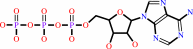 ATP
ATP
|
=
|
O-phospho-L-seryl-[protein]
Bound ligand (Het Group name = )
corresponds exactly
|
+
|
 ADP
ADP
|
+
|
H(+)
|
|
|
|
|
|
|
L-threonyl-[protein]
|
+
|
ATP
|
=
|
O-phospho-L-threonyl-[protein]
Bound ligand (Het Group name = )
corresponds exactly
|
+
|
ADP
|
+
|
H(+)
|
|
|
|
|
|
|
|
|
|
|
|
|
Molecule diagrams generated from .mol files obtained from the
KEGG ftp site
|
|
|
|
|
|
|
|
|
|
|
|
|
|
 |
|
|
|
|
|
|
| |
|
|
| |
|
DOI no:
|
Nat Struct Biol
9:273-277
(2002)
|
|
PubMed id:
|
|
|
|
|
|
| |
|
Crystal structure of a transition state mimic of the catalytic subunit of cAMP-dependent protein kinase.
|
|
Madhusudan,
P.Akamine,
N.H.Xuong,
S.S.Taylor.
|
|
|
|
|
| |
ABSTRACT
|
|
|
|
| |
|
|
To understand the molecular mechanism underlying phosphoryl transfer of
cAMP-dependent protein kinase, the structure of the catalytic subunit in complex
with ADP, aluminum fluoride, Mg2+ ions and a substrate peptide was determined at
2.0 A resolution. Aluminum fluoride was modeled as AlF3 in a planar geometry; it
is positioned 2.3 A from both the donor oxygen of ADP and the hydroxyl group of
the recipient Ser residue. In this configuration, the aluminum atom forms a
trigonal bipyramidal coordination with the oxygen atoms of the donor and
recipient groups at the apical positions. This arrangement suggests that
aluminum fluoride mimics the transition state and provides the first direct
structural evidence for the in-line mechanism of phosphoryl transfer in a
protein kinase.
|
|
|
|
|
|
| |
Selected figure(s)
|
|
|
|
| |
|
|

|
|

|
|
Figure 1.
Figure 1. Overall view of the Mg[2]ADP -SP20 -AlF[3] complex of
the catalytic subunit (cAPK) with the difference density at the
position of AlF[3]. a, The disordered region of the catalytic
subunit consisting of residues 5 -13 is indicated by dashes.
SP20 and Mg2+ ions are displayed in yellow and red,
respectively, and ADP and AlF[3] are shown in green. The
Gly-rich loop is colored in magenta, and black spheres indicate
the three phosphorylation sites observed in the structure. The
MPD molecule is displayed in cyan. This figure was generated
using MOLSCRIPT33. b, Stereo view of the annealed F[o] - F[c]
omit map contoured at 6.0  .
This figure was generated from BOBSCRIPT33, 34. Dashed lines
indicate the aluminum (Al) coordination with the .
This figure was generated from BOBSCRIPT33, 34. Dashed lines
indicate the aluminum (Al) coordination with the  -phosphate
of ADP and the hydroxyl group of Ser from the SP20. -phosphate
of ADP and the hydroxyl group of Ser from the SP20.
|
|
Figure 3.
Figure 3. Schematic representation depicting the detailed
interactions of aluminum fluoride with Mg[2]ADP, active site
residues of the catalytic subunit, water molecules and the
phosphorylation site Ser from SP20. Mg2+ ions and water
molecules are indicated in large and small spheres,
respectively. Residues displayed in ball-and-stick
representation exhibit the exact conformation and relative
orientation as observed in the crystal structure; however, they
have been displaced with respect to one another for clarity.
|
|
|
|
|
|
| |
The above figures are
reprinted
by permission from Macmillan Publishers Ltd:
Nat Struct Biol
(2002,
9,
273-277)
copyright 2002.
|
|
| |
Figures were
selected
by an automated process.
|
|
|
|
|
|
|
|
|
|
|
|
|
|
|
|
 |
 |
 |
|
Literature references that cite this PDB file's key reference
|
|
|
| |
PubMed id
|
|
Reference
|
|
|
|
|
|
M.Montenegro,
M.Garcia-Viloca,
J.M.Lluch,
and
A.González-Lafont
(2011).
A QM/MM study of the phosphoryl transfer to the Kemptide substrate catalyzed by protein kinase A. The effect of the phosphorylation state of the protein on the mechanism.
|
| |
Phys Chem Chem Phys,
13,
530-539.
|
|
|
|
|
|
|
S.Re,
T.Imai,
J.Jung,
S.Ten-No,
and
Y.Sugita
(2011).
Geometrically associative yet electronically dissociative character in the transition state of enzymatic reversible phosphorylation.
|
| |
J Comput Chem,
32,
260-270.
|
|
|
|
|
|
|
S.S.Taylor,
and
A.P.Kornev
(2011).
Protein kinases: evolution of dynamic regulatory proteins.
|
| |
Trends Biochem Sci,
36,
65-77.
|
|
|
|
|
|
|
C.A.Boguth,
P.Singh,
C.C.Huang,
and
J.J.Tesmer
(2010).
Molecular basis for activation of G protein-coupled receptor kinases.
|
| |
EMBO J,
29,
3249-3259.
|
|
|
PDB codes:
|
|
|
|
|
|
|
|
E.D.Scheeff,
H.L.Axelrod,
M.D.Miller,
H.J.Chiu,
A.M.Deacon,
I.A.Wilson,
and
G.Manning
(2010).
Genomics, evolution, and crystal structure of a new family of bacterial spore kinases.
|
| |
Proteins,
78,
1470-1482.
|
|
|
PDB code:
|
|
|
|
|
|
|
|
I.Buch,
D.Fishelovitch,
N.London,
B.Raveh,
H.J.Wolfson,
and
R.Nussinov
(2010).
Allosteric regulation of glycogen synthase kinase 3β: a theoretical study.
|
| |
Biochemistry,
49,
10890-10901.
|
|
|
|
|
|
|
J.J.Tesmer,
V.M.Tesmer,
D.T.Lodowski,
H.Steinhagen,
and
J.Huber
(2010).
Structure of human G protein-coupled receptor kinase 2 in complex with the kinase inhibitor balanol.
|
| |
J Med Chem,
53,
1867-1870.
|
|
|
PDB codes:
|
|
|
|
|
|
|
|
M.Rabiller,
M.Getlik,
S.Klüter,
A.Richters,
S.Tückmantel,
J.R.Simard,
and
D.Rauh
(2010).
Proteus in the world of proteins: conformational changes in protein kinases.
|
| |
Arch Pharm (Weinheim),
343,
193-206.
|
|
|
|
|
|
|
P.Gruszczyński,
M.Obuchowski,
and
R.Kaźmierkiewicz
(2010).
Phosphorylation and ATP-binding induced conformational changes in the PrkC, Ser/Thr kinase from B. subtilis.
|
| |
J Comput Aided Mol Des,
24,
733-747.
|
|
|
|
|
|
|
A.G.Turjanski,
G.Hummer,
and
J.S.Gutkind
(2009).
How mitogen-activated protein kinases recognize and phosphorylate their targets: A QM/MM study.
|
| |
J Am Chem Soc,
131,
6141-6148.
|
|
|
|
|
|
|
C.C.Huang,
K.Yoshino-Koh,
and
J.J.Tesmer
(2009).
A Surface of the Kinase Domain Critical for the Allosteric Activation of G Protein-coupled Receptor Kinases.
|
| |
J Biol Chem,
284,
17206-17215.
|
|
|
|
|
|
|
D.H.Fong,
and
A.M.Berghuis
(2009).
Structural basis of APH(3')-IIIa-mediated resistance to N1-substituted aminoglycoside antibiotics.
|
| |
Antimicrob Agents Chemother,
53,
3049-3055.
|
|
|
PDB codes:
|
|
|
|
|
|
|
|
E.D.Scheeff,
J.Eswaran,
G.Bunkoczi,
S.Knapp,
and
G.Manning
(2009).
Structure of the Pseudokinase VRK3 Reveals a Degraded Catalytic Site, a Highly Conserved Kinase Fold, and a Putative Regulatory Binding Site.
|
| |
Structure,
17,
128-138.
|
|
|
PDB codes:
|
|
|
|
|
|
|
|
J.Eswaran,
D.Patnaik,
P.Filippakopoulos,
F.Wang,
R.L.Stein,
J.W.Murray,
J.M.Higgins,
and
S.Knapp
(2009).
Structure and functional characterization of the atypical human kinase haspin.
|
| |
Proc Natl Acad Sci U S A,
106,
20198-20203.
|
|
|
PDB codes:
|
|
|
|
|
|
|
|
J.Yang,
E.J.Kennedy,
J.Wu,
M.S.Deal,
J.Pennypacker,
G.Ghosh,
and
S.S.Taylor
(2009).
Contribution of Non-catalytic Core Residues to Activity and Regulation in Protein Kinase A.
|
| |
J Biol Chem,
284,
6241-6248.
|
|
|
PDB code:
|
|
|
|
|
|
|
|
S.Naviglio,
M.Caraglia,
A.Abbruzzese,
E.Chiosi,
D.Di Gesto,
M.Marra,
M.Romano,
A.Sorrentino,
L.Sorvillo,
A.Spina,
and
G.Illiano
(2009).
Protein kinase A as a biological target in cancer therapy.
|
| |
Expert Opin Ther Targets,
13,
83-92.
|
|
|
|
|
|
|
T.Alber
(2009).
Signaling mechanisms of the Mycobacterium tuberculosis receptor Ser/Thr protein kinases.
|
| |
Curr Opin Struct Biol,
19,
650-657.
|
|
|
|
|
|
|
C.Mieczkowski,
A.T.Iavarone,
and
T.Alber
(2008).
Auto-activation mechanism of the Mycobacterium tuberculosis PknB receptor Ser/Thr kinase.
|
| |
EMBO J,
27,
3186-3197.
|
|
|
PDB codes:
|
|
|
|
|
|
|
|
E.J.Kennedy,
G.Ghosh,
and
L.Pillus
(2008).
Identification of functionally distinct regions that mediate biological activity of the protein kinase a homolog Tpk2.
|
| |
J Biol Chem,
283,
1084-1093.
|
|
|
|
|
|
|
N.Kannan,
and
S.S.Taylor
(2008).
Rethinking pseudokinases.
|
| |
Cell,
133,
204-205.
|
|
|
|
|
|
|
P.Singh,
B.Wang,
T.Maeda,
K.Palczewski,
and
J.J.Tesmer
(2008).
Structures of rhodopsin kinase in different ligand states reveal key elements involved in G protein-coupled receptor kinase activation.
|
| |
J Biol Chem,
283,
14053-14062.
|
|
|
PDB codes:
|
|
|
|
|
|
|
|
S.S.Taylor,
C.Kim,
C.Y.Cheng,
S.H.Brown,
J.Wu,
and
N.Kannan
(2008).
Signaling through cAMP and cAMP-dependent protein kinase: diverse strategies for drug design.
|
| |
Biochim Biophys Acta,
1784,
16-26.
|
|
|
|
|
|
|
F.S.Domingues,
J.Rahnenführer,
and
T.Lengauer
(2007).
Conformational analysis of alternative protein structures.
|
| |
Bioinformatics,
23,
3131-3138.
|
|
|
|
|
|
|
J.Wu,
S.H.Brown,
S.von Daake,
and
S.S.Taylor
(2007).
PKA type IIalpha holoenzyme reveals a combinatorial strategy for isoform diversity.
|
| |
Science,
318,
274-279.
|
|
|
PDB code:
|
|
|
|
|
|
|
|
M.Montenegro,
M.Garcia-Viloca,
A.González-Lafont,
and
J.M.Lluch
(2007).
Comparative study of the prereactive Protein Kinase A Michaelis complex with Kemptide substrate.
|
| |
J Comput Aided Mol Des,
21,
603-615.
|
|
|
|
|
|
|
P.Rellos,
F.J.Ivins,
J.E.Baxter,
A.Pike,
T.J.Nott,
D.M.Parkinson,
S.Das,
S.Howell,
O.Fedorov,
Q.Y.Shen,
A.M.Fry,
S.Knapp,
and
S.J.Smerdon
(2007).
Structure and regulation of the human Nek2 centrosomal kinase.
|
| |
J Biol Chem,
282,
6833-6842.
|
|
|
PDB code:
|
|
|
|
|
|
|
|
Y.O.You,
and
W.A.van der Donk
(2007).
Mechanistic investigations of the dehydration reaction of lacticin 481 synthetase using site-directed mutagenesis.
|
| |
Biochemistry,
46,
5991-6000.
|
|
|
|
|
|
|
Z.X.Wang,
and
J.W.Wu
(2007).
The complete pathway for ERK2-catalyzed reaction. Evidence for an iso random Bi Bi mechanism.
|
| |
J Biol Chem,
282,
27678-27684.
|
|
|
|
|
|
|
Y.Cheng,
Y.Zhang,
and
J.A.McCammon
(2006).
How does activation loop phosphorylation modulate catalytic activity in the cAMP-dependent protein kinase: a theoretical study.
|
| |
Protein Sci,
15,
672-683.
|
|
|
|
|
|
|
C.J.Squire,
J.M.Dickson,
I.Ivanovic,
and
E.N.Baker
(2005).
Structure and inhibition of the human cell cycle checkpoint kinase, Wee1A kinase: an atypical tyrosine kinase with a key role in CDK1 regulation.
|
| |
Structure,
13,
541-550.
|
|
|
PDB code:
|
|
|
|
|
|
|
|
G.Henkelman,
M.X.LaBute,
C.S.Tung,
P.W.Fenimore,
and
B.H.McMahon
(2005).
Conformational dependence of a protein kinase phosphate transfer reaction.
|
| |
Proc Natl Acad Sci U S A,
102,
15347-15351.
|
|
|
|
|
|
|
A.N.Hoofnagle,
J.W.Stoner,
T.Lee,
S.S.Eaton,
and
N.G.Ahn
(2004).
Phosphorylation-dependent changes in structure and dynamics in ERK2 detected by SDSL and EPR.
|
| |
Biophys J,
86,
395-403.
|
|
|
|
|
|
|
R.A.Ivey,
Y.M.Zhang,
K.G.Virga,
K.Hevener,
R.E.Lee,
C.O.Rock,
S.Jackowski,
and
H.W.Park
(2004).
The structure of the pantothenate kinase.ADP.pantothenate ternary complex reveals the relationship between the binding sites for substrate, allosteric regulator, and antimetabolites.
|
| |
J Biol Chem,
279,
35622-35629.
|
|
|
PDB code:
|
|
|
|
|
|
|
|
T.Langer,
M.Vogtherr,
B.Elshorst,
M.Betz,
U.Schieborr,
K.Saxena,
and
H.Schwalbe
(2004).
NMR backbone assignment of a protein kinase catalytic domain by a combination of several approaches: application to the catalytic subunit of cAMP-dependent protein kinase.
|
| |
Chembiochem,
5,
1508-1516.
|
|
|
|
|
|
|
T.A.Young,
B.Delagoutte,
J.A.Endrizzi,
A.M.Falick,
and
T.Alber
(2003).
Structure of Mycobacterium tuberculosis PknB supports a universal activation mechanism for Ser/Thr protein kinases.
|
| |
Nat Struct Biol,
10,
168-174.
|
|
|
PDB code:
|
|
|
|
|
|
|
|
A.Cook,
E.D.Lowe,
E.D.Chrysina,
V.T.Skamnaki,
N.G.Oikonomakos,
and
L.N.Johnson
(2002).
Structural studies on phospho-CDK2/cyclin A bound to nitrate, a transition state analogue: implications for the protein kinase mechanism.
|
| |
Biochemistry,
41,
7301-7311.
|
|
|
PDB code:
|
|
|
|
|
|
|
The most recent references are shown first.
Citation data come partly from CiteXplore and partly
from an automated harvesting procedure. Note that this is likely to be
only a partial list as not all journals are covered by
either method. However, we are continually building up the citation data
so more and more references will be included with time.
Where a reference describes a PDB structure, the PDB
codes are
shown on the right.
|
 |


 Links
Links


