Our story
EMBL-EBI’s history begins in 1980, when the EMBL Nucleotide Sequence Data Library was established in EMBL Heidelberg, with the goal of creating a central database of DNA sequences.
What began as a modest task of abstracting information from scientific literature soon grew into a major database activity, with researchers submitting their data directly and an ever-increasing demand for highly-skilled informaticians to manage it all.
High-profile genome projects brought more attention to the initiative, and the commercial sector began to see the relevance of public data.
EMBL-EBI established in the UK
In 1992, the EMBL Council voted to establish EMBL’s European Bioinformatics Institute (EMBL-EBI) on the Wellcome Genome Campus in Hinxton, UK, where it would be in close proximity to the major sequencing efforts at the Wellcome Sanger Institute.
The transition of two major bioinformatics services from Heidelberg to Hinxton began in 1992 and in September 1994, EMBL-EBI was firmly established in the UK.
The European Nucleotide Archive (previously known as the EMBL Nucleotide Sequence Data Library) and the protein sequence resource UniProt (then known as Swiss-Prot–TrEMBL) were the original EMBL-EBI databases. Since then, EMBL-EBI’s offering of data resources and bioinformatics tools has flourished. The institute itself played a major part in the bioinformatics revolution.
Why bioinformatics matters today
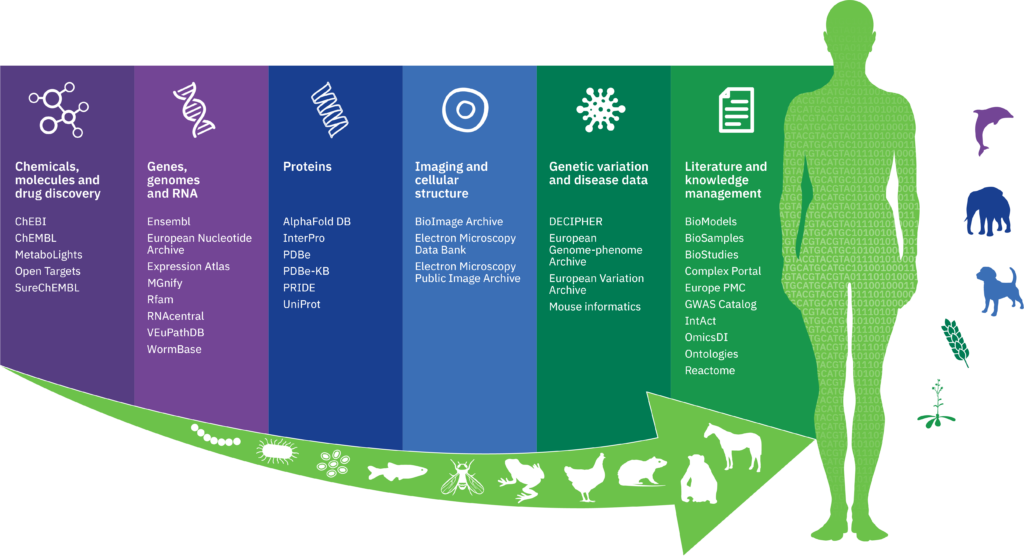
We now provide the world’s most comprehensive range of molecular databases and offer an extensive training programme. Our basic research programme has grown substantially, and remains closely tied with the evolution of our resources.
Life-science experiments are generating a flood of data every day, which is good news for researchers but poses practical challenges. The amount of data produced is doubling twice as quickly as computer storage and processing power, and this rate is increasing.
Bioinformatics makes it possible to collect, store and add value to these data so that researchers in many fields can retrieve and analyse them efficiently. EMBL-EBI is one of very few places in the world that has the capacity and expertise to fulfil this important task.
EMBL-EBI data resources span genomics, protein function and structure, expression, ontologies, imaging and scientific literature.
Scientists need access to large, high-quality datasets for their research. They also use the data to train cutting-edge artificial intelligence (AI) tools, to drive discovery forward in fields such as:
- Drug discovery
- Infectious disease
- Food security
- Biodiversity and climate change