 |
PDBsum entry 5lhx

|
|
|
|
|
|

|

|

|

|
|

|
|

|
|

|
|

|
|
|
 |

|

|
|
|
|
|
|
|
|
|
|
|
|
|
|
|
|
|
|
|
|
|
|
|
|
|
|
|
|
|
|
|
|
|
Structural protein
|
PDB id
|
|
|
|
5lhx
|
|
|
|
|
|
|
|
|
|
|
|
|
|
|

|

|

|
|
|
|
|
|
|
|
|
Enzyme class:
|
|
E.C.2.7.11.21
- polo kinase.
|
|
|
|
|
|
|
Reaction:
|
|
|
1.
|
L-seryl-[protein] + ATP = O-phospho-L-seryl-[protein] + ADP + H+
|
|
2.
|
L-threonyl-[protein] + ATP = O-phospho-L-threonyl-[protein] + ADP + H+
|
|
|
|
|
|
|
L-seryl-[protein]
|
+
|
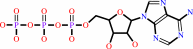 ATP
ATP
|
=
|
O-phospho-L-seryl-[protein]
|
+
|
 ADP
ADP
|
+
|
H(+)
|
|
|
|
|
|
|
L-threonyl-[protein]
|
+
|
ATP
|
=
|
O-phospho-L-threonyl-[protein]
|
+
|
ADP
|
+
|
H(+)
|
|
|
|
|
|
|
|
|
|
|
|
|
Molecule diagrams generated from .mol files obtained from the
KEGG ftp site
|
|
|
|
|
|
|
|
|
|
|
|
|
|
 |
|
|
|
|
|
|
| |
|
|
| |
|
DOI no:
|
Biol Open
6:381-389
(2017)
|
|
PubMed id:
|
|
|
|
|
|
| |
|
A key centriole assembly interaction interface between human PLK4 and STIL appears to not be conserved in flies.
|
|
M.A.Cottee,
S.Johnson,
J.W.Raff,
S.M.Lea.
|
|
|
|
|
| |
ABSTRACT
|
|
|
|
| |
|
|
A small number of proteins form a conserved pathway of centriole duplication. In
humans and flies, the binding of PLK4/Sak to STIL/Ana2 initiates daughter
centriole assembly. In humans, this interaction is mediated by an interaction
between the Polo-Box-3 (PB3) domain of PLK4 and the coiled-coil domain of STIL
(HsCCD). We showed previously that the Drosophila Ana2 coiled-coil domain
(DmCCD) is essential for centriole assembly, but it forms a tight parallel
tetramer in vitro that likely precludes an interaction with PB3. Here, we show
that the isolated HsCCD and HsPB3 domains form a mixture of homo-multimers in
vitro, but these readily dissociate when mixed to form the previously described
1:1 HsCCD:HsPB3 complex. In contrast, although Drosophila PB3 (DmPB3) adopts a
canonical polo-box fold, it does not detectably interact with DmCCD in vitro
Thus, surprisingly, a key centriole assembly interaction interface appears to
differ between humans and flies.
|
|
|
|
|
|
|
|
|
|
|
|
|
|
|
|
|
|
 |
 |
 |
|


 Links
Links


